


 Chinese
 Spanish
 Russian
 Portuguese
 French
 German
 Indonesian
 Thai
 Vietnamese
 Arabic
 Italian
 Turkish
 Polish
 Japanese

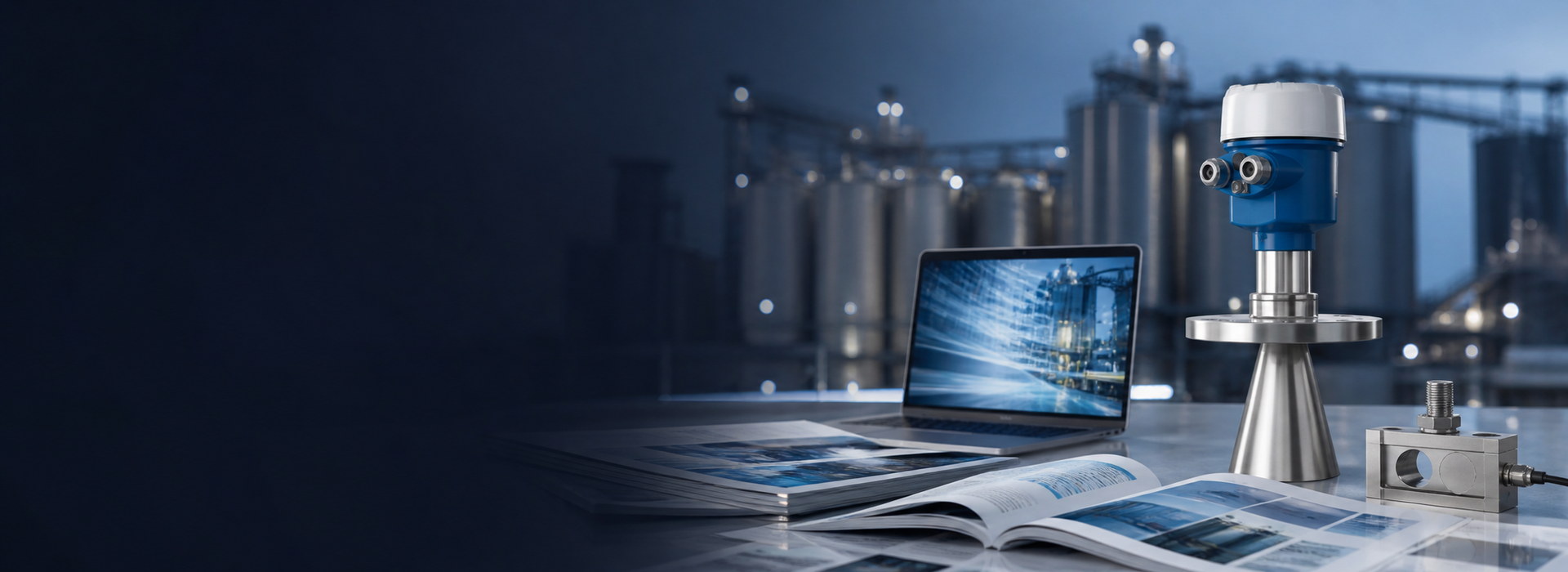
Industrial Liquid Level Sensors: Seven Technologies, Application Selection and PLC/IoT Integration
Liquid level sensors provide continuous liquid height, a water-surface elevation or a high/low level state. They can support pump/valve control, refilling, hydrological telemetry and tank inventory, but different measurement principles respond differently to temperature, media, mounting and maintenance.
An integrator should first distinguish continuous level measurement from a point-level switch, then match the medium, range, required accuracy, installation and PLC/RTU interface.
Seven common sensing technologies
| Technology | Measuring duty | Selection limits |
|---|---|---|
| Submersible hydrostatic | Immersed continuous level from liquid pressure | Density, probe elevation, sediment and vent or barometric compensation |
| Free-space radar | Continuous distance or level without immersion | Foam, deposits, reference geometry and competing targets |
| Ultrasonic | Continuous distance or level through a suitable gas path | Gas conditions, beam, blocking distance and condensation |
| Float | Switching or continuous indication in an appropriate design | Density matching, free movement and deposits |
| Capacitive | Continuous or point duty for the selected construction | Electrical properties, counter-electrode and coating |
| Conductive electrode | Point detection in a suitable conductive liquid | Liquid conductivity, insulation and deposits; not ordinary insulating oil |
| Optical | Commonly point detection for compatible equipment | Wetting, fouling and process-material limits |
Start with the medium and site, not only nominal range
For a 5 m tank with a non-contact reference plane 5.4 m above its bottom, the maximum empty-tank range approaches 5.4 m. If the liquid rises close to the sensor, check minimum measuring distance too.
A submersible hydrostatic sensor instead needs pressure range, density, probe immersion position and vent-tube moisture protection. For acids, fertilizers and oils, review all wetted materials and any required safety approvals.
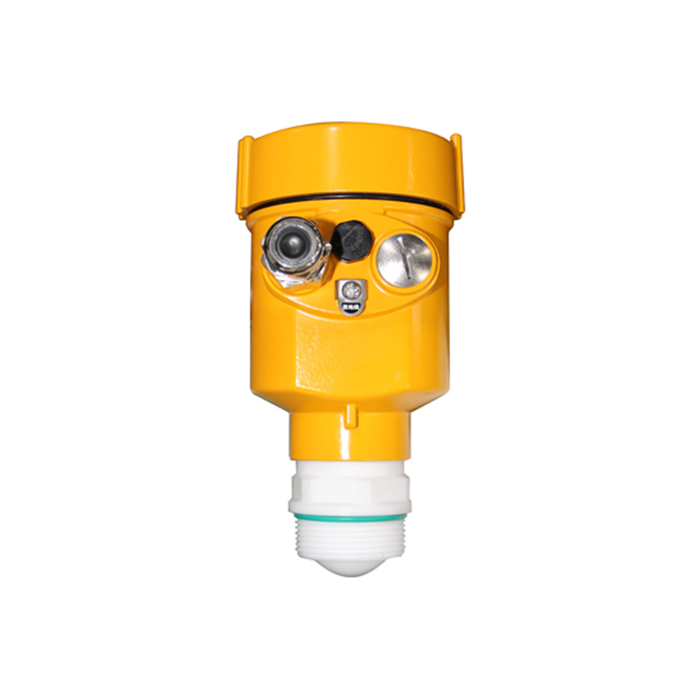
Water, wastewater, industrial and agricultural examples
| Site | Candidate methods | Priority checks |
|---|---|---|
| Deep groundwater well | Submersible hydrostatic | Well diameter, cable, density, sediment |
| Bridge river | Radar / suitable hydrostatic | Seasonal levels, beam, elevation datum |
| Wastewater basin | Radar, ultrasonic, hydrostatic | Foam, sludge, vapor, access |
| General water tank | Hydrostatic, ultrasonic, float | Cost, dead zone, alarm duty |
| Fertigation tank | Compatible hydrostatic or radar | Concentration, corrosion, foam, density |
| Chemical storage | Process-approved radar or pressure | Temperature/pressure, Ex, dielectric, interlocks |
Choosing 4-20 mA versus RS485 Modbus
A 4-20 mA output is straightforward for a PLC analog input if supply and loop loading are correct. With 4-20 mA mapped to 0–5m, 12mA equals 2.5m. If the remote display is wrong, verify whether the analog variable is level or distance.
Where Modbus RTU is supported, a compatible serial network can serve multiple devices. Verify unique addresses, serial settings, register definitions, numeric types, byte order and units. RS485 specifies the electrical interface, not internet or MQTT capability; a separate gateway or RTU may be needed.
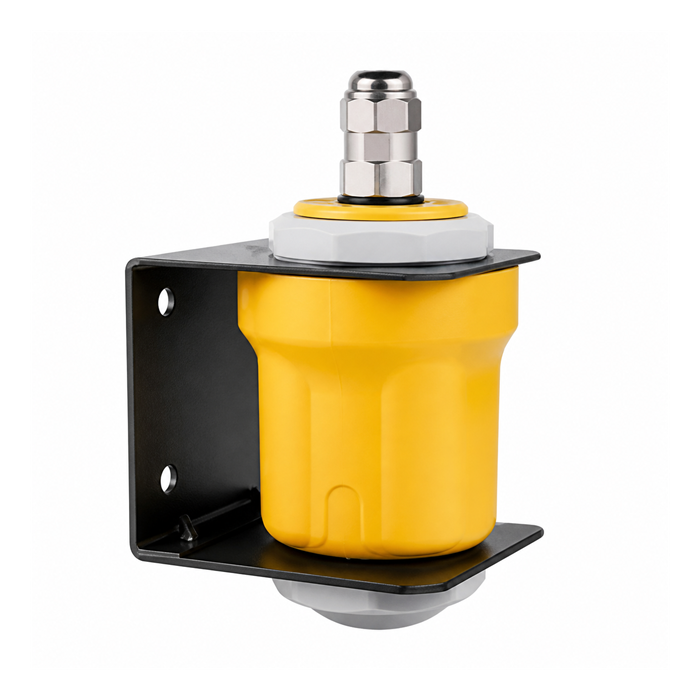
IoT architecture and outage handling
A typical architecture is sensor → PLC/RTU/data logger → 4G, Ethernet or suitable wireless network → SCADA/cloud. Multi-site systems need consistent timestamps, site IDs, engineering units and alarm semantics.
For offline backfill, confirm nonvolatile local storage, original timestamps, duplicate handling and retransmission. A fully unpowered logger does not continue measuring. Solar stations require power budgeting from actual sensor and modem currents.
Safety and acceptance
Continuous process monitoring does not automatically constitute an independent safety level trip. Explosion protection, hygienic design, pressure rating and IP ingress protection must be checked independently. Non-contact also does not inherently mean sterile, maintenance-free or custody-transfer capable.
During a pilot, compare local and remote readings at safely accessible levels representative of the required range. Test thresholds, faults, communication loss and recovery under an approved procedure. Keep models, settings, wiring and evidence, including operating conditions that were not tested.
Request-for-quotation data
Supply medium and concentration, level extremes, accuracy requirement, installation drawing, temperature/pressure, power supply, 4-20 mA or RS485 protocol, cable length, controller model, pilot/batch quantities, destination country and delivery target. Confirm each model’s outputs and options rather than assuming a feature is standard across the line.
Frequently Asked Questions
Q1. Does a level sensor send MQTT directly?
Only if networking and that protocol are documented in the selected configuration. A conventional analog or RS485 instrument normally needs a compatible gateway or RTU. Assign the sensor protocol, network transport, authentication and destination interface separately, then test the complete chain rather than inferring internet connectivity from a serial-output label.
Q2. Can the same probe measure water, oil and chemicals?
Do not assume so. Match the measuring principle, complete exposed construction, process limits and approvals to each medium and duty. Density, conductivity, dielectric behavior, foam and deposits can change the result. Confirm an actual model and configuration for each route rather than treating seven sensing principles as interchangeable METRAVON catalog options.
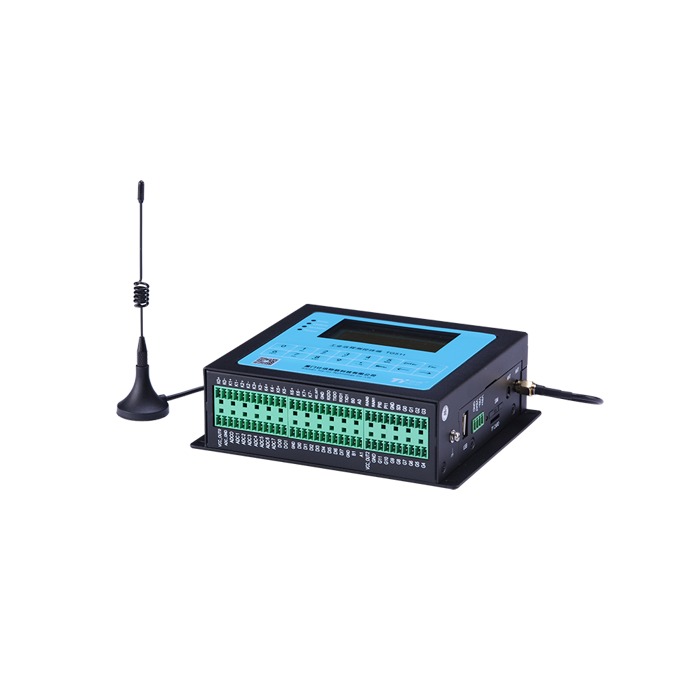
Integrator Checklist: Avoid a Correct Sensor Reading and an Incorrect Platform Value
For mixed-brand installations, define the measured quantity first: distance, level, depth or elevation relative to a datum. Then align engineering units, output direction, out-of-range current handling and Modbus register scaling. Maintain an I/O schedule with each Tag ID, device address, range, power supply, poll interval, reference datum and alarm duty.
Before volume procurement, test at least one sample end-to-end: local reading, analog/register value, RTU record and cloud display. Verify restart, communication loss and restoration as well. Quotations become meaningfully comparable only after interfaces and data definitions are verified.
Chemical-property changes can eliminate an otherwise convenient sensing principle. Chemical-service comparison and material checks
Specify the measurement and acquisition chain
Submit the continuous or point-level duty, medium variations, installation drawing and device-to-controller I/O schedule. Identify which functions belong to the sensor, PLC, RTU and platform, and obtain a documented model for each required role before comparing quotations.
METRAVON Level Measurement Products | Send an inquiry | Arvin@metravon.com
