


 Chinese
 Spanish
 Russian
 Portuguese
 French
 German
 Indonesian
 Thai
 Vietnamese
 Arabic
 Italian
 Turkish
 Polish
 Japanese


Level Measurement in Pharmaceutical Manufacturing: GMP, Cleanability and Validation
Pharmaceutical level measurement has two acceptance questions: does the instrument measure the required variable, and can the installation be qualified for its intended use? Hygienic construction, cleaning, documentation and controlled data handling matter alongside signal performance. A transmitter alone cannot make a process GMP-compliant.
Define the variable in the user requirements
Level, volume and mass answer different process questions. Radar measures distance to a reflecting surface. A vessel table converts level to volume. Load cells measure supported weight, subject to mechanical installation effects. Select the measurement according to the batch operation rather than treating these outputs as interchangeable.
| Required result | Candidate arrangement | Additional checks |
|---|---|---|
| Liquid level for operation | Suitable non-contact or guided-wave radar | Agitation, foam, usable range and alarm response |
| Batch mass | Qualified weighing system | Pipe forces, supports, tare and calibration |
| Calculated volume | Level plus a validated vessel model | Geometry, internals and temperature effects |
| Independent overfill protection | A separate function where required by risk assessment | Independence, diagnostics and proof testing |
| Electronic process record | Qualified acquisition and record system | Data integrity and applicable record requirements |
Set the accuracy, response and operating range from the process requirement. A generic plus-or-minus-five-millimetre target is not appropriate for every reactor or batch size.
Hygienic design includes the whole assembly
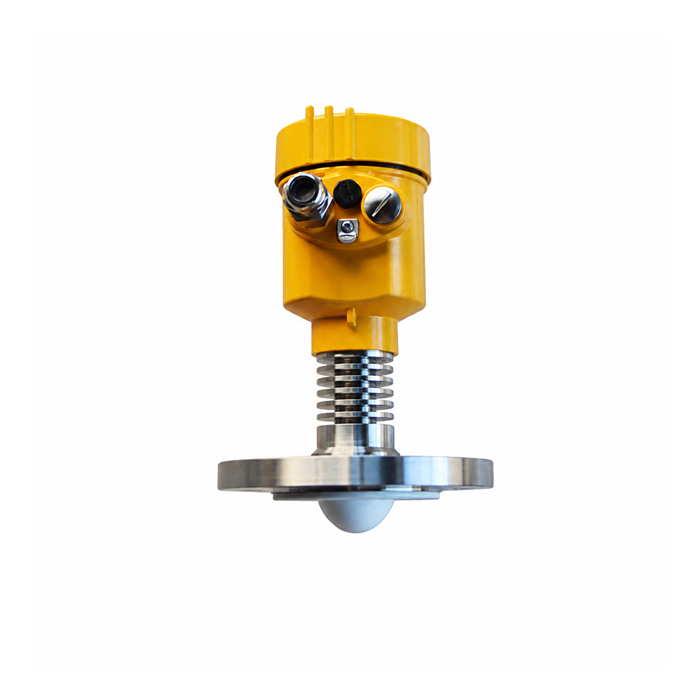
An antenna face may be smooth while the adapter, gasket or nozzle retains product. Review cleanability, drainage, crevices and the effect of the actual installation on CIP and SIP coverage. Non-contact does not mean that only the lens requires cleaning.
Specify surface finish and inspection methods according to the process and material. Do not impose a single roughness value on all polymers or claim one finish is a universal requirement for every parenteral process.
Material declarations, traceability and biological test evidence should match the intended use and risk assessment. USP Class VI, food-contact declarations and an EN 10204 inspection certificate are different documents; they are not interchangeable or automatically mandatory for every part.
Where EHEDG or other equipment certification is required, verify the exact configuration, seals and conditions. Cleaning certification does not replace the site's cleaning and sterilisation validation.
Small vessels: check both ends of the range
The radar blocking distance is normally near the antenna at high level. Separate that restriction from low-level issues such as bottom echoes, probe end effects or a curved vessel bottom. A different frequency does not automatically eliminate either limitation.
Draw the beam and nozzle arrangement for the complete operating range. For an ideal cone, footprint diameter is 2d tan(theta/2), where d is the distance and theta the full beam angle. As an example, a 10-degree beam at 0.5 m has a diameter of about 87 mm. The actual antenna pattern and installation still need checking.
Avoid universal rules such as mounting within 100 mm of the wall. Baffles, agitators, dip tubes and spray devices determine the available position. An operating agitator can form a vortex or waves; it does not guarantee a flat surface.
CIP, SIP and process ratings
Provide the cleaning chemicals, concentrations, peak temperature, pressure, hold time and cycle frequency. Confirm compatibility and ratings for the complete process assembly. Temporary sterilisation limits may differ from continuous operating limits and can have specific installation conditions.
If a guided-wave probe is used, include its supports and any centring components in the cleaning and mechanical review. If a standpipe or adapter is added, reassess drainage, retained product and signal performance. Do not solve a geometric issue by adding an unqualified dead leg.
Data integrity depends on intended use
FDA's Part 11 scope depends on the records and electronic signatures involved and their underlying regulatory requirements. It is not an automatic certification requirement for every smart transmitter. Determine applicability within the regulated system and document the decision.
Control access to configuration, record approved changes and retain calibration and verification evidence. Check units, scaling, time handling, transfer, storage and retrieval across the complete data path. A 4-20 mA loop or a digital protocol can be suitable when the implemented system is qualified for its purpose.
GAMP guidance is not legislation. Likewise, removing a digital interface does not by itself make a system easier to validate or compliant. The site's requirements, risks and evidence determine the necessary controls.
Documentation and qualification
| Deliverable | What to agree at quotation |
|---|---|
| Configuration and drawings | Ordered materials, connections, options and installation limits |
| Material and surface evidence | Scope, traceability and inspection methods required by the project |
| Calibration | Traceability, points, uncertainty and acceptance criteria |
| Cleaning compatibility | Relevant chemicals and full CIP/SIP envelope |
| Qualification support | Supplier documents needed for the site's IQ/OQ and intended-use checks |
| Configuration management | Access controls, backup, change records and return-to-service checks |
Use these requirements to build the instrument specification before ordering. METRAVON can review the vessel drawing, intended measurement, process envelope and requested documentation; the site's quality unit remains responsible for approving the qualified use.
FAQ
Is radar or weighing better for a reactor?
Use the required variable to decide. Radar measures level; a weighing system measures supported mass. Both may be needed, and each has installation and qualification requirements.
Does a flush antenna prove CIP suitability?
No. The complete connection, seals, nozzle and cleaning arrangement must be suitable, and the site must validate its cleaning process.
Is one surface-roughness value mandatory for every pharmaceutical tank?
No. Specify the finish, material, method and locations from the process requirements and applicable standards rather than using one universal number.
Does Part 11 apply to every level transmitter?
Not automatically. Assess the electronic records and signatures, predicate-rule requirements and the system's intended use. Document the applicable controls across the data path.
Can guided-wave radar be used in a sterile vessel?
It may be suitable if the complete probe arrangement is compatible, cleanable and sterilisable, with the required qualification evidence and process ratings.
What should be tested during qualification?
Test the intended operating range, agitation and foam conditions, cleaning recovery, calibration, alarms, fault response and the relevant record-handling functions against approved criteria.
Technical references
Related applications
Radar Level Transmitter for Food and Beverage Tanks: A Hygienic Selection Guide | Radar Level Transmitter for Chemical Tanks: Materials, Dielectrics and Traps
