


 Chinese
 Spanish
 Russian
 Portuguese
 French
 German
 Indonesian
 Thai
 Vietnamese
 Arabic
 Italian
 Turkish
 Polish
 Japanese


Cryogenic Level Measurement: LNG, Liquid Nitrogen and Liquid Oxygen Tanks
Cryogenic level measurement needs a purpose-rated installation. Radar, guided-wave radar, capacitance, differential pressure and servo systems can serve particular cryogenic duties, but an ordinary ambient-temperature model is not made suitable by adding insulation or a standpipe. Confirm the complete process boundary, materials, mechanical arrangement and operating limits before evaluating the signal.
LNG, nitrogen and oxygen are different services
| Service | Measurement issue | Safety or design issue |
|---|---|---|
| LNG storage | Weak surface return, composition changes and inventory calculation | Flammable releases, cold vapour dispersion and overfill prevention |
| Liquid nitrogen | Weak reflection and changing pressure or density | Oxygen displacement and pressure from vaporisation |
| Liquid oxygen | Weak reflection and cold equipment | Oxygen-compatible materials, cleanliness and ignition hazards |
| Mobile or marine tanks | Changing geometry and motion | Approved installation, mechanical loads and any trim/list correction |
These services cannot share a generic purge or heating recommendation. Oxygen service imposes specific cleanliness and material requirements, while a flammable-gas installation has its own electrical and process constraints. The tank designer and responsible engineering team must approve modifications.
Weak echoes need an application-specific assessment
Many cryogenic liquids have low relative permittivity and return less energy than common aqueous liquids. The usable signal depends on the liquid, temperature, frequency, antenna, range and geometry. A static dielectric table cannot establish that every radar will work or that all cryogenic liquids are unmeasurable.
A suitable stilling pipe can be part of an engineered gauging arrangement. It is not universally mandatory and must match the instrument's requirements for diameter, openings, alignment and thermal contraction. An unsuitable pipe may create reflections or prevent representative liquid exchange.
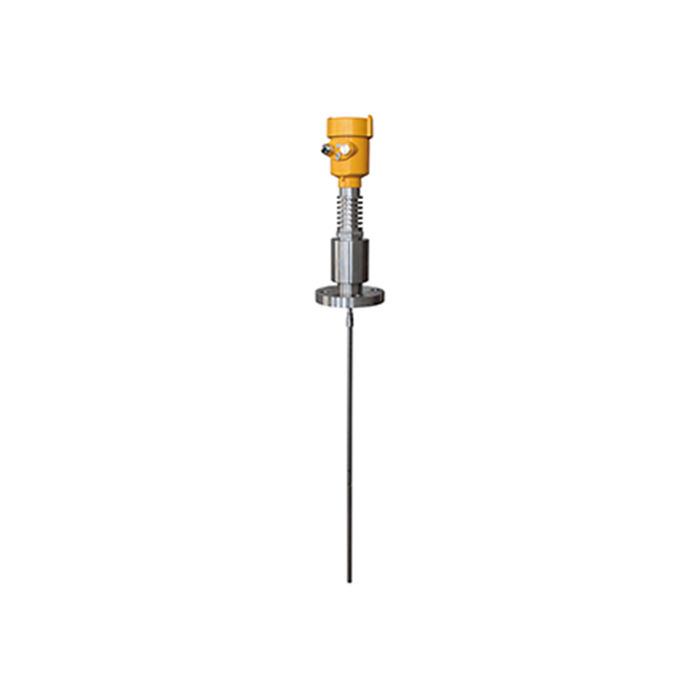
Guided-wave radar concentrates the signal along a probe but introduces product contact, probe loads and measuring-zone limitations. Only a version rated for the complete cryogenic service should be considered; ordinary probe construction is not sufficient evidence.
Compare technologies without assuming one is always preferred
| Principle | What to verify |
|---|---|
| Free-space radar | Cryogenic process assembly, echo margin and installation geometry |
| Guided-wave radar | Approved temperature range, probe arrangement, contraction and low-reflection performance |
| Differential pressure | Pressure reference, density model, piping or seal arrangement and thermal effects |
| Capacitance | Probe construction, dielectric variation and the required compensation |
| Servo or float | Approved gauging role, moving components and maintenance provisions |
No universal accuracy or price ranking follows from the sensing principle. DP instruments can have digital outputs, and a digital interface is not a reason by itself to change from DP to radar. Match the technology to the tank, measured quantity, maintenance strategy and required approvals.
Thermal design, insulation and icing
Identify the minimum process temperature and the expected temperatures at the seal, connection, extension and electronics. Thermal contraction can load probes, supports and pressure-boundary joints. Insulation and vapour barriers need to preserve the tank design and the instrument manufacturer's installation conditions.
External frost is not proof that the antenna is blocked, nor does a universal frost thickness predict failure. Compare the signal and inspect the installation through the approved maintenance process. Moisture ingress or an unwanted thermal bridge may require a design correction rather than repeated de-icing.
Do not add dry air, nitrogen, heaters or thermal breaks as a generic field fix. Gas purity, oxygen compatibility, flammability, contamination, pressure and heat input must be reviewed. A heating or purge arrangement can introduce a new hazard and cannot upgrade an unapproved instrument's temperature rating.
Inventory, density and stratification
Radar provides level, which can be converted to volume using the tank capacity data. Mass requires representative density, and LNG composition and temperature can change it. A DP level calculation also depends on the density and pressure-reference arrangement.
LNG stratification and rollover management require more than a surface-level reading. Use the facility's approved monitoring and operating strategy, including the required temperature, density or composition information. A single level instrument does not diagnose a density profile or establish that rollover risk is absent.
For shipboard tanks, the gauging system may need trim, list and motion treatment. Validate those calculations with the approved tank geometry and system design rather than assigning the task to a standalone distance sensor.
Safety and commissioning
Cold LNG vapour can initially be denser than air and spread at low level; do not assume it will immediately rise. Nitrogen releases can displace oxygen, while oxygen releases can enrich the atmosphere and greatly increase combustion hazards. Cold surfaces and trapped liquid also require specific controls.
Only qualified personnel should work on cryogenic connections under the site's isolation, pressure-release and permit procedures. Do not open, heat or mechanically de-ice a pressurised connection based on an instrument display. Oxygen equipment must retain the specified cleanliness throughout installation and service.
Before acceptance, verify model ratings, reference height, tank conversion, the usable range, diagnostics and the required independent alarm or protective functions. Retain the commissioning evidence and define a safe verification method for later maintenance.
For a cryogenic enquiry, supply the fluid composition, temperature-pressure envelope, vessel drawing, required measurement role and applicable approvals. Cryogenic compatibility must be confirmed for the exact offered configuration before purchase.
FAQ
Can radar measure LNG or liquid nitrogen?
Suitable purpose-rated systems can measure particular cryogenic services. Confirm the process assembly and echo performance for the actual liquid, tank and operating range.
Is a stilling pipe always required?
No. Its use depends on the gauging design. If specified, its dimensions, openings, alignment and thermal behaviour must follow the selected system's requirements.
Can an ambient radar be adapted with a longer nozzle?
Not as a substitute for cryogenic approval. An extension does not establish the suitability of seals, materials or the pressure boundary at low temperature.
Is nitrogen purging a safe default for every cryogenic tank?
No. Any purge must be approved for the fluid, cleanliness, pressure and hazard conditions. Oxygen and LNG services cannot be treated as interchangeable.
Does LNG vapour always rise?
No. Initially cold vapour can be denser than air and spread near the ground. Use the facility's gas-dispersion and emergency-response arrangements.
Can level alone detect LNG stratification?
No. Surface level does not reveal the internal density profile. Follow the approved strategy for temperature, density, composition and rollover-risk management.
Technical references
- Berkeley Lab: safe handling of cryogenic liquids
- NIST: cryogen safety programme
- PHMSA: LNG properties and hazards
Related applications
Level Measurement in Oil Storage Tanks: Inventory, Custody and Overfill Are Three Different Jobs | High Temperature Level Measurement: What Works from 150 °C to 450 °C
