


 Chinese
 Spanish
 Russian
 Portuguese
 French
 German
 Indonesian
 Thai
 Vietnamese
 Arabic
 Italian
 Turkish
 Polish
 Japanese


Radar Level Transmitter for Food and Beverage Tanks: A Hygienic Selection Guide
Radar level measurement can reduce product-contact hardware in food and beverage tanks, but a non-contact measuring principle does not make an instrument hygienic. The antenna face, process seal, connection and surrounding nozzle still have to withstand the product and the cleaning cycle. Select the complete installation, then verify its measurement performance during filling, agitation and cleaning recovery.
Start with the product and cleaning cycle
A milk balance tank, a syrup vessel and an edible-oil tank present different measurement conditions. Milk and beverages may foam during return flow; viscous ingredients can coat the antenna; oils may produce weaker surface echoes. Record the actual product, concentration, temperature and cleaning chemicals rather than choosing from an industry label alone.
CIP means cleaning in place; SIP means sterilisation in place. A transmitter that tolerates the normal storage temperature may not tolerate the cleaning peak, its duration or repeated thermal cycling. Include the temperature and pressure at the process connection, not just the temperature in the bulk liquid.
| Requirement | Information to provide | What to verify |
|---|---|---|
| Product contact | Product, cleaning agents, concentration and temperature | Compatibility of the antenna barrier, seals and connection |
| Cleaning cycle | CIP/SIP temperatures, duration, pressure and frequency | Ratings for the complete ordered assembly |
| Hygienic construction | Connection drawing, drainability and cleaning coverage | No uncleanable recesses or retained product at the joint |
| Documentation | Applicable site standard and destination market | Material declarations and equipment certificates for the exact configuration |
| External washdown | Water pressure, temperature and chemicals | Enclosure and cable-entry protection under those conditions |
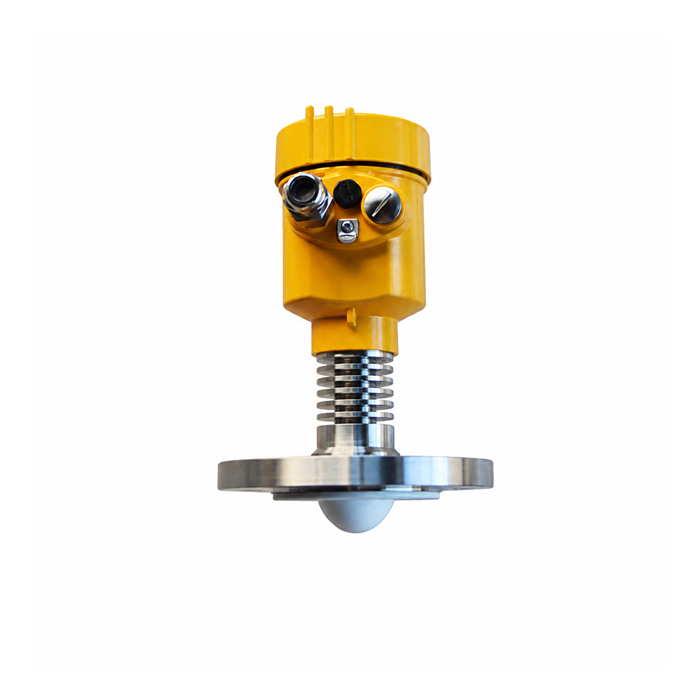
Hygienic materials and certificates are different checks
Stainless steel, PTFE and PFA are possible construction materials, not universal approvals. Check the full wetted-material list, including hidden seals. A suitable antenna material does not compensate for an incompatible gasket or an uncleanable adapter.
Specify surface finish where it is relevant, together with the measurement method and inspection locations. A metal roughness limit cannot simply be applied to every polymer surface. Food-contact declarations also depend on the material and intended conditions of use; an FDA-related material declaration is not approval of the finished instrument.
If the project requires EHEDG or 3-A evidence, obtain the current certificate or authorisation and verify the model, connection and seal options. EHEDG certification distinguishes cleaning and aseptic duties, and certified elastomer combinations matter. A clamp connection alone does not establish compliance.
Foam and ingredients: test the return, not just a calm tank
Foam may reflect, attenuate or transmit the radar signal depending on its structure and moisture content. Changing from 26 GHz to 80 GHz does not guarantee that the reading will move from the foam surface to the liquid beneath it. Establish which surface the control loop needs and compare readings with an independent reference during the foamiest operating condition.
Guided-wave radar is another option where a compatible, cleanable probe is acceptable. It is not immune to coating, bridging or foam. A bypass chamber or stilling arrangement must exchange liquid properly and remain cleanable; it should not create a stagnant pocket in a sanitary process.
For oils, syrups and other ingredients, examine the echo margin across the required range. Do not use a static dielectric-constant table as a guaranteed microwave performance specification. Temperature, formulation, antenna design and the installation all affect the result.
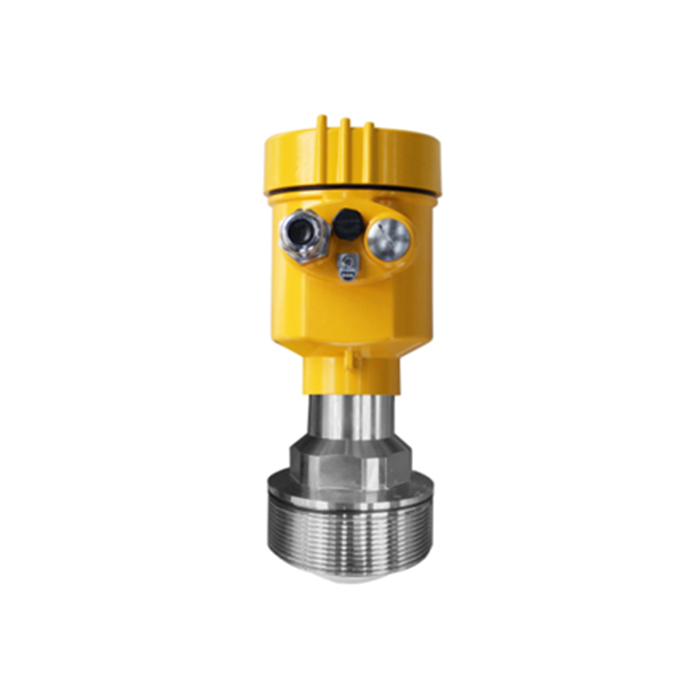
Installation geometry and the usable level range
Draw the beam envelope at the lowest, normal and highest liquid levels. For a fixed beam angle, the footprint grows with antenna-to-surface distance, so it is normally widest at low level. Keep the main measuring region clear of the inlet stream, agitator, baffles, spray devices and wall fittings.
Blocking distance normally limits measurement close to the antenna, at the high-level end. Bottom echoes and low-level performance are separate checks. Neither a nominal maximum range nor an advertised small blocking distance proves that the entire vessel can be measured.
Agitation can produce a vortex, waves or a tilted surface. Choose a representative measuring point and enough filtering for stable control without delaying a real rise. Verify both extremes of the operating range rather than assigning one universal mounting distance from the wall.
Commissioning and maintenance
| Test | Evidence to retain |
|---|---|
| Empty and low-level inspection | Reference height, bottom echoes and minimum usable level |
| Filling and return flow | Reading trend and echo quality while the inlet is active |
| Agitator operation | Stable tracking through speed and recipe changes |
| Cleaning and restart | Seal condition, absence of retained product and recovery after condensation |
| Control-system check | Scaling, alarm direction, fault indication and actual response |
Keep the original echo curve and configuration backup. Set cleaning and inspection intervals from observed deposits, hygiene procedures and operating risk. Purging or heating requires process and hygienic approval; it is not a default remedy for every coated lens.
For an enquiry, send the vessel drawing, ingredient list, cleaning recipe, usable level range and required documentation. These details let METRAVON review the antenna, connection and integration requirements without assuming that every food-industry tank needs the same configuration.
FAQ
Is non-contact radar automatically food grade?
No. The product-facing assembly, connection, seals and cleaning arrangement must meet the intended food-contact and hygienic requirements. Verify documentation for the ordered configuration.
Can radar measure through foam in a beverage tank?
Sometimes. Foam structure and moisture affect the return, so test the selected instrument during actual return flow and agitation. Decide whether liquid level or foam height is the required measurement.
Does a clamp connection prove hygienic certification?
No. Certification applies to a defined equipment configuration and its conditions of use, not to the connection shape alone.
Where is the radar blocking distance?
It is normally the near-antenna region at the high-level end. Bottom limitations must be assessed separately from this near-end restriction.
Can a transmitter remain installed during SIP?
Only if its full process assembly is rated for the specified steam temperature, pressure, duration and cycling, and its installation follows the manufacturer instructions.
What should a food-tank acceptance test include?
Check low and high levels, filling, agitation, foam, cleaning recovery, system scaling and fault response. Record the reference method and acceptance limits before testing.
Technical references
Related applications
Level Measurement in Pharmaceutical Manufacturing: GMP, Cleanability and Validation | Radar Level Transmitter for Chemical Tanks: Materials, Dielectrics and Traps | High Temperature Level Measurement: What Works from 150 °C to 450 °C
