


 Chinese
 Spanish
 Russian
 Portuguese
 French
 German
 Indonesian
 Thai
 Vietnamese
 Arabic
 Italian
 Turkish
 Polish
 Japanese


Petrochemical Radar Level Measurement: Oil Tanks, Coal/Calcium Carbide Silos and Desulfurization Towers
Petrochemical level measurement involves not only stable readings but flammable atmospheres, low-dielectric hydrocarbons, dusty solids and slurry vessels with sprays or deposits. These applications have different echo and failure mechanisms. A single 80 GHz specification must not be presented as a standard solution for all of them.
The oil-tank, coal/calcium-carbide silo and desulfurization-tower examples below are engineering scenarios, not unverified customer success stories. Selection starts with the medium, process limits, mounting geometry and intended measurement duty.
Scenario 1: oil storage tanks
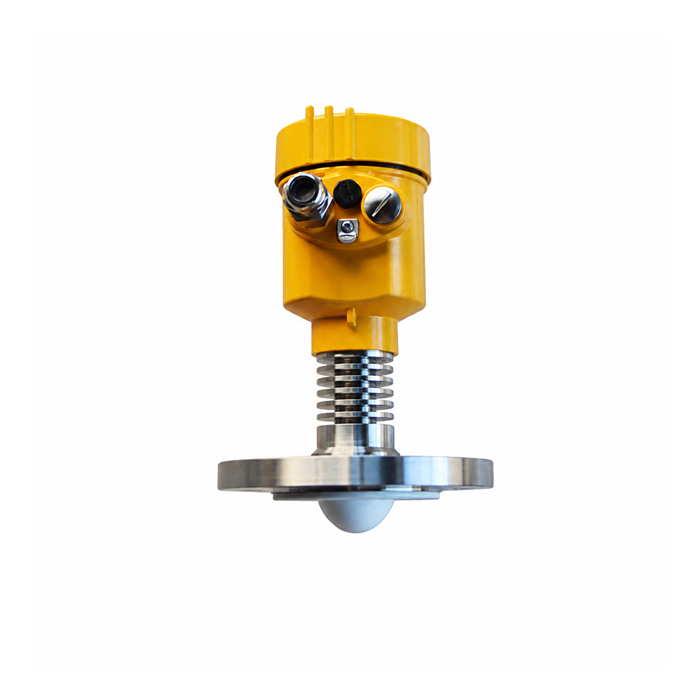
Crude oil, gasoline, diesel and light hydrocarbons differ in dielectric constant, volatility and surface behavior. Low-dielectric products can yield weak echoes; the bottom, coils, ladders, floating roofs and filling turbulence can create other targets. A free-space FMCW radar requires sufficient receiver capability and appropriate near-field/low-level handling.
Around 80 GHz can enable compact narrow-beam antennas, but does not guarantee ±1 mm accuracy throughout any oil tank. Specify product, tank height, minimum level, internals, temperature/pressure, hazardous-area classification and the actual control duty.
Separate process inventory from custody transfer
Radar ranging accuracy is not the same as standard-volume inventory accuracy. Custody-transfer automatic tank gauging may require applicable standards, strapping tables, temperature/density corrections, traceable calibration, acceptance tests and independent overfill protection.
LNG and pressurized liquefied-gas storage bring additional cryogenic, pressure, material and certification issues; ordinary atmospheric-tank instruments are not automatically suitable. Avoid invented loss-reduction percentages or claims that accidents have been eliminated.
Scenario 2: coal and bulk-solid silos
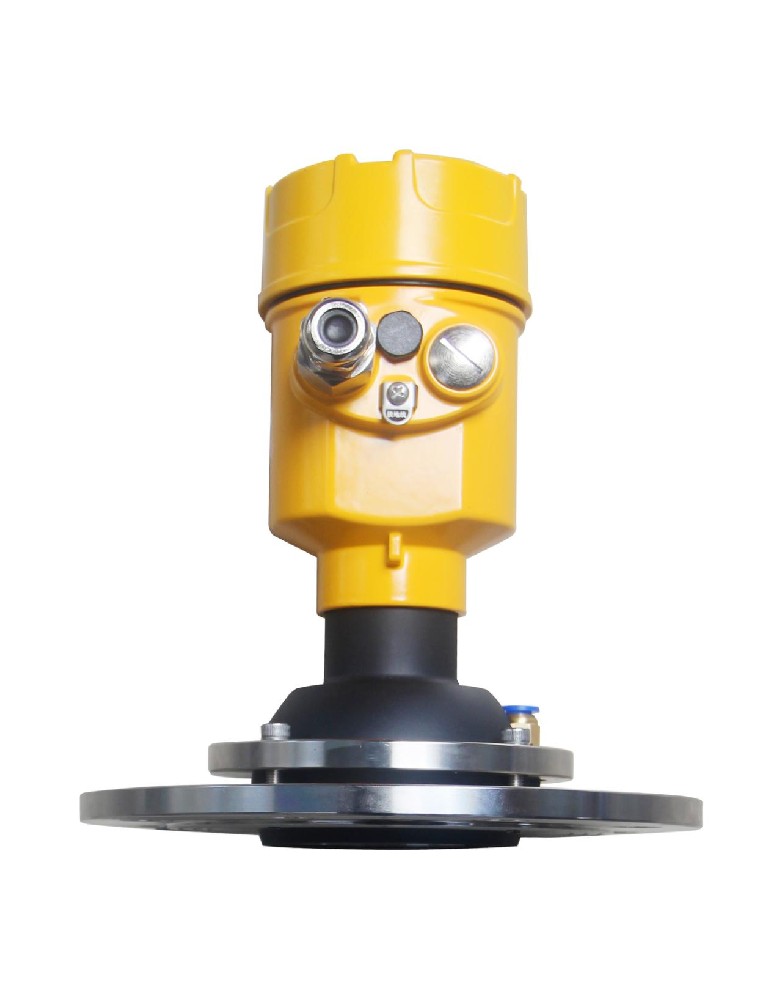
Coal and bulk-solid silos may feature cones, collapsed piles, bridging, falling streams, dust and strong structural echoes. The radar reports the position of the tracked surface target rather than the full three-dimensional average. A single-point reading cannot directly deliver accurate tonnage without pile geometry, bulk density and vessel dimensions.
Review fill inlet, typical surface shapes, diameter, height, wall reflections and antenna buildup. Both 26 and 80 GHz may be candidates; beam angle, dynamic range and mounting geometry matter more than the band alone.
Purging and calcium-carbide safety boundaries
For a silo whose instrument design permits purging, appropriately clean, dry, oil-free gas may help reduce buildup, but purge medium and limits are not universal.
Calcium carbide can react with moisture to release flammable acetylene. Do not use ordinary moist compressed-air purging in a carbide silo without process and hazardous-area engineering approval. Moisture exclusion, static electricity, gas/dust classification and certified equipment must be reviewed.
Scenario 3: desulfurization towers and slurry vessels
Desulfurization slurry may generate foam, sprays, condensation, solid deposits and corrosive constituents. A lower radar frequency does not guarantee penetration through every foam, and 80 GHz does not always distinguish foam from liquid.
Guided-wave rods or cables contact the medium and can suffer buildup, crystallization or mechanical load. Compare free-space radar, a suitable guided-wave design and diaphragm-sealed differential pressure against the actual process. Verify PTFE, PFA, 316L or nickel-alloy compatibility against the chemical, concentration and temperature.
Hazardous areas, communications and protective functions
IP66/IP67 enclosure protection is not an explosion-protection certificate. Select the actual instrument according to area classification, gas/dust group, temperature class, process sealing and applicable Ex approval; neither Ex d nor Ex ia should be assumed as standard across a product line.
4–20mA, HART and RS485/Modbus interfaces are model-dependent. High-high trips and critical overfill duties require an independent protection-layer assessment rather than assuming the process transmitter alone is sufficient.
Commissioning and service checks
- Confirm medium, range, minimum/maximum level and measurement datum
- Review echo curves for bottom, coils and falling-stream targets
- Compare local display, 4–20mA and PLC/DCS values against a trusted reference
- Test loss-of-echo, alarms and relevant process transitions
- Save parameters, echoes and installation photos
- Apply site safety procedures for isolation, depressurization, cleaning and retest
Application matrix and inquiry checklist
| Application | Candidate technology | Critical checks |
|---|---|---|
| General oil tank | Suitable free-space radar | Dielectric, bottom echo, Ex, metrology duty |
| Coal/powder silo | Bulk-solids radar | Dust, pile angle, buildup, filling |
| Calcium-carbide silo | Safety-reviewed non-contact radar | Moisture, acetylene, purge medium, Ex |
| Desulfurization tower | Compare free-space, guided-wave, DP | Foam, sprays, deposits, corrosion |
Frequently Asked Questions
Does 80 GHz mean custody-transfer grade?
No. Ranging performance is not a substitute for custody-transfer system qualification.
Will low-frequency radar always see through scrubber foam?
No. Foam behavior requires application-specific echo evaluation.
Specify Measurement Duty Before Asking for an 80GHz Price
Even for tanks of the same height, routine inventory trending, independent high-high overfill protection and custody-transfer measurement may require very different systems. The RFQ must define the process-control, safety or legal-metrology duty. A transmitter does not become suitable for a critical safety function simply because it has a 4–20mA output.
For calcium-carbide silos, the process team must separately assess moisture-bearing utilities, dust/acetylene hazardous zones and maintenance procedures. For desulfurization towers, record foam behavior, spray patterns, slurry solids and buildup frequency. These observations are often more useful than a headline accuracy claim.
Request a Project-Specific Selection and Quote
Share the medium, high and low levels, mounting photographs or vessel drawings, power supply, required output, site conditions, destination country and expected quantity. Model suitability is assessed against the actual application rather than frequency, range or price alone.
METRAVON Radar Level Products | Send an inquiry | Arvin@metravon.com
