


 Chinese
 Spanish
 Russian
 Portuguese
 French
 German
 Indonesian
 Thai
 Vietnamese
 Arabic
 Italian
 Turkish
 Polish
 Japanese


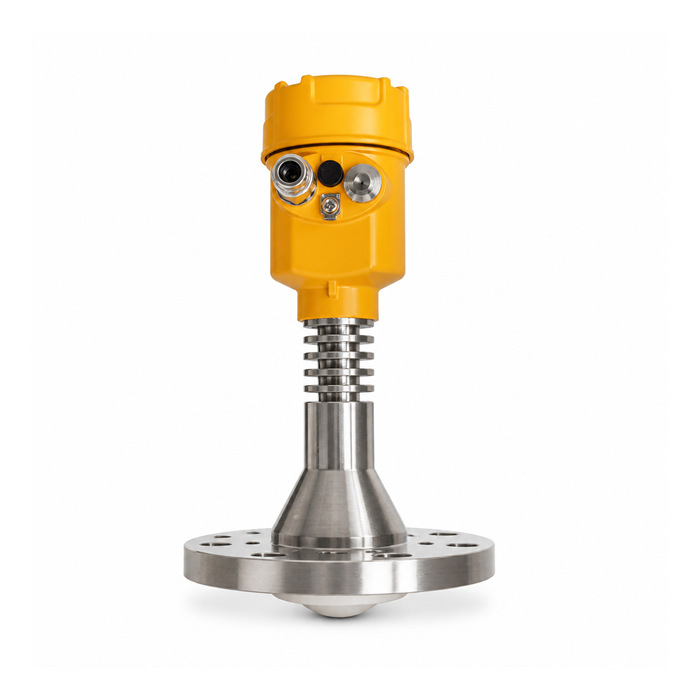
The METRAVON MV-RD13G high-temperature 80 GHz radar level meter combines a 76 mm PEEK lens with a heat-dissipating process assembly for liquid-level measurement. The model specification lists operation up to 260 deg C. Selecting it requires reviewing the fluid, seal, pressure and heat exposure together; a PEEK lens is not a general approval for every hot or corrosive process.
When the PEEK Lens Is Relevant
Consider the MV-RD13G when the process requires a different lens and thermal construction from a standard PTFE-lens radar. Submit the fluid composition, concentration and expected deposits. Include cleaning agents even if they are present only during shutdown: the process-facing parts must tolerate the whole operating cycle.
Do not assume PEEK is universally more chemically resistant than PTFE. Its suitability depends on the chemical and temperature, and the seal and metal connection can be the limiting parts. For a service within the lower-temperature PTFE assembly limits, compare the MV-RD13 extended-range model before specifying the higher-temperature construction.
MV-RD13G Configuration Details
| Item | Model reference | Purchasing condition |
|---|---|---|
| Application | Liquid-level measurement | Other media require an application assessment rather than selection by maximum range alone. |
| Antenna material and size | PEEK; 76 mm lens | Assess chemical compatibility for the complete wetted assembly and cleaning cycle. |
| Documented range configurations | 0.1-30 m; 0.3-150 m | The offered electronics and process conditions determine the usable interval. |
| Process-temperature limit | Up to 260 deg C | Obtain the allowable operating combination with pressure, seal and connection specified. |
| Listed process pressure | -0.1 to 2.5 MPa | Maximum temperature and pressure are not automatically valid at the same operating point. |
| Connection | Flanged assembly | Confirm flange size, standard, pressure class and bore against the supplied drawing. |
| Nominal accuracy | +/-2 mm | Define the required installed performance during stable and changing process conditions. |
Use 260 deg C as the published upper process-temperature reference, not as permission for an excursion above it. Any proposed temperature excursion needs its own written approval, including duration, pressure and the supplied seal. Beam angle and flange dimensions should also be stated for the quoted assembly before the installation is designed.
From a Hot Vessel to a Usable Control Signal
Radiant heat and a heavily insulated roof can make the enclosure environment more demanding than expected. Show the insulation boundary and surrounding pipework on the mounting sketch. The heat-dissipating neck must have the clearance required by the approved installation, and the housing must remain within its separate ambient limits.
For 4-20 mA/HART, establish the measurement span and fault response at the receiving input. If the plant requires RS485/Modbus, select the relevant electronics and obtain its register documentation. Specify additional relay or fieldbus requirements separately; the catalogue options are not all simultaneous functions of the standard transmitter.
Commission under both a stable-temperature condition and a representative operating cycle. Compare the local distance, calculated level and controller value. Inspect whether condensation, deposits or agitation change the echo. If a disturbance appears only when the vessel is heated, investigate the thermal and process conditions before treating it as a zero-adjustment error.
Questions for Hot Liquid Applications
Q1. Can this model be specified for continuous 300 deg C service?
Not from the 260 deg C model rating. A higher continuous temperature or short excursion requires a separately approved construction and operating envelope. Specify the actual temperature history rather than reducing the requirement to a single normal-temperature value.
Q2. Does the PEEK lens solve deposits from hot liquids?
It does not eliminate deposits or guarantee a detectable surface echo through them. Describe whether material condenses, hardens or builds up during cooling. Allow access for inspection and an approved cleaning method, and include the dirty or cooling condition in the application review.
Q3. Is 150 m the depth of liquid that can be measured?
It refers to an antenna-to-surface distance configuration, not penetration through that depth of liquid. The surface reflectivity, mounting geometry and process atmosphere determine whether the selected range is usable. Provide the farthest air gap and closest surface position for assessment.
Q4. Does a high-temperature rating establish explosion protection?
These are separate requirements. A hazardous-area installation needs documentation for the supplied instrument, its protection method and applicable temperature classification. The site's ambient and process conditions must fall within those documented limits.
Q5. What should be checked when the instrument arrives?
Match the nameplate and order identification to the approved flange, lens, seal and electronic configuration. Inspect the thermal section and cable-entry components, then retain the dimensional drawing and wiring information for installation. Do not substitute a visually similar assembly when the process rating cannot be traced.
Prepare a Configuration-Specific Request
Send the MV-RD13G process requirements with the chemical composition, temperature cycle, pressure profile, tank and nozzle drawings, and preferred signal interface. Include enclosure exposure and required approvals. These inputs allow the quotation to identify an installable assembly instead of quoting only an antenna size and maximum range.
