


 Chinese
 Spanish
 Russian
 Portuguese
 French
 German
 Indonesian
 Thai
 Vietnamese
 Arabic
 Italian
 Turkish
 Polish
 Japanese


Radar Level Measurement in Grain Silos and Pellet Bins
Radar level measurement in grain silos depends on the actual material, antenna and signal processing as well as dust, moisture and filling geometry. Dry grain and polymer pellets can give weaker returns than water. Obtain product-specific dielectric data where available and verify the surface echo at the longest operating distance.
The dielectric budget
A radar needs adequate signal margin to identify and track the material surface. For a simplified smooth, non-magnetic dielectric boundary at normal incidence, the reflected power fraction is approximately ((sqrt(epsilon_r) - 1)/(sqrt(epsilon_r) + 1))². This is not an amplitude formula or a prediction for a granular surface: packing, moisture, particle shape and antenna geometry also matter. Diagnose weak returns using the actual echo curve.
| Material | Information to obtain | Practical consequence |
|---|---|---|
| Dry wheat or corn | Moisture range, packing and measured or supplier dielectric data | Check signal margin and keep the measurement path clear |
| PE or PP pellets | Resin, additives, bulk packing and application evidence | Verify low-level tracking during filling and discharge |
| Coated or antistatic pellets | Exact coating and product behaviour | Test the actual product |
| Wet grain | Operating moisture and buildup tendency | Stronger reflection may coincide with crusts and adhesion |
Moisture matters twice: it raises the dielectric (helpful) and raises the risk of crusts and wall buildup (harmful). Specify with the actual product at its actual moisture range, not with a brochure value.
Dust during filling is a different problem from dust on the surface
During pneumatic filling, the air above the product carries a dense dust cloud. The radar beam crosses it twice, and fine dust scatters and absorbs energy. The standard responses are:
fill from the side or with a deflector plate so the fill stream does not pass through the beam;
keep the antenna out of the fill stream's splash zone;
use an antenna with low sensitivity to deposits and, where specified, a continuous small air purge to keep the antenna face clear;
keep the moving fill stream out of the measurement path where possible; suppress fixed obstructions only using the instrument procedure and a known material level. Do not permanently mask a changing fill stream or the true product echo.
If the reading stabilises after filling stops, investigate the fill stream, airborne dust, moving surface and antenna deposits. The timing narrows the investigation but does not identify a single cause or rule out unsuitable instrument settings.
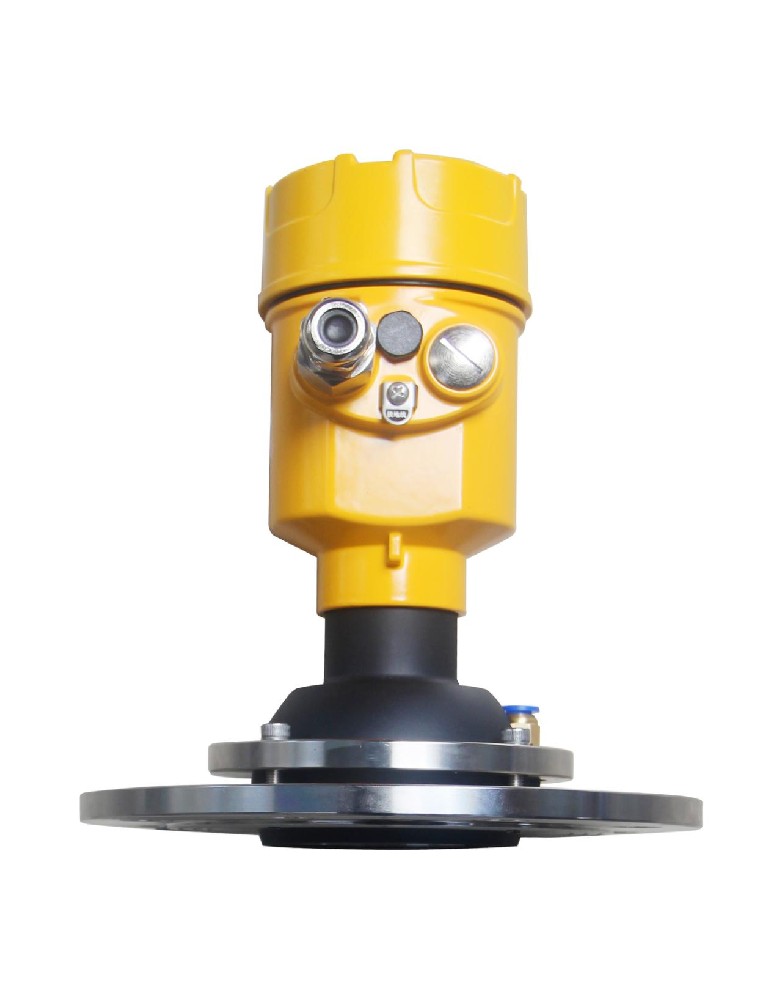
Buildup on the roof fakes a surface
Grain dust and fines stick to the silo roof and to the antenna. A heavy deposit layer directly under the antenna becomes the nearest reflector, and some devices report it as the level — the reading sticks near the top while the real level falls. The failure is silent and dangerous for inventory control.
An echo-curve check during a known low-inventory period shows the two echoes: the deposit and the distant surface. A device that cannot display or export its echo curve makes this diagnosis much harder. Specify echo-curve access in the purchase; it is a diagnostic feature, not a luxury.
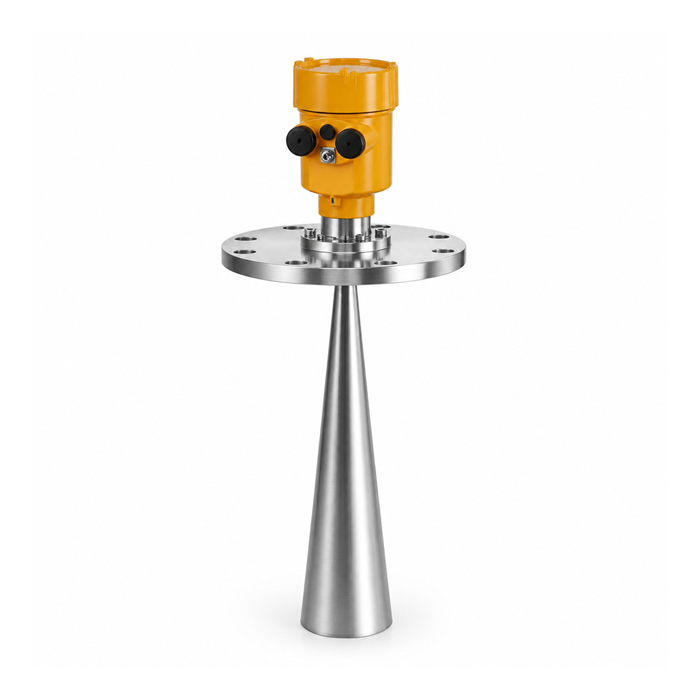
The discharge cone distorts the last metres
As product drains, the surface forms a funnel above the outlet — the opposite of the fill cone in a cement silo, where the peak sits under the fill point. With an eccentric outlet, the funnel can sit far from the beam axis. A single point measurement near the wall can see the wall-side residue while the centre drains, or the centre funnel while the wall holds product.
For inventory purposes, determine from silo geometry and operating evidence where a single point no longer represents the remaining volume adequately, and state the usable measuring range accordingly. Multiple measurements or a load-cell comparison serve reconciliation better than arguing about the last metre.
Questions from grain and pellet handling
Q1. Is guided wave radar better for pellets?
A compatible probe gives a guided path and may improve surface tracking, but pellets and grain are harsh on cables and rods: mechanical load, abrasion and product trapped between probe and wall. Non-contact radar with good mounting is usually the lower-maintenance choice for tall silos.
Q2. What accuracy should be expected on a grain surface?
The surface is rarely flat. After filling it peaks under the fill point; during discharge it funnels. State accuracy against a defined reference condition — typically still, settled product — and treat the rest as inventory indication rather than measurement.
Q3. Can one device cover fill and inventory?
It may, if both duties are demonstrated during commissioning. Verify tracking during the fill cycle and at known inventory states, and keep any required independent high-level protection separate. Fill-stream suppression alone does not establish reliable operation.
