


 Chinese
 Spanish
 Russian
 Portuguese
 French
 German
 Indonesian
 Thai
 Vietnamese
 Arabic
 Italian
 Turkish
 Polish
 Japanese

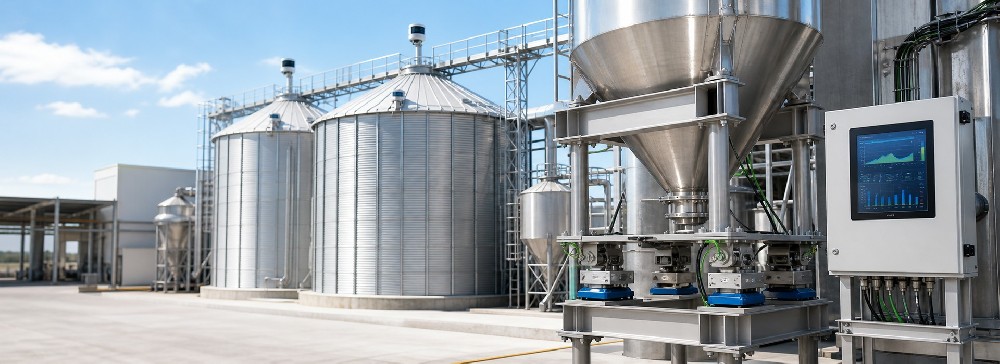

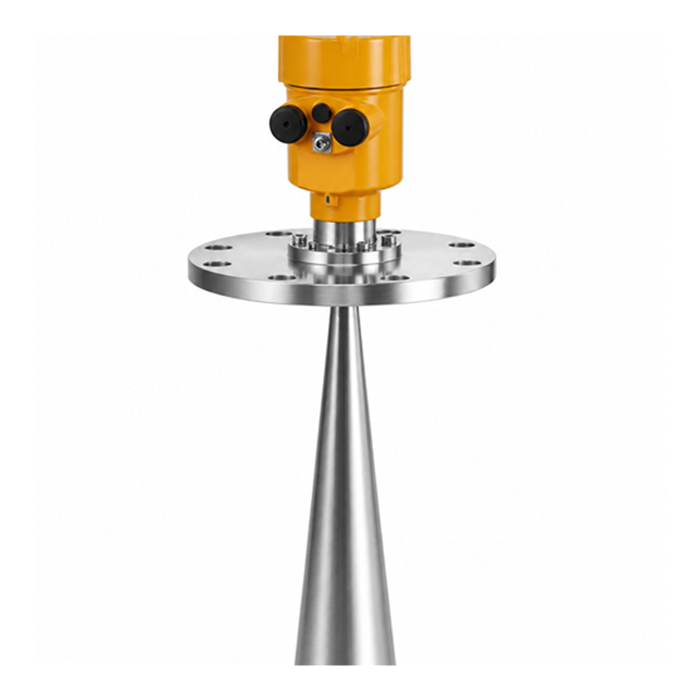
METRAVON MV-RD903 is a 26 GHz radar level meter for bulk solids, using a horn antenna to measure the distance to a material surface. Its listed range is 0.6-70 m. For a cement, fly-ash or coal silo, the first task is to choose which part of the changing pile the instrument can observe reliably; a long distance range alone does not establish useful inventory measurement.
Position the measurement around filling and discharge
Mark the inlet, discharge point, cone and internal structures on a silo section. Then consider how the pile changes between filling and emptying. A location that reads well over a settled pile may see falling material during delivery or a steep slope during discharge. Do not approve a mounting position using only an empty-silo photograph.
The horn must have clearance through the mounting opening and towards the intended surface. An adjustable flange can help set the direction, but its pressure rating and mechanical support must match the installation. Record the final orientation so maintenance staff can return the antenna to the same position after removal.
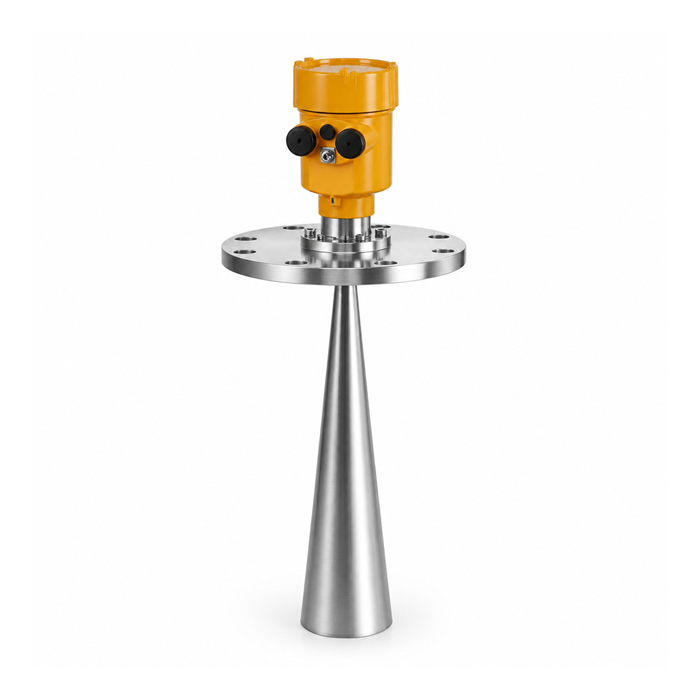
Radar level meter for bulk solids: configuration checks
| Parameter | Listed silo configuration |
|---|---|
| Measuring distance | 0.6-70 m |
| Horn diameter / beam | 96 mm / 8 degrees; 121 mm / 6 degrees |
| Flange connection | DN100 or larger; confirm clearance and the required adjustment arrangement. |
| Temperature options | -40 to 120 deg C; -40 to 200 deg C for the high-temperature configuration. |
| Process pressure | -0.1 to 0.3 MPa |
| Reference accuracy | +/-15 mm; not a silo weight or volume accuracy specification. |
What a single level reading can tell the operator
A repeatable surface-distance measurement can support level trends and filling decisions. Converting it to volume requires a suitable vessel model and an assumption about the pile profile. Converting volume to mass also requires bulk-density information. Changes in aeration, moisture or compaction can therefore change the relationship between indicated level and material weight.
If inventory reconciliation is important, compare the level trend with independent receipts or weighing records over representative cycles. Investigate whether disagreement comes from the surface measurement, the volume calculation or the density assumption. Adjusting the radar offset to make one batch agree can conceal a calculation problem.
Test while the silo is operating
Check low, intermediate and high levels, then observe filling when dust and falling material are greatest. Compare the instrument display with the PLC or RTU value and record any echo loss. An empty-silo setup is useful for locating fixed reflections, but it does not replace a test with the actual material.
Specify 24 VDC two-wire 4-20 mA/HART or the required RS485/Modbus electronics in the order. Define the receiving system's response to an invalid measurement. If the installation repeatedly loses the material echo during delivery, assess mounting changes and the MV-RD904 parabolic antenna option rather than merely extending the displayed range.
Questions from silo projects
Q1. Is a reading taken at the pile peak the average material level?
No. It describes the surface seen by the radar, which may not represent the whole cross-section. Choose the measurement position and inventory calculation together, and validate the result against the range of pile shapes expected in operation.
Q2. Can I use the 70 m rating for every powder?
Not without an application review. Echo strength, moisture, dust, surface slope and obstructions affect the usable distance. Provide the lowest surface position and the material conditions during filling, not just the overall silo height.
Send a silo drawing, material description, filling sequence, required level range and control-system interface with your MV-RD903 request. Include the required enclosure rating and hazardous-area documentation so these are checked against the selected assembly rather than inferred from the model family.
