


 Chinese
 Spanish
 Russian
 Portuguese
 French
 German
 Indonesian
 Thai
 Vietnamese
 Arabic
 Italian
 Turkish
 Polish
 Japanese



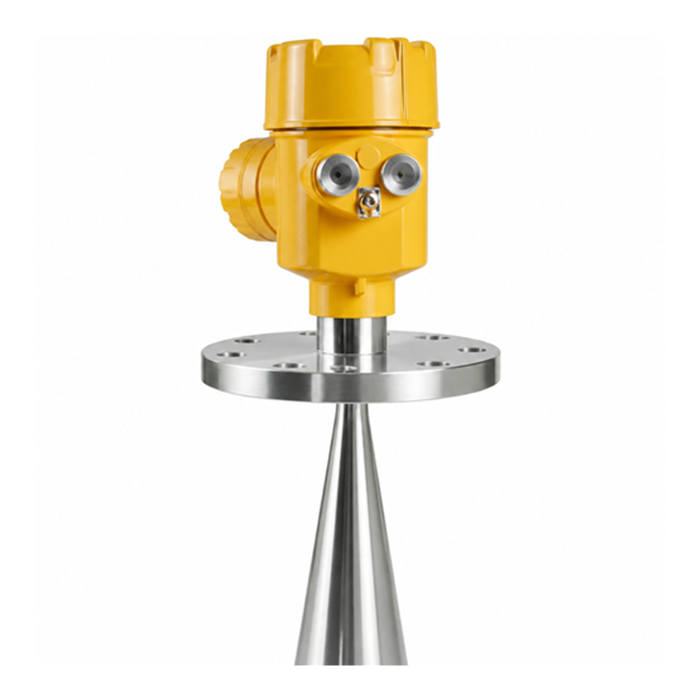
METRAVON MV-RD902 is a horn antenna radar level meter for liquid tanks, operating at 26 GHz with a listed 0.3-30 m distance range. Its stainless-steel horn is available in several diameters. The useful choice depends on both the opening available for installation and the unobstructed measurement path inside the vessel.
Select the horn before finalising the nozzle
A smaller horn can pass through a restricted opening, but it generally requires more attention to nearby structures because of its wider beam. A larger horn needs more mechanical clearance. Select the antenna diameter and its beam data together; do not use a beam angle from a different horn size when checking the tank drawing.
| MV-RD902 item | Selection data |
|---|---|
| Frequency / medium | 26 GHz / liquids |
| Distance range | 0.3-30 m |
| Horn diameter options | 46 mm / 76 mm / 96 mm |
| Temperature configurations | Standard: -40 to 120 deg C; high-temperature: -40 to 200 deg C. |
| Listed process pressure | -0.1 to 2.5 MPa |
| Reference accuracy | +/-5 mm |
| Process connection | Thread or flange; match the connection drawing to the selected horn. |
The pressure, temperature and seal must be approved as one assembly. A hot asphalt tank, for example, requires assessment of antenna deposits and local heat exposure as well as the nominal liquid temperature. A temperature option alone does not establish that the instrument will read reliably through dense vapour or a coated antenna.
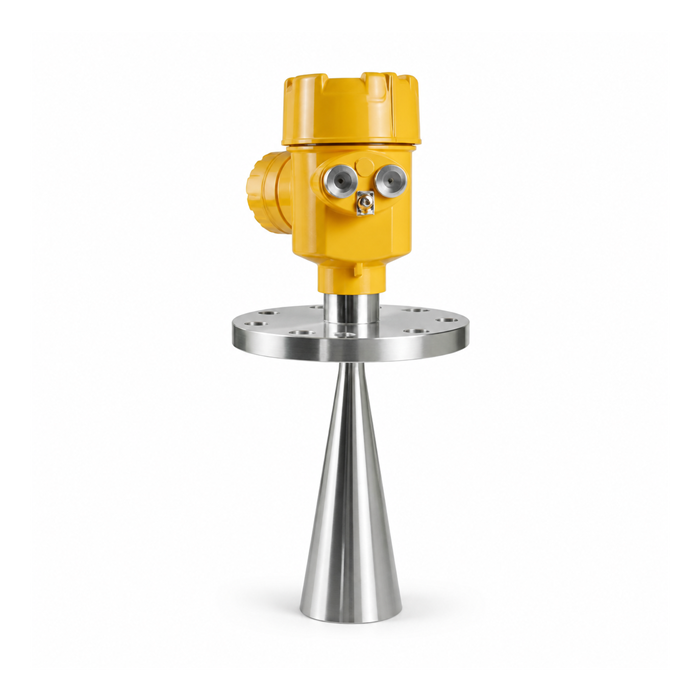
Installing a horn antenna radar level meter on an existing tank
Measure the nozzle's internal diameter and height rather than relying on its flange label. Establish where the horn opening will sit relative to the nozzle outlet. A horn recessed into unsuitable pipework can produce strong fixed echoes. Keep the beam away from ladders, heating coils and the incoming liquid stream throughout the required level range.
When replacing an older radar, record its reference plane, empty distance and full-level setting before removal. Moving the reference plane without updating those values produces an offset even if the new instrument measures distance correctly. Do not copy every old setting into a different antenna assembly.
Separate echo problems from PLC scaling errors
If the local display agrees with a known level but the PLC does not, inspect the loop scaling, units and configured signal endpoints. If both readings are wrong or unstable, inspect the mounting, surface conditions and antenna before adjusting the control-system calculation. Save a known-good echo trace and parameter record after commissioning.
Two-wire 24 VDC with 4-20 mA/HART is one electrical option. RS485/Modbus uses its specified electronics and wiring arrangement. Tell the supplier whether the host requires an analogue level signal or digital registers; the protocol name alone does not define power or terminal compatibility.
Questions about fit and replacement
Q1. Should I always choose the largest horn?
No. Its installation clearance and position must be practical, and the selected beam must avoid interference over the operating span. A larger antenna that cannot be fitted correctly is not an improvement. Compare the proposed assembly drawings before changing the nozzle.
Q2. Can I use this model for a strongly corrosive liquid?
Only after confirming all exposed materials for that chemical and concentration. For an atmospheric chemical tank, assess the PTFE-antenna MV-RD901 instead of assuming a stainless-steel horn has the same resistance. The alternative has a shorter listed measuring range and different operating limits.
Include the tank section, nozzle measurements, fluid properties, operating conditions and existing instrument settings in your MV-RD902 enquiry. For replacement work, identify whether the mounting, signal wiring and PLC scaling can be changed during the shutdown.
