Chinese
 Spanish
 Russian
 Portuguese
 French
 German
 Indonesian
 Thai
Thai Vietnamese
 Arabic
 Italian
 Turkish
 Polish
 Japanese
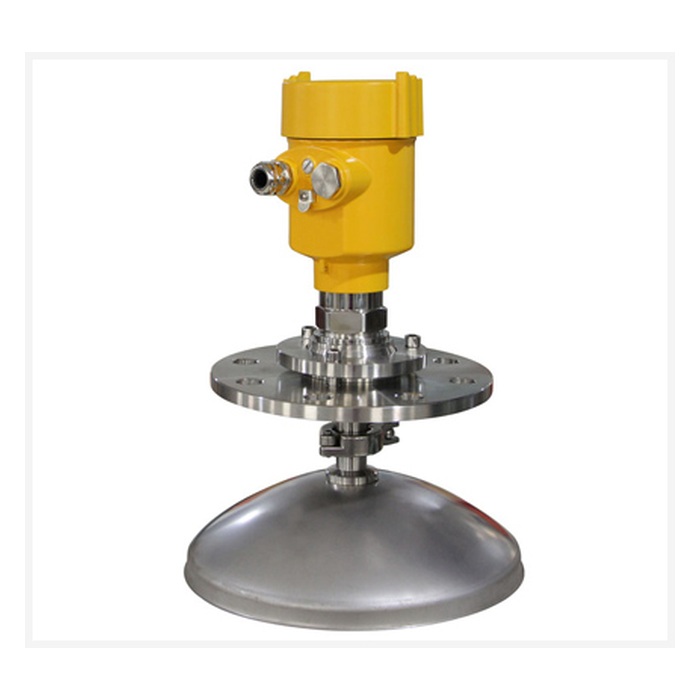

selection summary
For applications with solid materials, heavy dust, easy crystallization and condensation, the reference range is 80m, using a 26 GHz horn antenna and threaded or universal flange connection. Before ordering, the material, measuring range, dust, material surface, installation port, temperature and pressure, explosion-proof and output should be confirmed as a set of conditions.
Product overview
MV-RD904 high-dust 26 GHz radar level meter is used for non-contact continuous level measurement in industrial silos. It outputs continuous distance or level signals, which is suitable for inventory trends, material incoming and outgoing control, and high and low level warnings; it is not the same product as the level switch that only determines "material present/no material".
Measurement principle
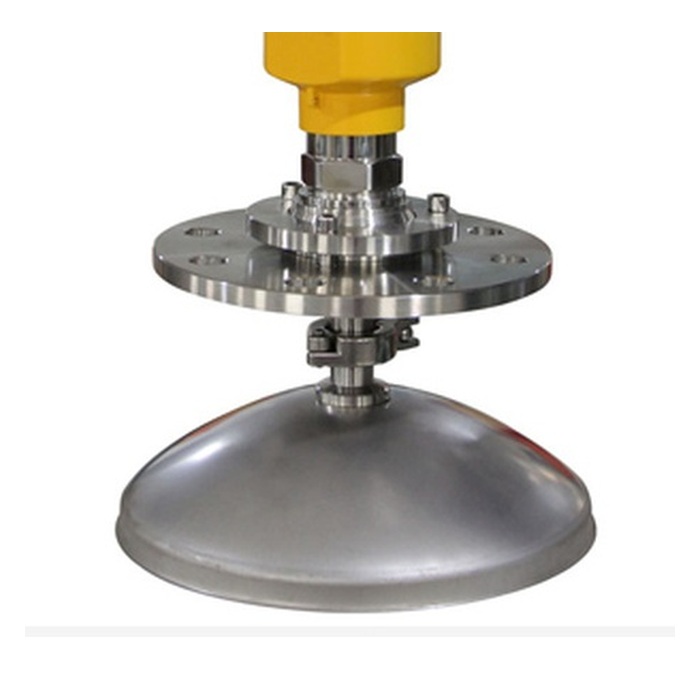
The 26 GHz antenna emits microwaves to the material surface and receives the echo. The instrument calculates the distance and level based on the propagation characteristics. The short wavelength and 4° narrow beam are conducive to echoes from solid inclined material surfaces and obstacle avoidance in the silo; the universal flange is used to adjust the antenna direction to a representative material surface.
Applicable materials and usage scenarios
- Silos for heavy dust such as cement, fly ash, coal powder, ore powder.
- Long-range continuous measurement of ore, coal, coke and granular raw material bins.
- process conditions where condensation may form on the antenna, materials are prone to crystallization, or echo fluctuations during the feeding phase are large.
- Renovation projects that require the antenna to be adjusted through a gimbal flange to align the beam with the inclined material surface.
Value applied to procurement and technicians
Technical parameters
| Application | Suitable for solid materials, heavy dust, easy crystallization, and condensation situations; covering applications of block, granular and powdery materials |
|---|---|
| Measuring range | Maximum 80m |
| process connection | Threaded, universal flange |
| process temperature | -40~130℃ standard type; -40~250℃ high temperature type |
| process pressure | -0.1~0.3MPa |
| Measurement accuracy | ±15mm |
| Frequency | 26 GHz |
| The beam horn. | 4° |
| Protection level | IP67 |
| Electricity | Two-wire system DC24V; four-wire system DC24V or AC220V |
| Signal output | 4-20mA/HART (two wires/four wires) or RS485 Modbus |
| Explosion proof | Optional Ex ia IIC T6 Ga or Ex d IIC T6 Gb, please confirm with complete model number and certificate |
| Shell | Aluminum single chamber, aluminum dual chamber, plastic or stainless steel single chamber configurations |
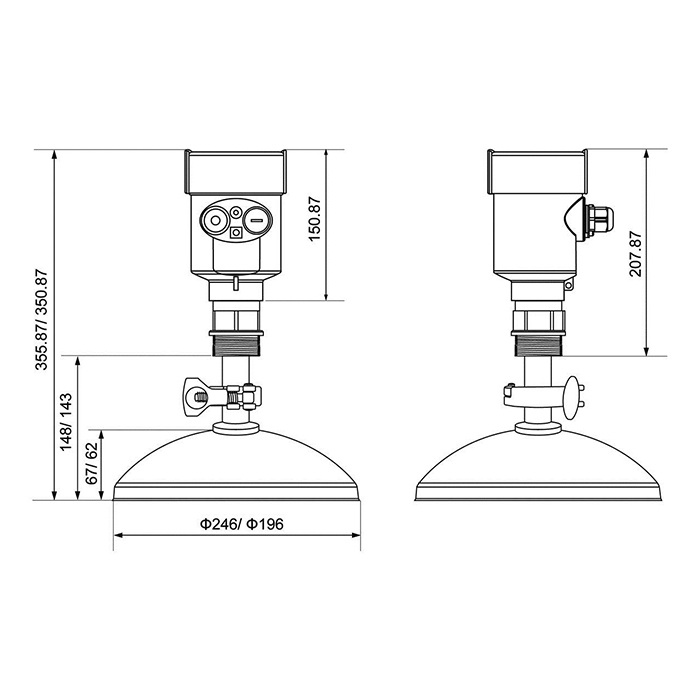
Note: The values on this page are used for inquiry and preliminary selection. Temperature, pressure, flange, antenna, housing, explosion-proof and output options need to be confirmed according to the complete configuration, and the upper limits cannot be combined by default.
Selection guide
- Provide solid material name, particle size, dielectric properties, dust concentration, moisture content, crystallization and condensation conditions.
- Check whether the 80m range is needed and whether there is sufficient echo margin according to the silo height, maximum level, blind area and abnormal process conditions.
- Submit the silo body, feed inlet, material mound direction and internal component diagrams to decide whether to use threaded or universal flange.
- The standard type and high temperature type are selected according to the actual temperature at the flange, and cannot be judged only by the temperature of the material in the silo.
- Check process pressure, housing, protection, explosion-proof area and grounding requirements to form a complete configuration.
- Confirm 4-20mA/HART or RS485 Modbus, power supply method and on-site display requirements.
Key points for installation and commissioning
- The installation point should avoid the feed flow and give priority to a location where the main material surface can be observed and is not affected by materials hanging on the silo wall.
- When using a universal flange, try to align the antenna vertically with the material surface instead of just keeping the flange horizontal.
- Keep clear space below the bell mouth, and the protective cover, purge parts and short installation pipes cannot enter the 4° beam.
- Save echoes during empty bin, normal feeding and maximum dust stages to establish fixed interference and effective echo baselines.
- Regularly check the antenna for dust accumulation, condensation, loose flange and cable sealing; keep records of parameter adjustments.
FAQ
What process conditions is MV-RD904 mainly aimed at?
It is suitable for solid materials, heavy dust, easy crystallization and condensation situations, and can be used for continuous measurement of block, granular and powdery materials.
Can the 80m range of MV-RD904 be directly selected based on the bin height?
No. 80m is the reference maximum range, and it also depends on the material’s reflective ability, dust, material surface inclination angle, installation port and signal margin.
What does the 4° beam angle do?
The narrow beam is easy to avoid the silo walls and components, and concentrates the energy on the solid material surface; the actual installation still needs to confirm the beam path based on the silo body diagram.
When is a universal flange needed?
When the material mound is obvious, the installation opening is incorrect, or the antenna needs to be aligned with the main material surface, the universal flange can be evaluated and the structural strength and pressure boundary confirmed.
Is it necessary to purge in heavy dust conditions?
Not necessarily. It should be determined based on the dust accumulation in the horn, dust adhesion and air source conditions; even if there is purging, it is necessary to select the correct point and cleanable structure.
How to choose between standard type and high temperature type?
The reference process temperature of the standard type is up to 130℃, and the high temperature type is up to 250℃. The selection should be based on the actual temperature at the antenna and flange, and the sealing and heat insulation should be checked.
Can it measure materials that are prone to crystallization?
It can be used as an evaluation process condition, but if the crystal seals the horn or the installation port, it will still affect the echo. Purge, heat insulation, cleaning and shutdown maintenance need to be considered.
Can it be connected to PLC or DCS?
Optional 4-20mA/HART or RS485 Modbus. When purchasing, the power supply, output, fault status and system I/O list should be unified.
How to check and accept after installation?
At least cover the empty silo, low, medium and high levels and the maximum dust stage, and check the display, analog or communication values, echo quality and high material stop logic.
Inquiry What to offer for MV-RD904?
Provide materials, particle size, bin body and material mound, dust condensation, temperature and pressure, installation port, explosion-proof, power supply output, on-site photos and interlocking purposes.
Ordering instructions
When ordering, please provide the material name and form, particle size and dust, bin size, material inlet and outlet location, measuring range, normal and abnormal temperature and pressure, process connection, hazardous area, power supply, output protocol, on-site photos and control purposes. The final parameters are subject to the written selection confirmation and order drawing.