Chinese
 Spanish
 Russian
 Portuguese
 French
 German
 Indonesian
 Thai
Thai Vietnamese
 Arabic
 Italian
 Turkish
 Polish
 Japanese
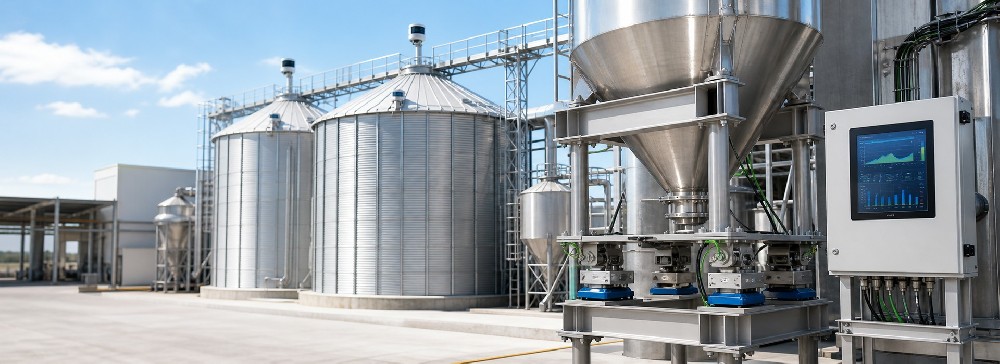
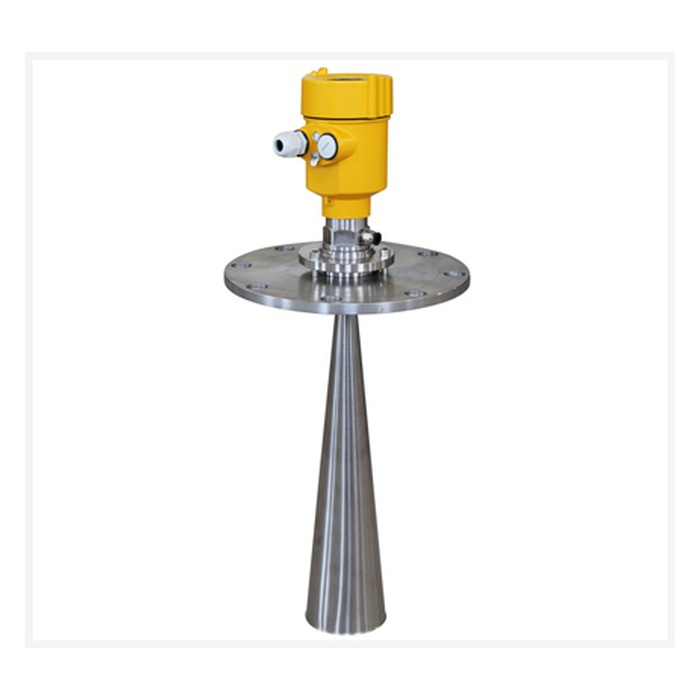

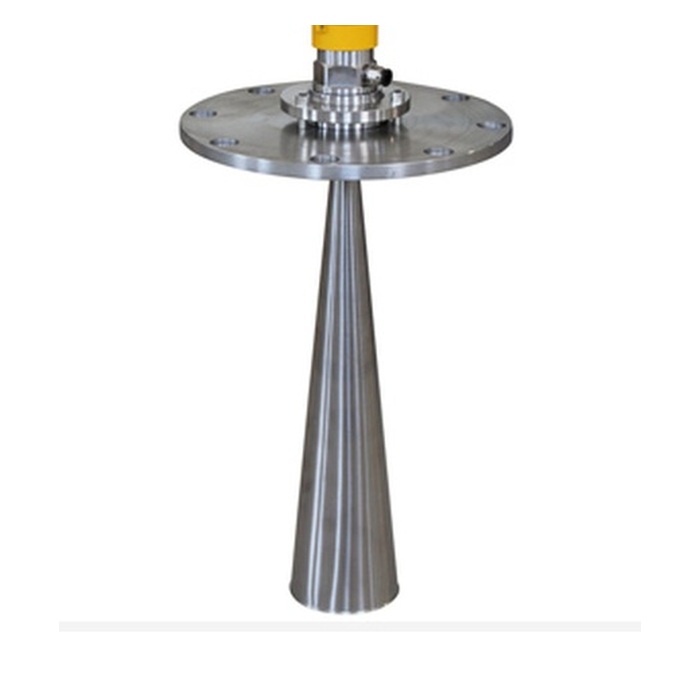
selection summary
It is used for measuring solid particles, powders and lump materials. The reference range is 30m for liquids, 20m for solid blocks and 15m for solid powders. Threaded or flanged and high-temperature configurations are optional. Before ordering, the material, measuring range, dust, material surface, installation port, temperature and pressure, explosion-proof and output should be confirmed as a set of conditions.
Product overview
MV-RD905 general-purpose bulk-solids 26 GHz radar level meter is used for non-contact continuous level measurement in industrial silos. It outputs continuous distance or level signals, which is suitable for inventory trends, material incoming and outgoing control, and high and low level warnings; it is not the same product as the level switch that only determines "material present/no material".
Measurement principle
The 26 GHz horn antenna emits microwave pulses to the medium surface and receives the reflected signals, and the instrument calculates the distance and level based on this. Different materials have different dielectric properties, dust and material surface inclination angle, so the reference ranges for liquid, solid block and solid powder are given on the page respectively.
Applicable materials and usage scenarios
- Grain, feed, plastic particles and chemical pellet silos.
- Powder material silos such as cement, coal powder, mineral powder, additives, etc.
- Continuous measurement of medium and short range materials such as coal, ore, coke and other lumpy materials.
- Projects that require installation matching between threaded, flat flanges or universal flanges.
Value applied to procurement and technicians
Technical parameters
| Application | Solid particles, powders and lumps |
|---|---|
| Measuring range | Liquid 30m; solid block 20m; solid powder 15m |
| process connection | Thread, flange |
| process temperature | -40~130℃ standard type; -40~250℃ high temperature type |
| process pressure | Flat flange-0.1~4.0MPa; universal flange-0.1~0.3MPa |
| Measurement accuracy | ±15mm |
| Frequency | 26 GHz |
| The beam horn. | 8° |
| Protection level | IP67 |
| Electricity | Two-wire system DC24V; four-wire system DC24V or AC220V |
| Signal output | 4-20mA/HART (two wires/four wires) or RS485 Modbus |
| Explosion proof | Optional Ex ia IIC T6 Ga or Ex d IIC T6 Gb, please confirm with complete model number and certificate |
| Shell | Aluminum single chamber, aluminum dual chamber, plastic or stainless steel single chamber configurations |
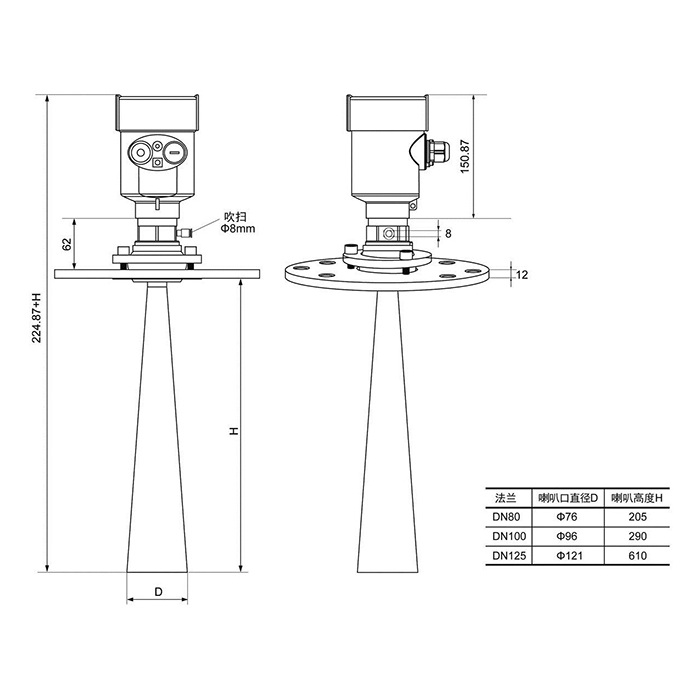
Note: The values on this page are used for inquiry and preliminary selection. Temperature, pressure, flange, antenna, housing, explosion-proof and output options need to be confirmed according to the complete configuration, and the upper limits cannot be combined by default.
Selection guide
- First, distinguish whether the material is in the form of lumps, granules or powder, and provide particle size, dielectric properties, moisture content, dust and material surface conditions.
- Use the solid block 20m or solid powder 15m reference range according to the actual material, and the liquid 30m indicator should not be applied.
- Submit the bin size, installation opening, feeding position and internal components, and check the 8° beam range.
- Threads, flat flanges and universal flanges affect the installation direction and pressure limit at the same time and must be selected in combination.
- For high-temperature models, confirm the actual temperature at the flange and antenna, and check the insulation, sealing and maintenance space.
- Confirm power supply, 4-20mA/HART or RS485 Modbus, explosion protection and control system interface.
Key points for installation and commissioning
- The installation point is far away from the feed beam to avoid direct impact of large pieces of material on the horn and flange.
- Adjust the antenna according to the direction of the material mound; when using a universal flange, also check its lower pressure limit.
- Avoid ladders, stiffeners and long installation short pipes within the 8° beam, and complete fixed echo suppression when the position is empty.
- Check the display, output and alarm thresholds respectively at low level, high level and feeding dust stage.
- Inspect antenna dust, condensation, grounding, cable entries and fasteners, and keep parameters and echo records.
FAQ
Can MV-RD905 measure lump, granular and powdery materials?
It can be used as a selection object for these three types of solid materials, but the reference ranges of different materials are different, and the dielectric properties, dust and material surface need to be checked.
Which value should be considered for the measuring range of MV-RD905?
The reference is 20m for solid blocks and 15m for solid powder; the 30m for liquids cannot be directly used for solid selection. When approaching the upper limit, echo and process condition margins should be retained.
Why is the measuring range of solid powder shorter than that of solid block?
Different materials have different dielectric properties, dust, and material surface reflection conditions. The page gives different reference distances based on typical media. The actual project still needs to be confirmed.
What should you pay attention to when installing an 8° beam angle?
The installation opening, silo walls, ladders and stiffeners should not enter the effective beam. The higher the silo, the larger the beam coverage diameter, and it needs to be checked according to the drawings.
How to choose between threaded, flat flange and universal flange?
The thread is suitable for matching small interfaces; the flat flange covers higher pressures; the universal flange is easy to align with the material surface, but the upper limit of the reference pressure is lower.
Can the high temperature type withstand the highest pressure at the same time?
The upper limit of temperature and pressure cannot be established at the same time by default. Seals, flanges, antennas and explosion-proof configurations need to be confirmed in writing according to the combined process conditions.
Can the measurement be stable even when there is a lot of dust?
The 26 GHz solid-state radar can be used in dusty process conditions, but extremely dense dust, dust on the antenna and direct feeding of materials will still affect the echo and should be accepted under dynamic process conditions.
Can it be connected to PLC or DCS?
Optional 4-20mA/HART or RS485 Modbus. Before connecting, confirm the power supply, range, station number, baud rate, isolation and fault output.
How to set high level alarm?
Continuous levels can provide early warning and control thresholds, but high-level material stops should be included in the in-transit volume of the conveying system; key independent protection is determined by process safety design.
Inquiry What to provide for MV-RD905?
Provide material shape and particle size, silo height and diameter, dust, temperature and pressure, installation port and material mound, dangerous area, power supply output and on-site diagram.
Ordering instructions
When ordering, please provide the material name and form, particle size and dust, bin size, material inlet and outlet location, measuring range, normal and abnormal temperature and pressure, process connection, hazardous area, power supply, output protocol, on-site photos and control purposes. The final parameters are subject to the written selection confirmation and order drawing.