


 Chinese
 Spanish
 Russian
 Portuguese
 French
 German
 Indonesian
 Thai
 Vietnamese
 Arabic
 Italian
 Turkish
 Polish
 Japanese

Wireless Level Monitoring: LoRa, NB-IoT and 4G for Remote Tanks
A level instrument on a tank in the middle of nowhere has one overriding constraint that a wired instrument never faces: energy. Every feature — how often it measures, how far it transmits, how long it lasts — is a trade against a battery. Choosing the radio technology is therefore not a technical trivia question; it is the decision that sets the whole power budget, and getting it wrong means a sensor that is dead in six months instead of six years.
The three radios, and what each is for
LoRa / LoRaWAN. LoRa is a radio modulation technology; LoRaWAN specifies the network protocol and architecture. A LoRaWAN deployment uses a gateway and network server, which can be private or provided as a service. It suits small messages and energy-conscious reporting, with capacity and latency constrained by region, airtime, network load and device class.
NB-IoT. This cellular IoT technology can support low-energy devices through supported network power-saving features. Confirm the operator, band, actual site coverage, SIM service and latency. It is not restricted to readings every few hours; attainable reporting and alarm response depend on the module, coverage, sleep settings and application.
LTE-M and other LTE categories. LTE-M is a low-power cellular IoT option, not simply a high-power broadband radio. Cat-1, Cat-1 bis and other LTE devices have different data and power characteristics. Compare measured wake-up energy, throughput, latency, firmware-update needs and operator support rather than grouping every LTE modem under one power rating.
| Technology | Infrastructure to verify | Main energy and response factors |
|---|---|---|
| LoRaWAN | Gateway, network server and backhaul, private or public | Airtime, spreading factor, retries, regional rules and device class |
| NB-IoT | Actual operator and band support at the site | Coverage, registration, repetitions, PSM/eDRX and message interval |
| LTE-M | Actual operator and module support | Coverage, sleep behaviour, traffic and latency |
| Other LTE categories | Service plan and site coverage | Module category, connection time and data volume |
The power budget is the real spec
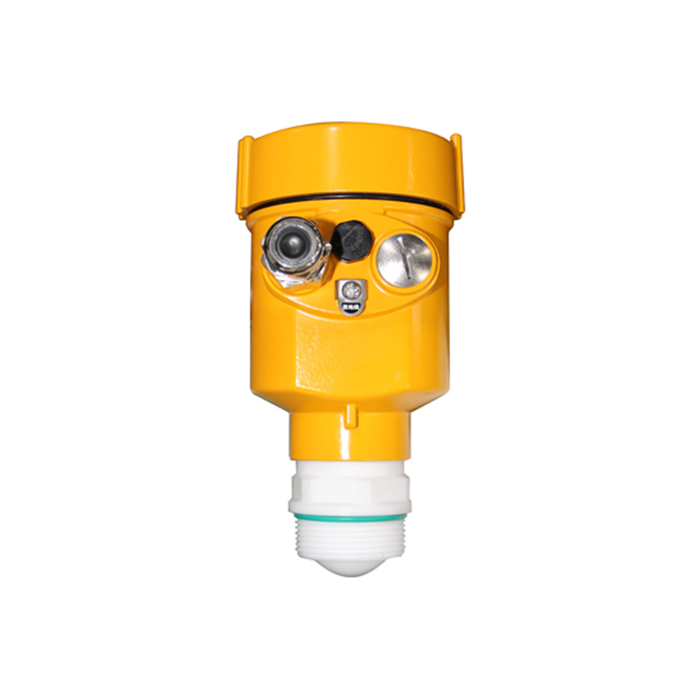
Battery life depends on measurement energy, radio wake-up and registration, transmission retries, reporting interval, sleep current and usable battery capacity. Increasing the interval means fewer reports and usually longer life; reducing it usually consumes more energy. Obtain measurements for the actual sensor, coverage and temperature instead of accepting a fixed lifetime claim.
For non-contact radar, which needs a measurement burst that costs real power, the reporting interval is the lever. Many remote designs use a wake-and-measure cycle: the sensor sleeps, wakes on a timer, takes one measurement, transmits, and returns to sleep. The engineering is in making that one wake-up cheap.
Choosing for the site
Many tanks on one site → assess a private or public LoRaWAN deployment, including gateway coverage, backhaul, network capacity, maintenance and ownership cost.
Scattered remote tanks → compare supported NB-IoT and LTE-M services at the actual sites, using the required reporting interval and battery budget.
Need prompt alarms → establish the complete detection-to-notification delay and availability, including measurement interval, sleep, registration, retries, server and recipient. No radio label guarantees immediate delivery.
The other axis is what happens when a reading is out of range. A remote level system is only as useful as its alarm path: decide whether the device pushes an alert on its own, whether the cloud platform raises it, and who gets it — because a remote tank you cannot alarm on is just a remote tank you still have to drive to.
Questions engineers ask
Q1. How long will the battery really last?
That is a function of the reporting interval, not a fixed number. Get the manufacturer's battery-life curve against interval, and design the interval to the application, not the marketing number.
Q2. Does LoRa need a licence?
Many deployments use licence-exempt spectrum subject to national frequency, power, access and equipment-approval conditions. Check the destination rules and the appropriate LoRaWAN regional parameters. A private gateway does not remove those obligations; a public network may add a service subscription.
Q3. Can I use wireless for a safety function?
Ordinary wireless inventory monitoring must not be credited as an independent safety trip without a specific functional-safety design and validation. Wireless technology is not categorically excluded, but the complete function would need demonstrated latency, availability, failure response, integrity and independence. Keep the routine monitoring radio outside a credited safety function unless the safety assessment establishes otherwise.
Q4. What is the real cost difference?
The radio module is a small part; the cost is in battery replacement visits, gateway ownership and data plans over years. Compare total cost of ownership, not the sensor price.
Related technical guides
- Radar Level Transmitter Output Signals: Choosing the Right One
- How to Specify a Radar Level Transmitter: The 14 Fields That Decide the Quote
Discuss your measurement application with METRAVON
