Chinese
 Spanish
 Russian
 Portuguese
 French
 German
 Indonesian
 Thai
Thai Vietnamese
 Arabic
 Italian
 Turkish
 Polish
 Japanese
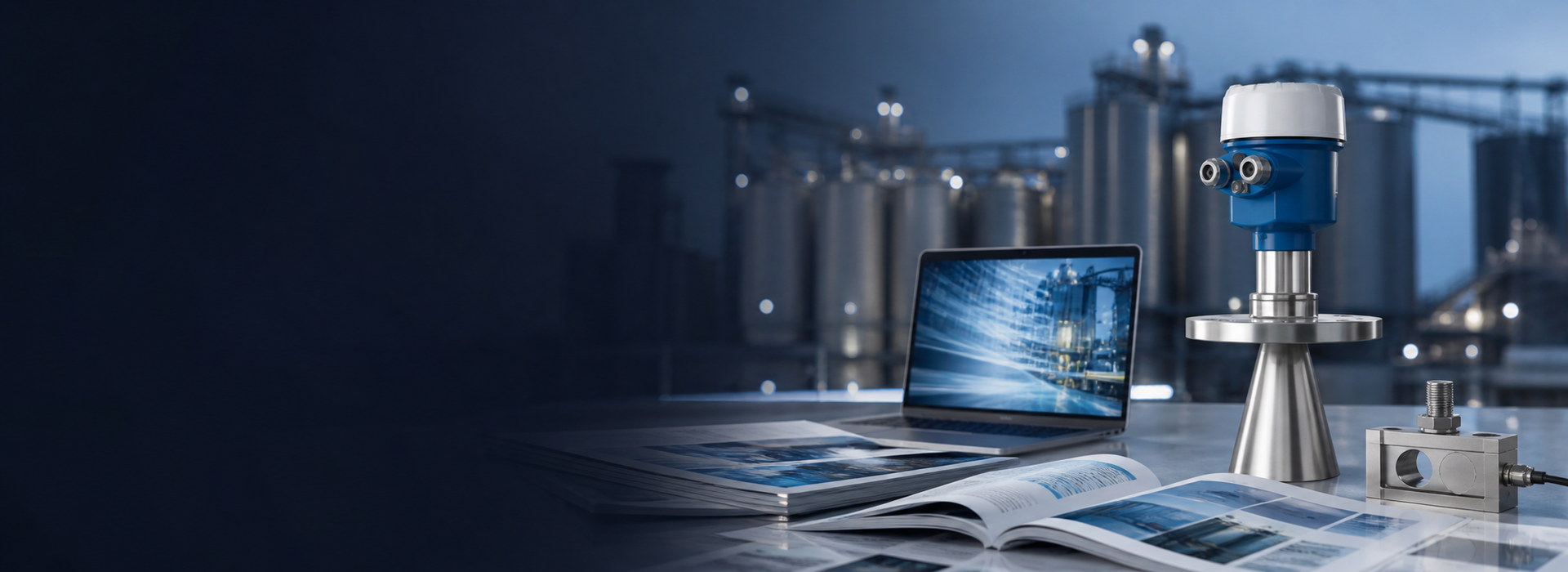
High-frequency radar level gauges use a transmission frequency of 26GHz or 24GHz, significantly improving measurement range and accuracy. Combined with optimized antennas and high-speed signal processors, they can operate stably under complex conditions involving strong corrosion, high temperatures, and viscous media, making them particularly suitable for level measurement in large vertical tanks and spherical tanks.
This article systematically explains the working principles, selection considerations, and practical advantages of high-frequency radar level gauges, guided wave radar level gauges, parabolic antenna radar instruments, and frequency-modulated continuous-wave radar, helping engineers select and install the appropriate instrument correctly.
Core Features and Performance Advantages of High-Frequency Radar Level Gauges
High-frequency radar level gauges operate at transmission frequencies of 26GHz/24GHz. Compared with low-frequency products, they generally offer longer measurement distances and higher accuracy. Their antennas are further optimized, while their processors support higher-speed signal analysis, enabling the instruments to more effectively overcome false reflections, dust, steam, and other interference and obtain more accurate measurement data.
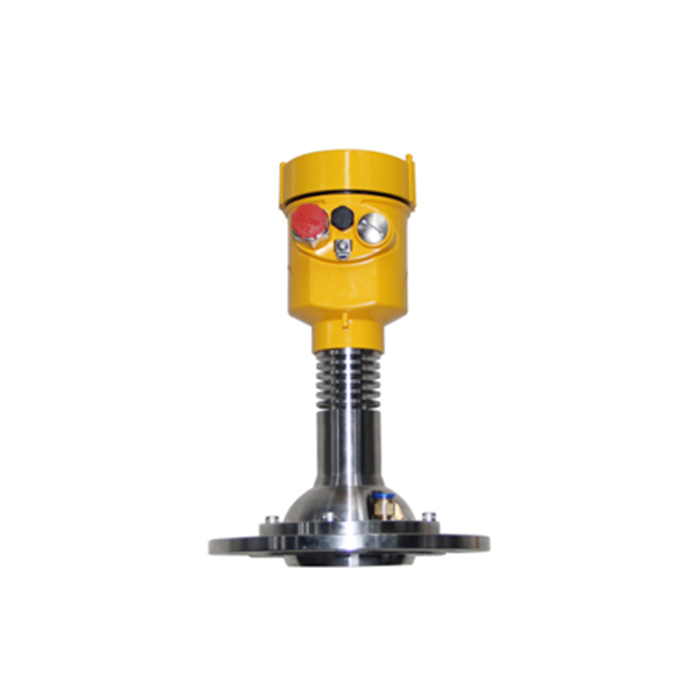
METRAVON 26GHz high-frequency radar level gauges perform well under demanding conditions involving strong corrosion, high temperatures, and viscous media, and are suitable for large vertical tanks, spherical tanks, and similar applications. The following points should be considered during installation:
Avoid placing limit switches, temperature sensors, or other devices that may generate false reflections within the radar transmission angle whenever possible.
The nearest one-third of the conical transmission zone close to the antenna should preferably be free of obstacles. If this cannot be avoided, a deflector plate can be used to redirect strong false reflections, reducing false echo energy density and making it easier for the sensor to filter them out.
Do not install the radar level gauge directly above the material inlet.
Do not install the instrument at the center of a domed tank or too close to the tank wall. The distance from the tank inner wall to the outer wall of the mounting nozzle should be greater than one-sixth of the tank diameter.
Avoid areas with strong vortex flow, such as locations with intense agitation or chemical reactions. If necessary, use a stilling well or bypass chamber installation.
These measures can significantly improve measurement stability and reliability.
Working Principle of Guided Wave Radar Level Gauges
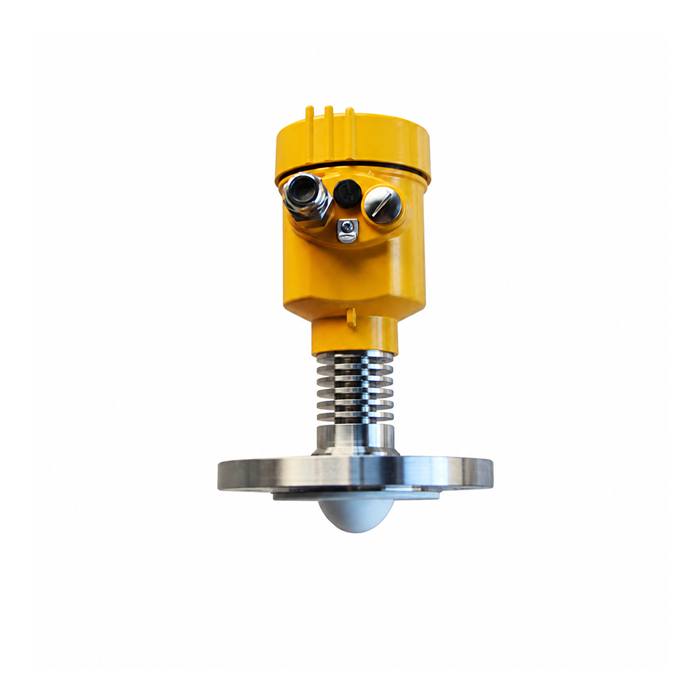
Guided wave radar level gauges operate according to the time-of-flight principle. Radar waves travel at the speed of light, and the propagation time is converted into a level signal by the electronic circuitry. The probe transmits high-frequency pulses along a cable probe. When the pulse reaches the material surface, it is reflected and received by the instrument receiver. The distance signal is then converted into a level signal.
Conventional radar level gauges use a “transmit–reflect–receive” operating method. The antenna transmits electromagnetic waves in the form of a beam. After the signal is reflected from the surface of the measured material, it is received by the same antenna. Each point in the transmitted and reflected waveforms is sampled and processed by an intelligent processor to determine the distance between the medium and the probe, after which the result is sent to the terminal for display, alarm, and operation.
Because guided wave radar pulses travel along the probe, they are generally less affected by interference and are suitable for complex measurement conditions or media with relatively low dielectric constants.
Main Applications and Suitable Conditions for Parabolic Radar Level Meters
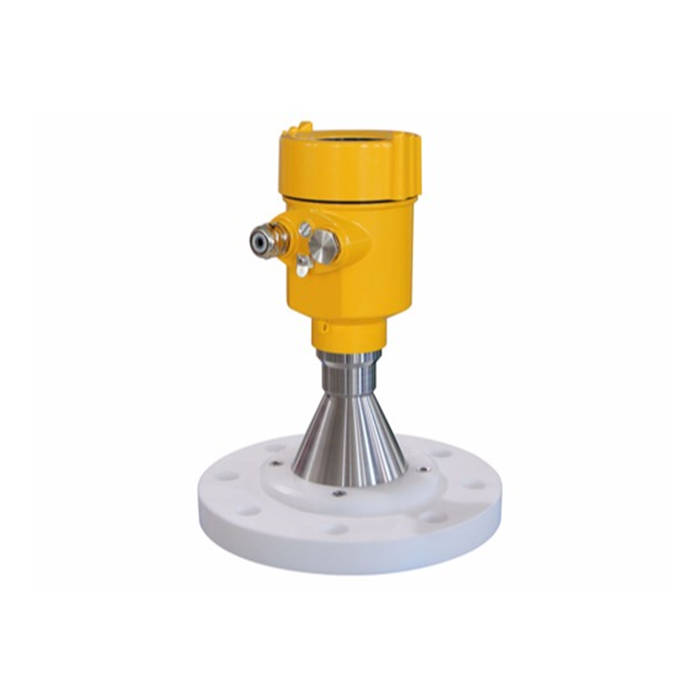
Radar instruments with parabolic antennas have a very small transmission angle and better directionality than planar antennas, making them less susceptible to interference. Compared with conventional horn antenna radar, parabolic antennas can receive stronger and richer echo signals, helping improve measurement accuracy.
They are particularly suitable for operating conditions involving large particles, heavy dust, or materials with strong microwave absorption. During selection, the actual medium characteristics and installation conditions should be carefully evaluated to fully utilize their interference resistance and high-accuracy advantages.
Key Parameters to Provide When Purchasing a Radar Level Gauge
To ensure accurate model selection, it is recommended to provide the manufacturer with the following key technical parameters:
Operating frequency: 6.8GHz low-frequency pulse radar, 26GHz high-frequency pulse radar, or 80–120GHz FMCW radar;
Sensor type: guided wave probe, rod antenna, horn antenna, planar antenna, drop-shaped antenna, or parabolic antenna;
Power supply: 24VDC two-wire system; 24VDC/220VAC four-wire system;
Accuracy: ±0.2% F.S.;
Measurement range: 0–100 m;
Operating pressure: standard range from -0.1 to 0.6 MPa, with customized versions available up to -0.1 to 6 MPa;
Medium temperature: standard ≤120°C, medium-temperature versions ≤260°C, with customized high-temperature versions available for higher temperatures;
Output: 4–20mA + HART; RS-485/232;
Explosion-proof rating: Ex d (ia) IIC T6.
The medium name, dielectric constant, vessel type and dimensions, installation position, and whether agitation, steam, or dust are present should also be provided so that the manufacturer can recommend the most suitable antenna and installation method.
Features and Advantages of FMCW Radar Level Gauges
Frequency-Modulated Continuous-Wave (FMCW) radar level meters use a voltage-controlled oscillator principle. Their internal circuitry generates a radar signal with a base frequency of approximately 24GHz and a bandwidth of approximately 1GHz that increases linearly in a controlled manner. The signal is transmitted through the antenna and performs a linear frequency sweep.
FMCW radar is a general-purpose solution for measuring coal, cement, grain, alumina, limestone, chemical raw materials, and other materials. It is widely used in cement, chemical, environmental protection, power generation, food, and other industries.
Compared with pulse radar, FMCW radar generally provides advantages in measurement accuracy, interference resistance, and adaptability to complex operating conditions.
METRAVON Radar Level Gauge Quality and Selection Recommendations
There are many domestic radar level gauge brands on the market. METRAVON products feature a simple structure, safe operation, straightforward installation, and economical pricing, making them a reliable option.
By combining high-frequency radar, guided wave radar, parabolic antenna radar, and FMCW radar technologies, users can select the appropriate frequency, antenna type, and installation method according to actual operating conditions to obtain more accurate and stable level measurement data.
Correct model selection and standardized installation are essential for fully utilizing the performance of radar level gauges. It is recommended to comprehensively evaluate medium characteristics, vessel structure, and on-site interference factors. When necessary, auxiliary measures such as stilling wells, bypass chambers, or deflector plates can be used to ensure long-term reliable operation.
FAQ
Q1: What Is the Difference Between a High-Frequency Radar Level Gauge and a Conventional Radar Level Gauge?
High-frequency radar level gauges use transmission frequencies such as 26GHz or 24GHz, generally providing longer measurement ranges, higher accuracy, optimized antennas and processors, and stronger resistance to interference. They are particularly suitable for large storage tanks and complex operating conditions.
Q2: How Does a Guided Wave Radar Level Gauge Work?
Guided wave radar operates according to the time-of-flight principle. High-frequency pulses travel along a cable probe, are reflected when they reach the material surface, and return to the instrument. The propagation time is converted into a level signal, and the guided transmission path helps reduce interference.
Q3: What Operating Conditions Are Suitable for Parabolic Antenna Radar?
Parabolic antennas provide a narrow transmission angle, strong directionality, and strong echo signals. They are particularly suitable for measuring materials with large particles, heavy dust, or strong microwave absorption.
Q4: What Parameters Should Be Provided When Purchasing a Radar Level Gauge?
The main parameters include operating frequency, sensor type, power supply, accuracy, measurement range, pressure, medium temperature, output signal, and explosion-proof rating. The medium name, vessel dimensions, installation position, and on-site interference conditions should also be provided.
Q5: What Are the Advantages of FMCW Radar?
FMCW radar uses linear frequency-sweep measurement and provides high accuracy, strong interference resistance, and good adaptability to complex operating conditions. It is widely used for coal, cement, chemical raw materials, and other media in industries such as cement, chemicals, and power generation.
Q6: What Are the Most Important Installation Considerations for Radar Level Gauges?
Avoid installing the instrument directly above the material inlet, at the center of a domed tank, or too close to the tank wall. Keep the transmission angle as free from obstacles as possible. For strong vortex or highly disturbed conditions, a stilling well or bypass chamber is recommended.
Q7: How Is the Quality of METRAVON Radar Level Gauges?
METRAVON radar level gauges feature a simple structure, safe operation, convenient installation, and economical pricing. They provide stable performance under demanding conditions involving corrosion, high temperatures, and viscous media, making them a reliable option for industrial applications.