


 Chinese
 Spanish
 Russian
 Portuguese
 French
 German
 Indonesian
 Thai
 Vietnamese
 Arabic
 Italian
 Turkish
 Polish
 Japanese


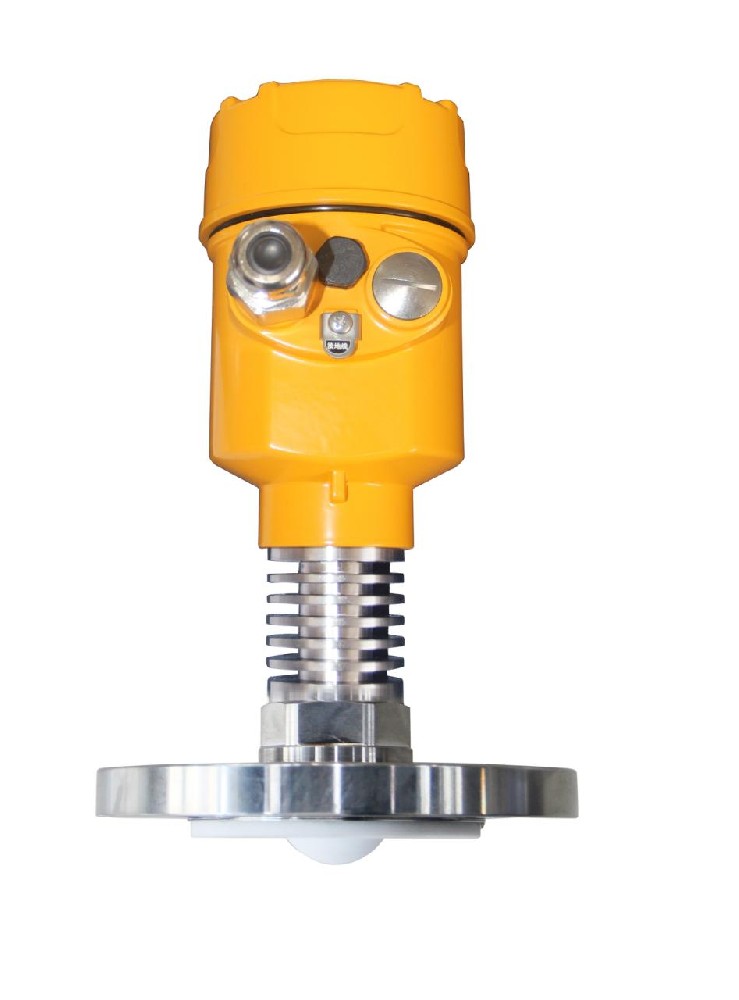
The METRAVON MV-RD12G high-temperature 80 GHz radar level meter is a liquid-level instrument with a 32 mm PTFE lens and a heat-dissipating process assembly. Its model specification lists a 0.1-30 m measuring interval and process temperatures from -40 to 200 deg C. It is intended for applications where the temperature at the tank connection requires more than the standard MV-RD12 configuration.
Keep Process Heat Away From the Housing
The process rating applies to the selected process-facing assembly, not to the electronics enclosure. A hot tank, nearby pipework and insulation can heat the housing even when the liquid temperature remains within the process specification. Include the ambient temperature, insulation thickness and available clearance above the flange when requesting a mounting review.
Leave the heat-dissipating section exposed as required by the approved installation arrangement. Extending tank insulation over it can defeat its purpose. The access space must also allow removal of the cover and maintenance of the lens without disturbing adjacent hot equipment.
MV-RD12G Specification and Assembly Limits
| Parameter | Model data | Application note |
|---|---|---|
| Medium and range | Liquids; 0.1-30 m | The closest operating surface must remain outside the configured near-field limit. |
| Lens and beam | 32 mm PTFE; 8 degrees | Evaluate nozzle reflections and vessel internals along the full measurement path. |
| Process temperature | -40 to 200 deg C | The selected seal, connection and operating pressure constrain the permissible combination. |
| Listed process pressure | -0.1 to 2.5 MPa | This interval does not establish a 2.5 MPa rating at every temperature. |
| Flanged connection | From DN40 | Obtain the standard, pressure class and dimensioned assembly for the vessel nozzle. |
| Nominal measurement accuracy | +/-2 mm | Thermal movement and unstable surfaces must be included in the site acceptance assessment. |
| Enclosure options | Metal IP67; ABS IP65 | Choose the housing for its local environment, not just the process temperature. |
The high-temperature selection table specifies an FFKM seal option. Compatibility still depends on the actual fluid and cleaning chemicals; a seal family name is not sufficient to approve every concentration or temperature cycle.
Test the Reading Through a Heating Cycle
Save the cold-tank reference before heating. At stable, independently known levels, compare the indicated distance and transmitted value as the vessel reaches normal temperature. Repeat with the usual filling or agitation conditions. This distinguishes a mounting reference shift from a moving surface or a changing echo caused by condensation.
For a 4-20 mA/HART installation, verify the analogue scaling and selected fault-current behaviour at the receiver. Where RS485/Modbus is ordered, use the wiring and register information for the supplied electronics. Agree on how the PLC handles a communication timeout; the last valid value should not silently appear to be a new reading.
High-Temperature Service Questions
Q1. Is the 200 deg C process rating also the allowed ambient temperature?
No. The housing and electronics have separate temperature limits. Supply the maximum temperature around the enclosure, including radiant heat from nearby surfaces, so the selected assembly can be assessed for both process and ambient conditions.
Q2. Can the standard MV-RD12 be upgraded by adding insulation?
Insulation does not convert a standard connection and seal into the MV-RD12G high-temperature assembly. Compare the complete ordered construction. If the process remains within a standard version's approved limits, the MV-RD12 liquid-level meter may be sufficient without selecting the high-temperature version.
Q3. Does non-contact measurement eliminate cleaning?
It avoids an immersed measuring probe, but vapour can condense or material can deposit on the lens. Establish access and a cleaning method compatible with the antenna and seals. Follow the site's cooling and isolation procedure before working on a hot process connection.
Q4. Are relay and fieldbus outputs included with HART?
No. The electronics selection determines the available functions and wiring. Identify whether the project needs an analogue measurement, serial data or a separate switching function, then request the exact supported combination instead of treating the option list as one standard unit.
Q5. What evidence is needed for hazardous-area service?
Request the documentation for the exact instrument, protection method and temperature classification offered. A high process-temperature capability does not by itself establish the required hazardous-area approval or suitability of the installed glands and barriers.
Request the High-Temperature Configuration
For an MV-RD12G application review and quotation, provide the heating cycle, fluid composition, concurrent pressure and temperature, nozzle section, insulation layout and required output. State the expected cleaning cycle and maintenance access as well. These details identify the connection and thermal arrangement that must be included in the supplied assembly.
