


 Chinese
 Spanish
 Russian
 Portuguese
 French
 German
 Indonesian
 Thai
 Vietnamese
 Arabic
 Italian
 Turkish
 Polish
 Japanese



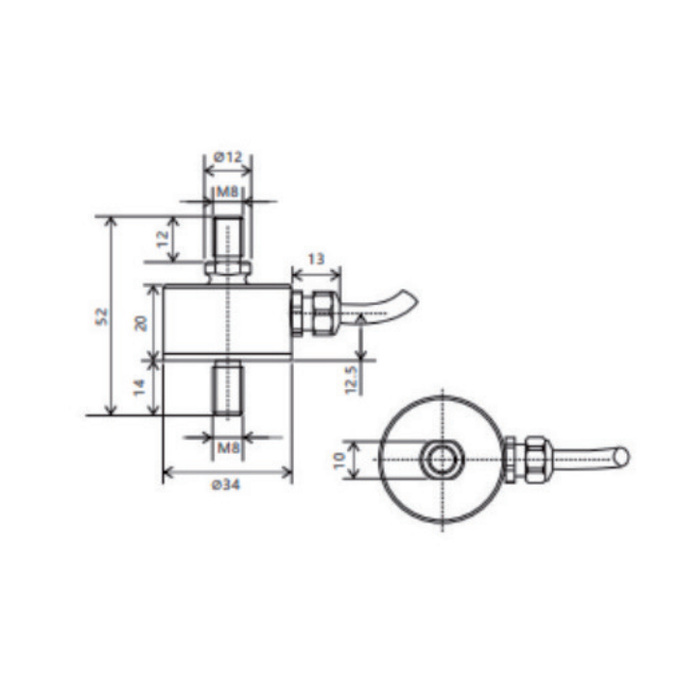
METRAVON MV-LC0237 is a threaded compression force sensor, with nominal ratings of 500 N, 1 kN, 2 kN and 5 kN. Threaded connections are visible in the drawing, but the documented measuring direction is compression. The presence of threads is not evidence that the unit can be used for a suspended tensile load.
Confirm compression duty before designing the joint
Show how the assembly pushes through the sensor and how it behaves during return travel. A fixture that normally compresses the sensor may still pull on it during retraction, servicing or an abnormal cycle. If tensile measurement is required, assess a documented tension/compression model rather than accepting the connection shape as proof of suitability.
A 2 mV/V output changes the reader setup
At 5 V reference excitation, nominal rated output is approximately 10 mV before sensitivity tolerance. Reusing settings from a 1 mV/V sensor can therefore produce a substantial scale error. Check excitation, input headroom, polarity and the available span adjustment, then calibrate the completed assembly with known compressive forces. Zeroing the instrument does not correct the wrong span.
| Item | Value | Use / fit |
|---|---|---|
| Measuring direction | Compression | Threaded appearance does not establish tensile capability. |
| Rated options | 500 N; 1, 2, 5 kN | No 50 N, 100 N or 200 N option is listed. |
| Sensitivity | 2 mV/V; +/-10% | Verify gain when replacing a 1 mV/V device. |
| Excitation | 5 V reference; 1-15 V operating | An external bridge reader supplies excitation and measures the output. |
| Input / output resistance | 350 +/-30 / 350 +/-5 ohms | Check compatibility with the connected measuring channel. |
| Nonlinearity / hysteresis / repeatability | Each +/-0.1% Cn | These are sensor characteristics, not a complete fixture acceptance limit. |
| Creep | +/-0.1% / 30 min | Agree a hold test if the process maintains force. |
| Construction / protection | Stainless steel; IP66 | Do not transfer the IP67 rating of nearby models to this unit. |
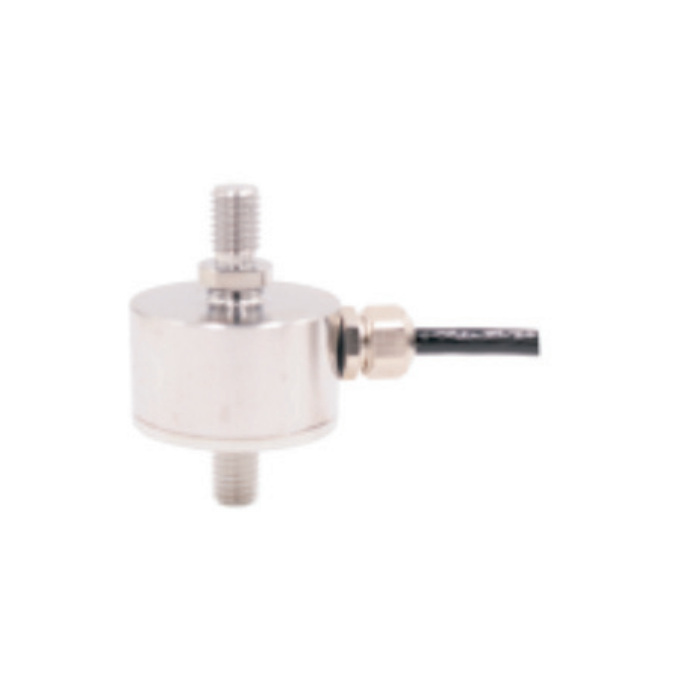
Threaded compression force sensor specifications
The drawing identifies M8 connections, a 34 mm body diameter and a 52 mm overall height. Obtain the selected-range drawing to verify thread engagement, mating parts and cable clearance before manufacture. Do not use the outer diameter alone to decide whether the unit fits an existing recess.
Include time under load in the purchase specification
The listed creep characteristic is +/-0.1% over 30 minutes. A brief spot-force check and a long constant-force hold are different measurement tasks, even at the same load. Define the duration of the application, warm-up and zeroing procedure, and the allowable reading change. This is particularly important when a fixture remains preloaded between cycles.
If the operating cycle includes tensile measurement, review the MV-LC0235 tension/compression sensor and its capacity-specific connection drawing.
Questions before ordering
Q1. Is this suitable for a pull test because both ends are threaded?
The available specification states compression only. A pull test needs a sensor with documented tensile capability and a suitable fixture. MV-LC0235 is a tension/compression alternative to investigate, but its dimensions, output and selected-capacity threads must be reviewed independently.
Q2. Can the existing calibration be kept after replacement?
Only after checking the actual sensor and the whole measuring chain. A nominal 2 mV/V value has a tolerance, and the mounted preload or force introduction may also change. Recheck zero, span and repeated compression before returning the equipment to service.
Q3. What should be included when requesting a quotation?
Send the required rating, mounting section, maximum compression including preload, any possible reverse force, cable routing and reader details. Include the hold duration and environmental exposure so that creep and the IP66 enclosure rating can be assessed against the application.
