


 Chinese
 Spanish
 Russian
 Portuguese
 French
 German
 Indonesian
 Thai
 Vietnamese
 Arabic
 Italian
 Turkish
 Polish
 Japanese



METRAVON MV-LC0221 is a single-point load cell for small platform scales and related weighing assemblies. Its listed ratings start at 2.5 kg and extend to 50 kg in discrete steps. Select the rating from the load carried by the sensor, including the platform and attached moving parts, rather than from the displayed net product weight alone.
Leave the sensing section free to deflect
The outline is 130 mm long, 30 mm wide and 22 mm high, with four M6 fixing features. One end attaches to the rigid base and the other carries the weighing assembly in the intended mounting arrangement. Provide clearance around the reduced sensing section and beneath the moving platform. A tray touching a guard or a fastener contacting the base can create an unmeasured support path.
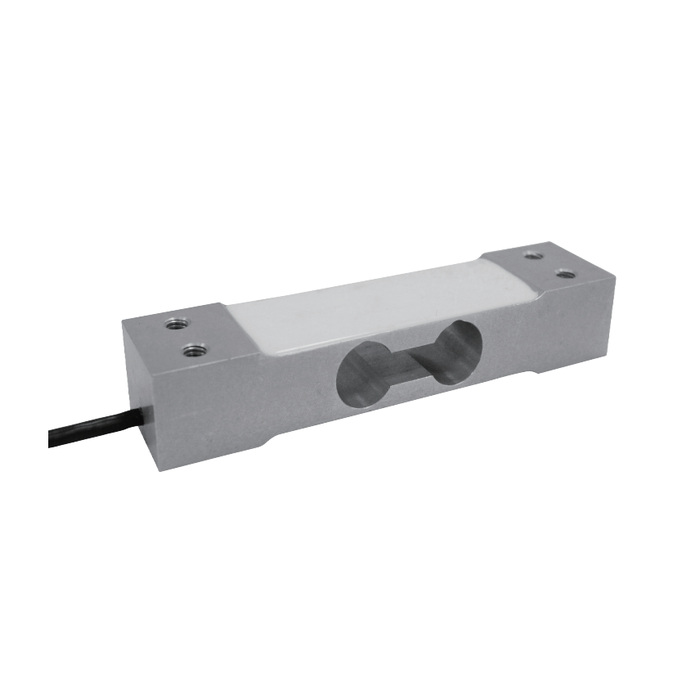
Choosing a single-point load cell for a small scale
A 5 kg display requirement is not enough information to choose a 5 kg sensor. Add the platform dead load and assess the largest load during filling, placement and cleaning. Then check whether the chosen reader and load cell can distinguish the smallest weight change required. The available data does not give an allowable platform size or an eccentric-load envelope, so submit the tray dimensions and load positions for confirmation.
| Item | Value | Use / fit |
|---|---|---|
| Capacity options | 2.5, 3, 5, 6, 8, 10, 15, 20, 30, 35, 40, 50 kg | Select one rating after including the platform dead load. |
| Rated output | 2.0 +/-0.2 mV/V | Sensitivity tolerance is not the installed scale accuracy. |
| Input / output resistance | 406 +/-10 / 350 +/-3 ohms | Verify the bridge reader can supply and measure this load cell. |
| Excitation | 4-12 V DC; maximum 15 V DC | Not a direct PLC voltage or current signal. |
| Creep, 30 minutes | +/-0.016% FS | Agree hold time where weighing includes a sustained load. |
| Working temperature | -30 to +70 deg C | Temperature range alone does not specify scale accuracy across it. |
| Ingress protection | IP65 | Do not assume the IP67 rating of other models in the family. |
Use the 120% overload figure correctly
The stated safe overload is 120% of full scale, while the destructive-load entry is 150%. Neither is an operating allowance. A dropped package can impose a transient load that is not described by its static weight. Review the loading method and any mechanical protection separately; do not set a universal overload-stop gap from these percentages.
Confirm the delivered cable before final calibration
The capacity table lists 2.5-50 kg, but the cable note associates a 2 m length with 50-500 kg. That mismatch prevents treating the cable note as a confirmed length for every capacity. Ask the quotation to identify the cable supplied with the selected rating. Complete wiring and cable routing before calibrating the assembled scale, and retain unloaded, loaded and corner-position readings.
MV-LC0224 is a smaller-envelope alternative to review, but its 1 mV/V output and 1000 ohm bridge require different compatibility checks.
Small-platform weighing questions
Q1. Does the catalogue C3 designation approve the complete scale?
No. A sensor classification does not establish approval of the finished weighing instrument. Where regulated weighing is involved, request applicable documentation for the supplied version and confirm the requirements for the complete scale in the intended market.
Q2. Why does the reading change when a package moves across the tray?
Investigate tray stiffness, contact with surrounding parts, mounting alignment and the permitted load-position envelope. Record position tests using the same reference load. Do not hide a mechanical contact problem by recalibrating only at the centre.
