


 Chinese
 Spanish
 Russian
 Portuguese
 French
 German
 Indonesian
 Thai
 Vietnamese
 Arabic
 Italian
 Turkish
 Polish
 Japanese


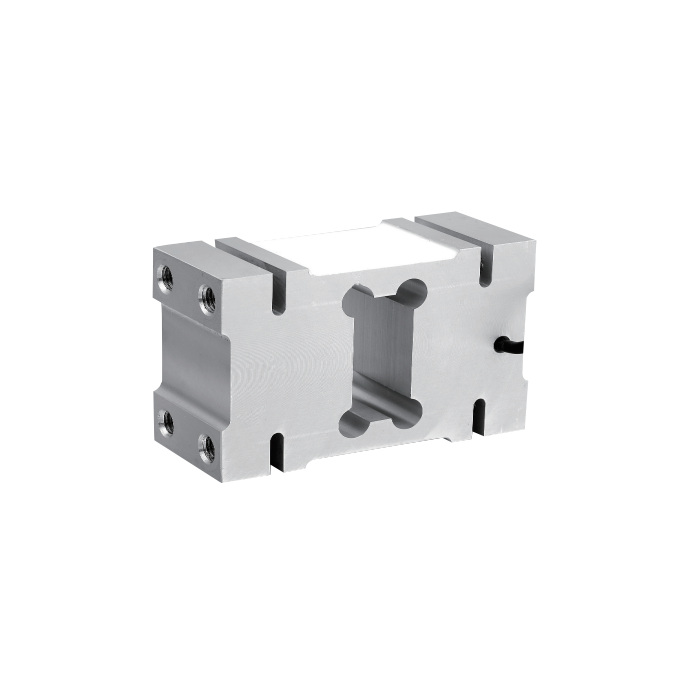
METRAVON MV-LC0215 is a high-capacity single-point load cell offered at 1000, 1500 and 2000 kg. Unlike a simple capacity change within an unchanged body, its product-family drawing groups dimensions and fixing threads by load range. Use the dimensional group that includes the ordered rating before designing the frame or approving a replacement.
Capacity-specific single-point load cell dimensions
For the 750-2000 kg dimensional group, which includes the three configurations offered here, the table gives H = 125 mm, H1 = 95 mm, L = 176 mm, B1 = 76 mm and B2 = 46 mm, with M16 x 2 fixings. The lower groups use different dimensions and M12 x 1.75 threads. Do not reuse their drawing values or adapters for a 1000-2000 kg order.
| Item | Value | Use / fit |
|---|---|---|
| Published ratings | 1000, 1500, 2000 kg | Confirm the complete gross supported load and selected version. |
| Applicable drawing group | 750-2000 kg | Use its dimensions, not the lower-capacity rows. |
| Fixing thread | M16 x 2 | Obtain the full drawing for engagement and attachment design. |
| Bridge input / output resistance | 406 +/-10 / 350 +/-3 ohms | Match excitation and measurement input before retaining a reader. |
| Excitation | 4-12 V DC; maximum 15 V DC | Not the supply of an amplified industrial sensor. |
| Catalogue total error | +/-0.02% FS | A sensor entry, not acceptance of the full platform. |
| Creep, 30 minutes | +/-0.016% FS | Define process hold duration and acceptable indication change. |
| Working temperature / ingress | -30 to +70 deg C / IP67 | Identify material choice and the final cable sealing arrangement. |
The frame must carry the load without bypassing measurement
Provide the receptor and base drawings, including supports, stops and any guides. The fixed and loaded attachment regions must perform their intended roles while the sensing section remains free to deform. Include receptor weight in the gross-load assessment. A heavier sensor rating does not establish an allowable platform footprint, which is not specified in the available table.
Confirm the high-capacity cable and reading device
The cable note associates a 2 m four-core cable with 50-500 kg and does not cover the configurations on this page. Obtain the cable length, termination and wiring information for the selected high-capacity unit. Its nominal output is 2.0 +/-0.2 mV/V, so a bridge instrument is required; the sensor rating does not imply an integrated industrial current or digital output.
Plan a practicable acceptance procedure before ordering
Specify the reference-loading method, the working load points and the positions that must be checked on the receptor. Include repeat loading and unloading, zero return and any required sustained-load test. Agree these checks while the quotation is reviewed so suitable loading equipment and access can be arranged. A calibration factor alone does not demonstrate the behaviour of the completed high-capacity platform.
For a lower 500-750 kg requirement, assess MV-LC0213 on its own mounting data rather than adapting the high-capacity dimensions.
High-capacity mounting questions
Q1. Can a lower-range unit be upgraded by increasing the indicator range?
No. The mechanical rating and capacity-dependent geometry do not change when the display is rescaled. The 1000-2000 kg group needs its matching mounting and an independent installation review.
Q2. Does the 750-2000 kg drawing group mean any rating can be ordered?
No. It identifies a dimensional group, not a continuous set of offered capacities. This page covers 1000, 1500 and 2000 kg configurations. Request a confirmed specification before selecting a different rating; the group label alone does not establish an orderable option.
Q3. What drawings are needed before the quotation can be approved?
Supply the load receptor and supporting frame, attachment locations, gross load, load positions and available access for installation and reference loading. Ask the quote to identify the selected-capacity drawing, cable configuration and calibration scope so those items are not left for site improvisation.
