


 Chinese
 Spanish
 Russian
 Portuguese
 French
 German
 Indonesian
 Thai
 Vietnamese
 Arabic
 Italian
 Turkish
 Polish
 Japanese


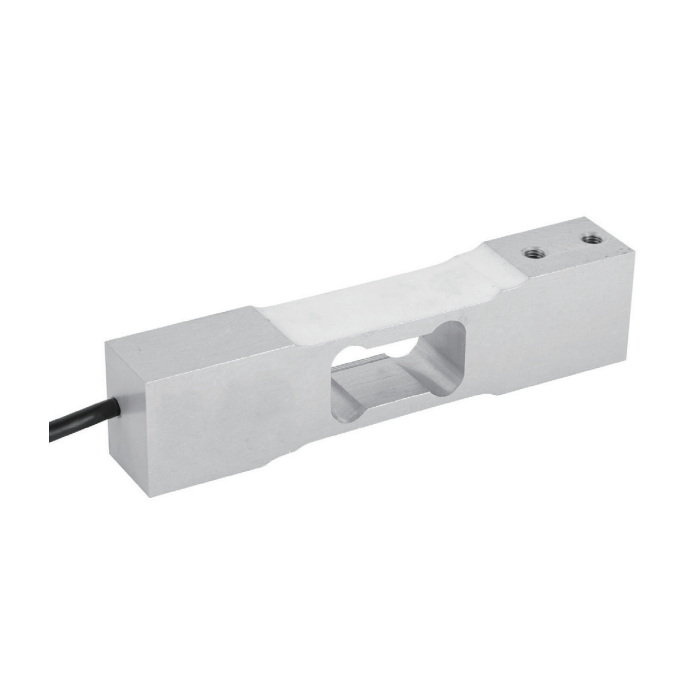
METRAVON MV-LC0216 is a single-point load cell with ten listed capacity options between 10 kg and 200 kg, including a 125 kg option. It is intended for bench or platform weighing with a defined base attachment and a separate loaded end. The sensor must carry the load receptor as well as the product; the required net display range alone does not determine the correct capacity.
Single-point load cell mounting: check both attachment faces
The outline shows a 150 mm length, 40 mm height and 25.4 mm width, with M6 fixing features. Review the attachment faces and screw engagement against the section drawing, not just the external dimensions. Keep the central sensing region clear of spacers and guards. A part that touches the moving end can divert some load away from the sensor without producing an obvious electrical fault.
Select a discrete capacity before setting the indicator range
The capacity list is not a software-adjustable range. Establish the receptor mass, the heaviest product and the way it is placed on the scale, then select the individual version. Ask for the permissible platform dimensions and load-position limits, which are not provided on the available sheet. A centre-loaded check is insufficient to approve an oversized tray.
| Item | Value | Use / fit |
|---|---|---|
| Listed ratings | 10, 15, 20, 30, 50, 75, 100, 125, 150, 200 kg | Include dead load when selecting the individual capacity. |
| Rated sensitivity | 2.0 +/-0.2 mV/V | Use actual calibration rather than a nominal 2 mV/V setting alone. |
| Input / output resistance | 406 +/-10 / 350 +/-3 ohms | Confirm the indicator supports the excitation load and differential input. |
| Excitation | 4-12 V DC; maximum 15 V DC | The output is a raw bridge signal, not a direct current loop. |
| Working temperature | -30 to +70 deg C | Check the required accuracy over the actual temperature cycle. |
| Safe overload | 150% FS | An overload limit does not extend the normal weighing range. |
| Ingress / construction | IP67; material option | Identify the ordered material and cable sealing details. |
Confirm cable length for the smaller ratings
The standard cable note states four-core, 2 m for 50-500 kg, whereas this model starts at 10 kg and stops at 200 kg. That note does not establish the cable supplied with the 10, 15, 20 or 30 kg versions. Identify the selected rating and the required cable route in the enquiry. Agree the final connection before calibration, particularly if an extension would otherwise be needed.
Separate scale calibration from sensor specifications
The catalogue total-error value is +/-0.02% FS and creep is +/-0.016% FS over 30 minutes. Neither entry defines the displayed division or guarantees a complete scale result. Calibrate after the load receptor and cable supports are installed, then record increasing loads, unloading, repeat placement and off-centre checks appropriate to the platform. Retain the setup conditions with the results.
MV-LC0217 has a similar nominal envelope but different bridge input resistance and overload limits; compare the selected drawings and electrical data before substitution.
Scale design and replacement questions
Q1. Can I reuse a platform built for another 150 mm load cell?
Only after comparing the attachment layout, supporting faces, height and available movement. Equal length does not establish the same hole pattern or load introduction. Send the frame and platform drawings with the old sensor drawing for a replacement review.
Q2. What should an enquiry include beyond maximum weight?
Provide the platform mass and dimensions, likely load positions, loading method, selected capacity and indicator model. Add cable routing and environmental exposure so the quotation addresses the assembly rather than just a sensor with a matching kg label.
