Chinese
 Spanish
 Russian
 Portuguese
 French
 German
 Indonesian
 Thai
 Vietnamese
 Arabic
 Italian
 Turkish
 Polish
 Japanese


Tank farm level inventory reconciliation turns many independent gauge readings into one defensible stock figure by comparing each tank over the same transfer window. Level error, density, temperature and transmission delay must be separated, not lumped. This article gives a multi-tank worked example and explains why floating-roof position must be distinguished from liquid-level gauging near the roof landing zone.
One transfer window, not one reading at a time
A tank farm level inventory reconciliation is only honest when every tank is read against the same clock window. Opening and closing stocks taken at different minutes, or a receipt logged before the sending tank is closed, let a few minutes of flow leak between the books and the gauges. Pick one window, stamp every reading with its time, and reconcile the net movement of the whole farm, not tank by tank in isolation. Where tanks report through different gateways, confirm the clocks are synchronised to one source before the window opens, because a gateway that drifts a few minutes silently reintroduces the very offset the window was meant to remove.
For each tank, use the current certified strapping table for that specific physical tank and keep its revision fixed across the opening and closing comparison. Different tanks normally have different tables and may have different revision numbers. Record the applicable tank identity and revision for every reading; do not require one shared revision number across the farm.
Separating the error terms
Most disputed inventories fail because the error terms were added together instead of examined separately. Tank farm level inventory reconciliation should list each term with its own source and magnitude, so the dominant one is fixed first. The table below separates the four terms that appear on a typical crude or product farm.
| Error term | Source | Typical magnitude | How it is separated |
|---|---|---|---|
| Level (gauge) | Level transmitter | ±0.02 m → ±14 m³ | Strapping table |
| Density | Lab or inferred | ±0.003 t/m³ | Separate mass calculation |
| Temperature | Volume correction | 0.6 % if ignored | Apply VCF to 15 °C |
| Transmission delay | Network or clock | up to 250 m³ | Time-align the window |
Magnitudes are typical reference values for a 30 m tank; confirm each against the current gauge specification and the product handling procedure before the reconciliation is signed. A custody-grade tank gauge is typically ±1–3 mm; ±0.02 m applies to a process radar transmitter.
Independent standard-uncertainty components may be combined in quadrature (root-sum-of-squares, RSS). Six tanks with a 0.02 m level contribution on a 707 m² cross-section give about 14.1 m³ each; the linear sum is about 85 m³ and the RSS is √6 × 14.1 = 35 m³. The RSS has an uncertainty interpretation only if the inputs are expressed on a consistent standard-uncertainty basis and correlations are addressed. A ±0.02 m maximum-error specification cannot simply be treated as one standard uncertainty. A 0.25 % closure tolerance on 20 000 m³ is 50 m³, but comparing these example figures alone does not establish acceptance or prove that a linear-limit alarm would be false.
The delay term stays out of that sum because it is common-mode: one clock offset moves every tank the same way, so it does not average down as tanks are added. Align the clocks, then combine the residual level, density and temperature terms as independent.
Assess correlation before combining uncertainty components. Shared instruments, common scaling errors or a density sample applied across the farm can create common contributions. Correct known biases and include the applicable covariance rather than assuming independence from different tank names. A conservative linear sum may be appropriate for a worst-case bound; partial correlation requires its own assessment.
A multi-tank reconciliation worked example
The example below is illustrative, based on assumed site values, and is not METRAVON measured data. It shows how the delay term dominates until it is closed, after which the level and density terms decide the residual uncertainty.
Assumed site values:
- Tank diameter, D = 30 m → cross-section area, A = 707 m²
- Gauge fill during window, Δh = 4.20 m
- Level error term, e_L = ±0.02 m
- Product density at 15 °C, ρ = 0.850 t/m³
- Temperature, 25 °C; volume correction factor, VCF = 0.994
- Transfer flow, q = 50 m³/min; max time misalignment, Δt = 5 min
Calculation:
- Gauge fill volume = Δh × A = 4.20 × 707 = 2969 m³
- Mass with VCF = 2969 × 0.850 × 0.994 = 2509 t
- If VCF ignored, mass = 2969 × 0.850 = 2524 t → error 15 t (0.6 %)
- Volume error from level term = A × e_L = 707 × 0.02 = ±14.1 m³
- Volume mismatch from delay = q × Δt = 50 × 5 = 250 m³
- Boundary: close the time-alignment first; a 250 m³ delay gap dwarfs the ±14 m³ level term, so the level accuracy is meaningless until the window is aligned.
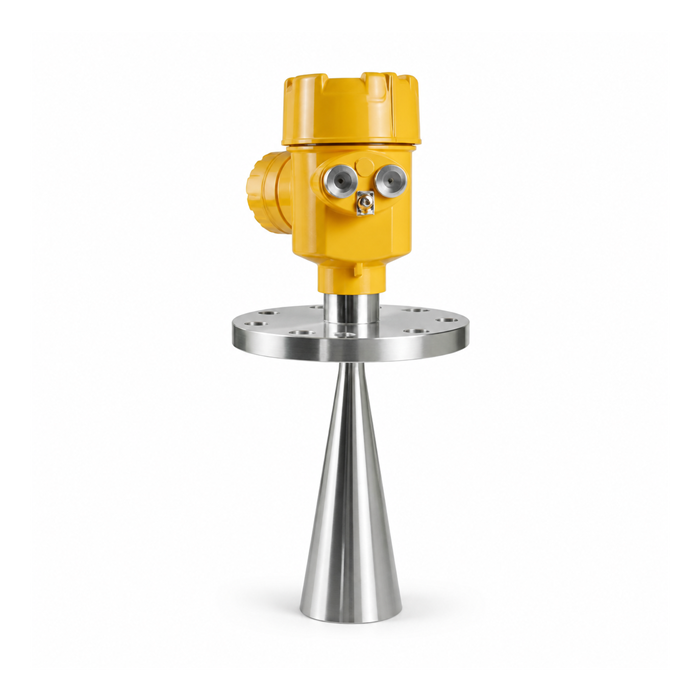
Density and temperature corrections
Two terms in tank farm level inventory reconciliation are physical, not instrumental, and they must be applied before the gauge error is judged. The product density at the reference temperature and the volume correction factor to that temperature together decide the mass, which is what most transfers are actually settled on. Ignoring the VCF, as the example shows, costs about 0.6 % of mass on a 10 °C warm product.
Apply the correction consistently across the farm: use one reference temperature, normally 15 °C, and one VCF source, and record the actual product temperature with each reading. A tank gauged at 25 °C but booked at the 15 °C density without the VCF will show a persistent apparent gain that looks like a leak but is only an unapplied correction.
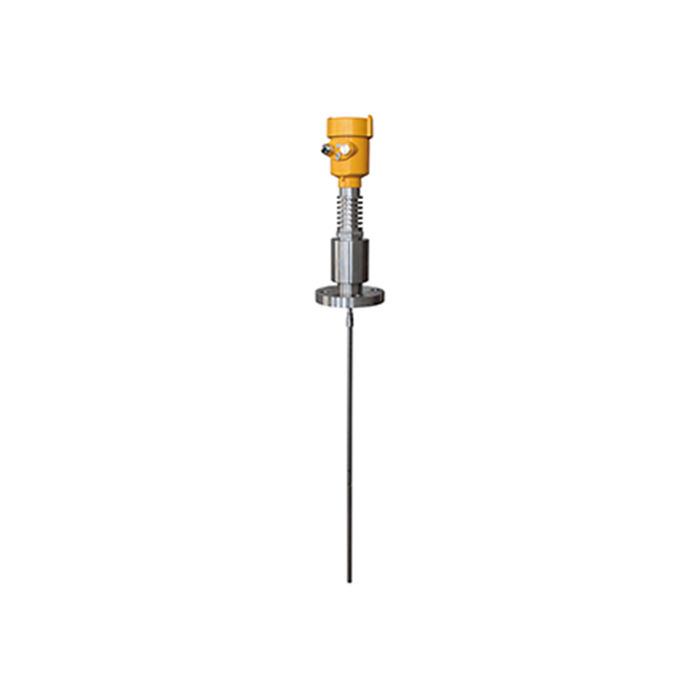
Internal floating-roof tanks: verify the roof landing zone and measurement path
For an internal floating-roof tank, establish the valid gauging range from the actual measurement path and the certified tank table. A device aimed at the roof measures roof position, not liquid level. A correctly installed liquid gauge using a suitable still-pipe is a different arrangement and is not automatically invalid whenever the roof lands. The following bands are illustrative site screening bands, not universal limits.
| Roof position | Measured level | Usable for stock? | Condition |
|---|---|---|---|
| Roof landed (bottom) | < 0.5 m | No | Roof-position signal is not liquid level; verify the actual liquid-gauge path |
| Roof floating | 0.5–11.0 m | Yes | Normal operating band |
| Near top rim | > 11.0 m | Caution | Seal and rim zone |
When the roof lands, apply the approved tank-specific landing-zone correction and gauging procedure. Reject a roof-position signal if it is being mistaken for liquid level. Do not automatically reject every liquid-level reading from a suitable still-pipe merely because the roof has landed. Verify upper-range restrictions against the actual gauge, seals and geometry, and record applicable limits with the tank table.
What to file with the reconciliation
The reconciliation is defensible only if the input data can be rebuilt by someone who was not present. File the window timestamps, the strapping revision number for every tank, the density and temperature used, and the gauge error term applied to each tank. Tank farm level inventory reconciliation that ships as a single total with no inputs cannot be audited when a discrepancy surfaces months later.
Keep the transmission-delay evidence too: the log that proves every reading was time-aligned to the window, not just "close enough". Store the set against the farm register by date, and retain the strapping revision with the figures it produced, because a later re-strapping changes the historical comparison unless the old revision is kept alongside the old numbers. A reconciliation that cannot be rebuilt from its own files will not survive an auditor's first question about where a discrepancy came from.

A reconciliation without its input files is an opinion, not evidence; bind the timestamps, revisions and corrections to the total before it leaves the control room.
FAQ
Q1. Why must all tanks share one transfer window?
The direct answer is that any time offset between readings lets flow leak between the books and the gauges, creating a phantom gain or loss. Stamp every tank reading with the window time and reconcile the farm net movement, not tank by tank. A few minutes of 50 m³/min flow is 250 m³, larger than the gauge error, so alignment comes before accuracy.
Q2. What is the biggest reconciliation error term?
The direct answer is usually transmission delay or time misalignment, not the gauge. In the worked example a 5 min offset gave 250 m³, while the level term was only ±14 m³. Close the window alignment first, then density and temperature, and only last the gauge error, because the larger terms hide the smaller ones.
Q3. Why apply a volume correction factor?
The direct answer is that product measured warm occupies more volume than at the 15 °C reference, so mass is overstated if you skip it. On a 10 °C warm product the VCF is about 0.994 and ignoring it costs roughly 0.6 % of mass. Apply one VCF source and record the actual temperature with each reading.
Q4. Is liquid-level gauging always unusable when a floating roof lands?
Roof position is not liquid level. Whether a reading remains usable when the roof lands depends on the gauge path, still-pipe arrangement, applicable tank-table corrections and site procedure. The illustrative 0.5 m landing band is not a universal invalid-liquid-level limit. Verify the actual arrangement before including or rejecting the reading.
Q5. How often should the strapping table be revised?
The direct answer is whenever the tank is re-lined, dented, or found discrepant at a gauging, and at the interval the plant procedure sets, commonly every 5–10 years. Keep the old revision with the old numbers, because a re-strapping changes historical comparisons. Use each tank's own current certified table and record that table's revision for each reconciliation.
Q6. Can I reconcile on volume alone without density?
The direct answer is only if the transfer is genuinely settled by volume, not mass, and the product temperature is stable. Most crude and product movements settle on mass, so density and VCF must enter. Reconciling warm product as volume without correction hides a 0.6 % term that later looks like a leak or theft.
SUMMARY
Tank farm level inventory reconciliation is defensible only when every tank is read in one time-aligned window, with each tank tied to its own current strapping-table revision, with density and VCF applied, where a 5 min delay gap of 250 m³ dwarfs the ±14 m³ level term. The next step is to verify each tank's roof-landing correction and valid gauging band before accepting the stock reading and bind the timestamps and revisions to the total.
Talk to a METRAVON engineer about this application
If you are building or auditing a tank farm reconciliation, send us the tank diameters, strapping revisions in use, and your transfer settlement basis (volume or mass). Our engineers will review the error-term separation, measurement paths and tank-specific floating-roof landing corrections for your tanks.