


 Chinese
 Spanish
 Russian
 Portuguese
 French
 German
 Indonesian
 Thai
 Vietnamese
 Arabic
 Italian
 Turkish
 Polish
 Japanese

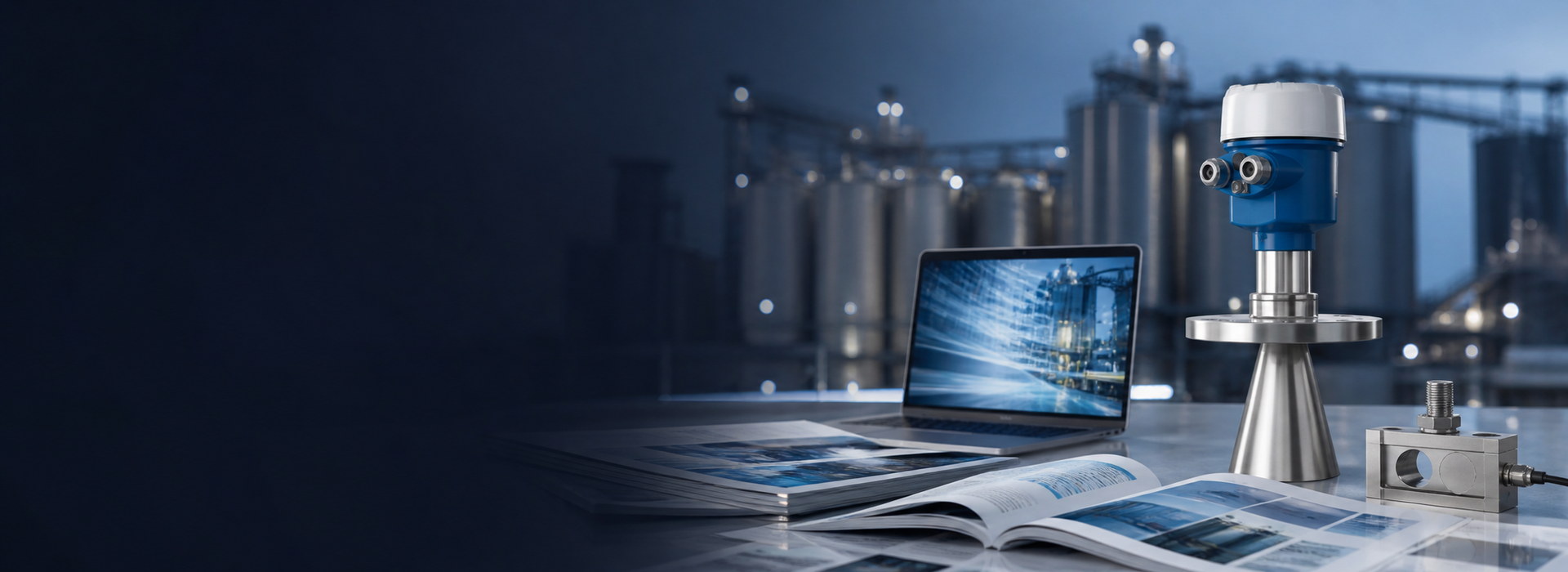
How much material sits in a silo can be answered in two different units, and the choice decides which error source you live with. Weighing with load cells or weigh modules reports mass directly but is disturbed by everything mechanically coupled to the silo. A radar level sensor reports the distance to the material surface and only becomes mass after you assume a bulk density. This article puts both methods on the same mass-error basis and gives a selection rule.
Two ways to know what is in a silo
Load cells sit under the silo supports and measure the total vertical force, which is mass under local gravity, independent of how the material is shaped inside. A radar level sensor mounted on the roof measures the empty distance to the surface and converts that to a fill height, then to a volume using the silo geometry. The two readings agree only when the bulk density used in the conversion equals the real bulk density of the stored material. They also fail for different reasons: weighing is corrupted by pipes, stairs and thermal strain tied to the structure, while radar is corrupted by dust, buildup and an uneven material surface. Neither is universally right, which is why the comparison has to be made in the unit the plant actually trades or controls in, namely mass.
The same inventory expressed as mass and as volume
The table contrasts the two principles on the quantities that matter for an inventory duty. It is a principle comparison, not a product selection, and the figures are typical engineering reference values to be confirmed against the data sheet for the actual silo.
| Aspect | Load cells / weigh modules | Radar level sensor |
|---|---|---|
| Measured quantity | mass (force) | distance to surface |
| Converted to inventory by | none | silo volume × bulk density |
| Dominant error source | support reaction, piping thrust | bulk-density assumption, surface shape |
| Unaffected by | dust, foam, dielectric constant | connected piping, thermal leg strain |
| Typical stock accuracy | ±0.5 % to ±2 % of mass; the 3.2 t thrust here puts the weighing error at 1.6 %, mid-band | ±1 % to ±5 % of mass after density |
The right-hand column shows why radar inventory is really a density problem in disguise: its accuracy is only as good as the bulk density you assign to the material sitting in the silo at that moment.
Worked comparison on one silo, two error sources
Consider one silo of internal diameter 6.0 m and height 18 m holding 200 t of material whose actual bulk density is 864 kg/m³ — 231.5 m³, a fill height of 8.2 m in the 6 m × 18 m silo. The transmitter is scaled with the catalogue value of 800 kg/m³. This is an illustrative calculation based on assumed site values, not a METRAVON measurement. Radar reads the level correctly, so it returns 231.5 m³, and converting with the assumed 800 kg/m³ gives an estimated mass of 185.2 t, an error of −7.4 %. Now assume a weighing system independently sized for the full gross load and support reactions. A connected conveyor introduces an additional vertical load equivalent to 3.2 t, so the total reads 203.2 t, an error of +1.6 %. Inputs (density shift, vertical-equivalent piping load) → conversion (volume×density, force sum) → results (−7.4 % radar mass, +1.6 % weigh mass). Boundary: the radar error grows with density variation, while the weighing error grows with mechanical coupling to the structure.
Where radar level loses accuracy
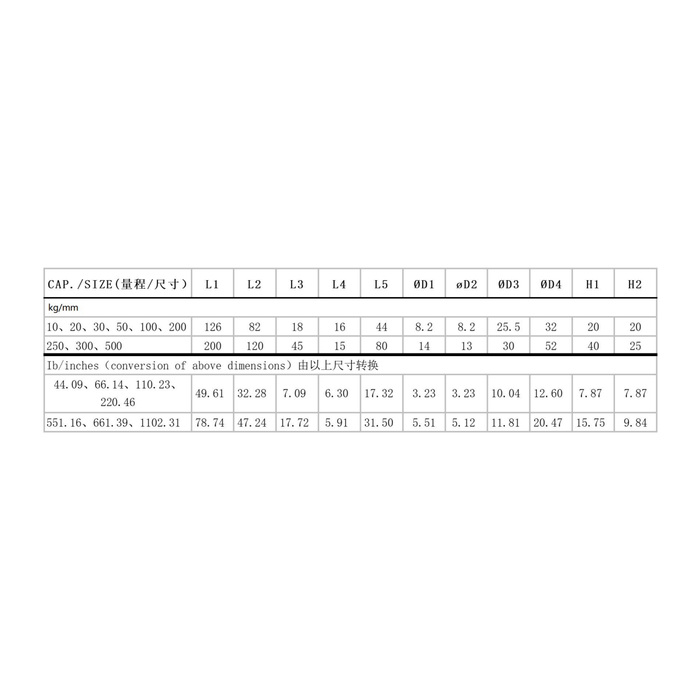
Radar inventory degrades whenever the bulk density is not stable or the surface is not a clean plane. Cement, fly ash and grain all compact or aerate, moving the bulk density by several percent between a loosely filled and a settled state, which the geometry calculation cannot see. A conical pile adds a volume bias set by the repose angle, quantified separately in our angle-of-repose note; here it is simply a second density-independent error term. Heavy dust on the antenna face and buildup on the wall also attenuate or false the return. For a duty where the reported mass must stay within about ±2 % and the material density swings widely, radar alone will not hold the tolerance, and a density input or a weighing backup is required.
The density assumption also needs an owner, because nothing in the level reading reveals that it has gone stale. Take a 1 L sample from three points across the fill, weigh it to ±1 %, note whether it is compacted or aerated, and reconcile the monthly stock figure against the feed and withdrawal mass balance. A persistent 2–3 % gap between the balance and the level-derived stock usually means the density input has drifted, not that the radar has failed.
Where load cells lose accuracy
Weighing degrades when forces other than the silo weight reach the cells. A rigidly connected inlet or discharge pipe, a stair or platform hung on the silo, or thermal expansion of one leg in sunlight all add or subtract apparent mass. Flexible connections and expansion joints are specified precisely to keep these reactions out of the load path, but they are often defeated by later piping changes on site. A silo that is not resting on a firm, level foundation can also bias the cell sum. For a legal-custody transfer where the mass must be defensible, the load-cell installation has to be reviewed as a structural problem, not just an instrument problem, and the flexible connections must be verified during the acceptance load test.
Selection rule and a duty checklist

The selection rule is a single question: which error source is smaller for this silo? Radar holds the tighter figure only while the density swing stays below the thrust-to-mass ratio. On this silo that is 1.6 %, so use ±2 % as a generic screening limit and compute the actual break-even per silo. Where the density is stable and the surface reasonably flat, radar gives volume inventory at low installed cost with no structural work; where the density swings or the duty is mass custody, load cells win provided the mechanical isolation is done properly.
The two sources can be compared directly, which turns the rule into arithmetic. Radar mass error is roughly the bulk-density error plus the level and geometry error; load-cell mass error is the sum of the parasitic forces divided by the true mass. They break even when the density swing, in percent, equals the thrust-to-mass ratio. On the 200 t silo, 3.2 t of thrust is 1.6 %, and the observed swing was 8 %, which settles the choice in favour of weighing. Input (3.2 t thrust, 200 t mass, 8 % density swing) → conversion (F/m against Δρ/ρ) → result (1.6 % versus 8 %). Boundary: the comparison is only as good as the thrust estimate, so every connection must be surveyed before a load-cell order.
The checklist below turns that into a site decision.
| Site condition | Preferred method | Reason |
|---|---|---|
| Stable bulk density, no piping on silo | radar level | low cost, no structural change |
| Density swings beyond the computed break-even | load cells | mass independent of density |
| Rigid connected pipework | radar level | avoids piping thrust error |
| Legal mass custody | load cells | direct force, defensible |
| Hazardous or inaccessible roof | load cells | Roof access impossible for radar; weigh modules work at the support level, outside the silo interior. |
When both matter, a hybrid using radar for level alarm and load cells for inventory is defensible, but the two must be reconciled on a common mass basis at commissioning.
FAQ
Q1. Why is radar silo inventory really a density problem?
Because radar measures distance to the surface and only becomes mass after you multiply the volume by a bulk density. If the real density differs from the assumed value, the mass is wrong even though the level is right. A +8 % density error gave a −7.4 % mass error in the worked example, so density stability decides radar suitability.
Q2. Are load cells always more accurate than radar?
No. Load cells avoid the density problem but pick up any force coupled into the silo through pipes, platforms or thermal strain. In the worked example a 3.2 t piping thrust on a 200 t silo gave +1.6 % error. Proper flexible connections are what make load cells accurate, not the cells alone.
Q3. Can I use radar for custody transfer of solids?
Only if the bulk density is stable and documented, and the surface shape is controlled, because radar reports volume that you convert to mass. For legal custody where mass must be defensible, load cells or a belt scale in the feed line is the usual choice, with radar kept for level alarm duties.
Q4. What surface shape hurts radar the most?
A steep conical pile under a centre antenna overstates or understates the average volume by an amount set by the repose half-angle and the fill height. A side-mounted or multiple-beam arrangement reduces the bias, but a strongly varying angle of repose still defeats a single point reading and needs density reconciliation.
Q5. How do I stop piping from corrupting the load cells?
Use flexible connections and expansion joints on every pipe that meets the silo, and keep stairs and platforms structurally separate. Verify during the acceptance load test that removing or flexing a connection changes the cell reading by less than the tolerance, because later site modifications often defeat the original isolation.
Q6. Is a hybrid radar-plus-load-cell system worthwhile?
It is, when level alarm and mass inventory have different accuracy needs. Radar gives a cheap high-high alarm and continuous level, load cells give defensible mass. The two must be reconciled to a common mass at commissioning so the alarm and the stock figure do not contradict each other during operation.
SUMMARY
Silo inventory is a choice between error sources: in the worked example a +8 % bulk-density swing gave radar a −7.4 % mass error while a 3.2 t piping thrust gave load cells a +1.6 % mass error. Next, send us the silo diameter, material bulk-density range and whether pipework is rigidly connected, and our engineers will state which method meets your stock-tolerance.
Talk to a METRAVON engineer about this application
If you are deciding between weighing and a radar sensor for a silo, send us the silo dimensions, the material and its bulk-density range, and a note on any connected pipework. Our engineers will compare the two error sources for your duty and recommend the method that keeps inventory inside tolerance.
