


 Chinese
 Spanish
 Russian
 Portuguese
 French
 German
 Indonesian
 Thai
 Vietnamese
 Arabic
 Italian
 Turkish
 Polish
 Japanese


Remote tank and silo monitoring should tell an operator both the measured value and when it was acquired. A number that remains unchanged after a network outage is not proof of a stable process. Design the data path so a current measurement, an invalid sensor and an old stored sample remain distinguishable.
Remote Tank and Silo Monitoring: Define the Record
Give every measurement a site and vessel identifier, engineering unit, acquisition time and validity state. Keep acquisition time separate from server receipt time. If the platform calculates volume or stock, retain the original level and the applicable conversion version instead of uploading only a derived percentage.
The field instrument determines what the value means. A liquid radar observes a surface distance; a solids radar observes a region of a changing pile. The communications system should preserve that meaning rather than presenting every vessel as an equally accurate inventory gauge.
Build a Channel Schedule for TG501
The METRAVON TG501 data acquisition RTU lists three analogue inputs, two digital inputs and one RS485 port. Its two listed RS232 ports include a debug connection, so they should not both be allocated to permanent field devices without the version-specific wiring information.
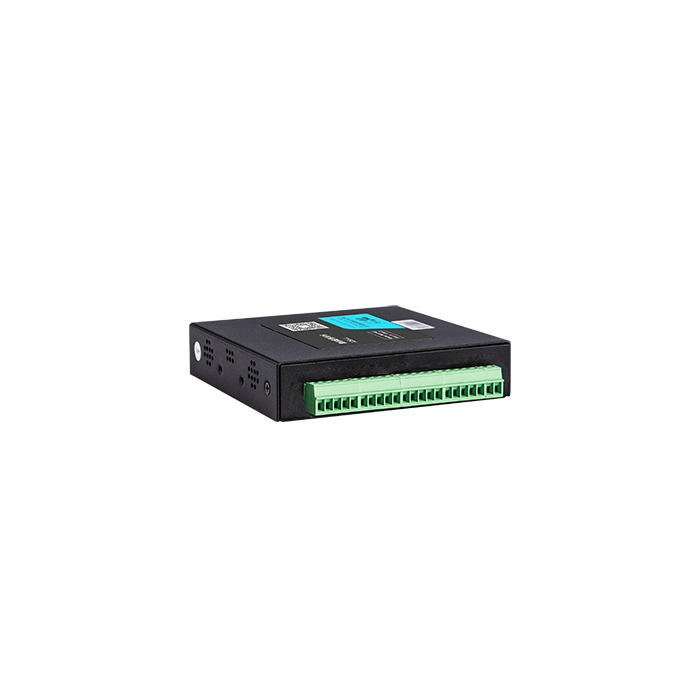
For 4-20 mA, confirm the input range, loop supply and isolation arrangement. For RS485/Modbus RTU, confirm device addresses, serial settings, register types, scaling and timeout behaviour. A compatible connector or protocol name does not prove that the configured data is correct. Check each field value through to the platform.
A silo using MV-RD21 needs the ordered radar output matched to that schedule. Choose the serial electronics where serial acquisition is required; a two-wire analogue/HART unit should not be assumed to provide RS485.
Test Failure and Recovery as Separate Events
| Event | Field check | Platform check |
|---|---|---|
| Sensor fault | RTU receives or detects an invalid measurement. | Invalid is distinguishable from a healthy unchanging value. |
| Network loss | Approved local functions continue and records follow the agreed policy. | The last update time and stale state are visible. |
| Reconnection | Current data and stored records are transmitted as specified. | Historical samples retain their original times without duplicate counting. |
| Power return | Clock, configuration and stored-data recovery are checked. | Any gap is identified rather than filled with apparently measured values. |
TG501 lists 16 MB of storage and retransmission functions. Those facts do not establish a fixed number of outage days. Agree on record size, enabled channels, logging interval, reserved capacity and full-buffer behaviour, then verify the required outage duration with the supplied firmware and configuration.
On reconnection, a historical high-level event must not appear as a newly occurring alarm merely because it has just arrived. Preserve the event time, receipt time and acknowledgement state. Define which alarms need an on-site response and who verifies closure; successful notification delivery is not proof that the field condition has been resolved.
Keep Immediate Control and Station Protection Local
Do not make a remote dashboard the sole path for a time-critical pump or filling stop. The plant's approved local controller and protective arrangement must handle those duties during network or platform failure. Optional RTU outputs are not evidence of a qualified protective controller.
TG501 has an IP30 housing, so an exposed outdoor installation needs a suitable cabinet and provisions for moisture, temperature, surge protection and power. Select the cellular module for the destination network and operator; regional band support must be confirmed for the ordered version. Review access permissions and the supported secure communications arrangement with the site's network owner.
Monitoring-System Questions
Q1. Can a short modem disconnect prove the required storage period?
No. It checks reconnection, not full retention. Test the agreed logging configuration and enough records to verify capacity, overflow behaviour and recovery. Include a power interruption if records must survive one.
Q2. Should every restored sample generate an alarm notification?
Only according to the agreed event policy. Historical alarms need their original timing and status, while the operator also needs the current condition. Test duplicate suppression and acknowledgement handling rather than assuming the server infers them.
Q3. What belongs in an RTU quotation request?
Include a channel list, sensor output details, register maps, logging and upload intervals, outage requirement, network destination and power source. State cabinet and commissioning responsibilities so the offer covers a working monitoring station rather than just a terminal.
Summary
Useful remote monitoring preserves measurement identity, freshness and outage history without weakening local control. Request a TG501 channel and recovery review with the field-instrument list and receiving-platform requirements. Accept the complete data path only after testing both normal operation and the specified failures.
