


 Chinese
 Spanish
 Russian
 Portuguese
 French
 German
 Indonesian
 Thai
 Vietnamese
 Arabic
 Italian
 Turkish
 Polish
 Japanese


Oil tank radar level measurement needs a defined product and a defined duty. A light product with a weak surface return, a crude oil that leaves deposits and a tank with floating structures present different measurement paths. A general liquid radar should not be selected from tank height alone or described as a complete commercial gauging system.
Oil Tank Radar Level Measurement at the Lowest Operating Level
Check the longest distance from the antenna to the product, not just the distance during a convenient mid-level test. Low-reflectivity liquids can produce a less distinct surface return, and bottom or internal reflections may then compete with it. Save the echo at an independently established low level before deciding that a stable display represents the liquid.
The METRAVON MV-RD13 uses a 76 mm PTFE lens and a listed 3-degree beam. Its 30 m and 150 m range choices do not establish a guaranteed measuring distance for every hydrocarbon. Submit product properties, operating distances and tank geometry so the proposed configuration can be assessed for the required return.
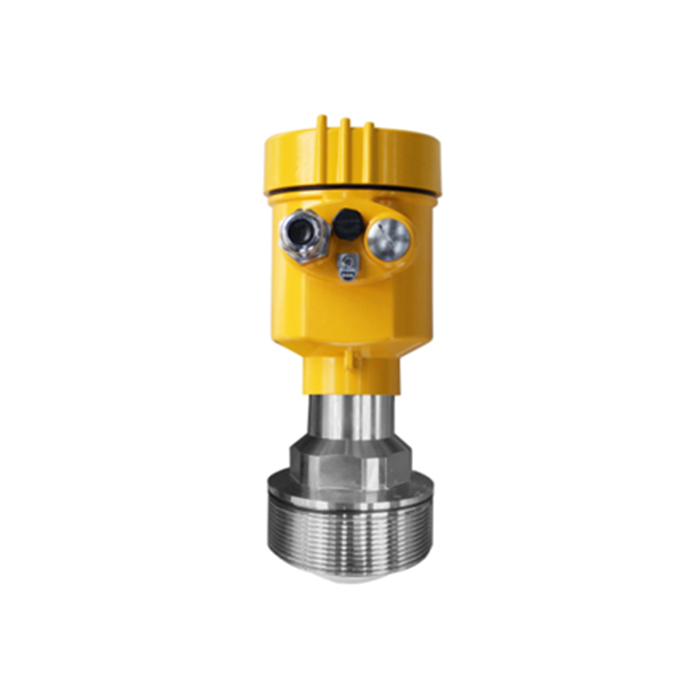
Review the Roof and Internals Before Reusing a Nozzle
| Feature | Check | Implication |
|---|---|---|
| Fixed roof | Nozzle, braces, coils and the filling stream. | The complete path must remain useful down to low level. |
| Floating roof | What physical surface lies beneath the antenna throughout travel. | A roof reflection must not be labelled liquid level without an approved method. |
| Stilling pipe | Bore, joints, slots, straightness and deposits. | Pipe installation requires a specific assessment, not a free-space assumption. |
| Water bottom | The separate method for identifying the oil-water boundary. | Top-surface radar alone does not establish net oil volume. |
Include the closest permitted surface and the specified near-field limit. A long adaptor may improve mechanical fit while moving the antenna into an unsuitable recess. Review process materials and the complete pressure-temperature rating as part of the same assembly decision.
Distinguish Operating Level, Protection and Accounted Quantity
An operating level signal can support transfer control. Independent overfill protection, where required by the site's design, has its own equipment, independence and testing requirements. Do not credit two PLC thresholds derived from the same transmitter as independent measurements.
For a calculated inventory, use the approved tank table and the relevant temperature and density basis. Identify any water-bottom or roof-related corrections that the selected method requires. Retain raw level so a calculation error can be investigated separately from instrument behaviour.
If the quantity is intended for commercial settlement, establish the requirements for the entire accepted measurement system. Neither a nominal radar distance accuracy nor an additional decimal place on the inventory display demonstrates that status.
Make the Order Conditional on the Required Evidence
Provide the site's hazardous-area classification and required documents for the exact instrument, protection method, entries and installation. Do not infer suitability from a metal housing or a generic product-family statement. Confirm fluid and vapour compatibility of all exposed materials and seals as well.
Agree on the commissioning observations before procurement: low-level return, filling behaviour, normal settled operation and receiver fault handling. Keep the test within the site's approved operating and protection arrangements. A water-only test may establish scaling without resolving hydrocarbon echo performance.
Oil-Storage Questions
Q1. Will changing oil density move the measured distance?
Radar distance is not calculated from density. Density belongs in a mass conversion. A product change can nevertheless alter reflection, coating or surface behaviour, so inspect the raw measurement and calculation separately rather than assigning every discrepancy to one cause.
Q2. Can an existing stilling pipe be retained?
Only after its geometry and condition are reviewed for the selected antenna and configuration. Provide the pipe drawing, joints and openings, not just nominal diameter. A pipe accepted for another technology or antenna is not automatically suitable for MV-RD13.
Q3. What should a replacement quotation identify?
It should identify the process connection, lens, near and far limits, electronics, required area documentation and the accepted measurement duty. List tank-table work and inventory integration separately so a transmitter replacement is not mistaken for a complete gauging-system upgrade.
Summary
Prove the intended liquid target at the weakest operating condition and keep each use of the reading explicit. Request an oil-tank radar review with the product range and tank section. Confirm documentation and acceptance conditions before treating the signal as an operational or inventory input.
