


 Chinese
 Spanish
 Russian
 Portuguese
 French
 German
 Indonesian
 Thai
 Vietnamese
 Arabic
 Italian
 Turkish
 Polish
 Japanese

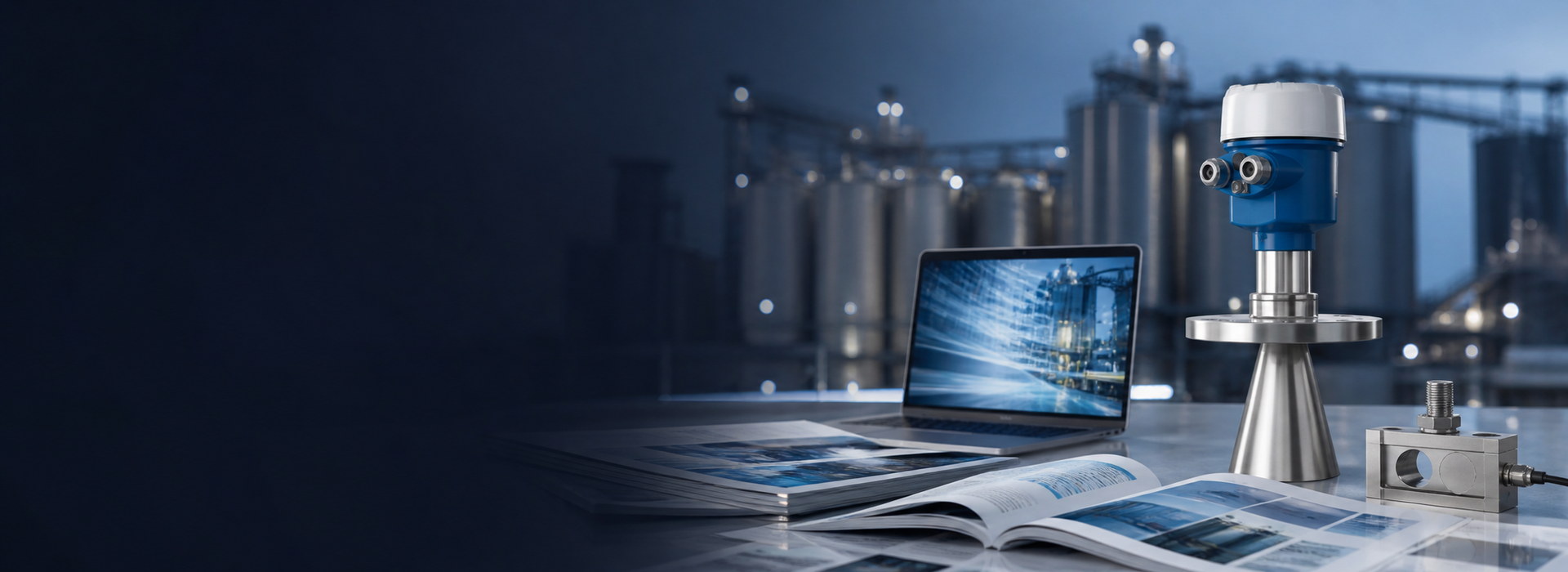
Radar vs Laser Level Sensor: Beam Width Against Dust
Laser and radar instruments can both measure non-contact distance, with pulsed or other implementations depending on the model. Optical instruments can offer a small target spot; radar can be useful where an optical path is difficult. Compare actual beam patterns, surfaces, atmosphere, process ratings and diagnostics rather than assuming every laser stops at dust or every radar reports the first return.
The geometry, in numbers
Use the published full beam angle or divergence for the selected instrument. For a simple conical envelope, spot diameter at distance d is approximately 2d tan(theta/2). The following assumed angles illustrate geometry; they are not specifications for all lasers or radar antennas.
| Assumed full beam angle | Diameter at 10 m | Diameter at 30 m | Diameter at 60 m |
|---|---|---|---|
| 0.1 degree | 17 mm | 52 mm | 105 mm |
| 4 degrees | 0.70 m | 2.10 m | 4.19 m |
| 10 degrees | 1.75 m | 5.25 m | 10.50 m |
A small spot can help separate a target from nearby structures. Check the opening, instrument position and all obstructions at their own distances. A spot-size calculation alone does not prove clearance through a nozzle or establish that a radar cannot find a usable path.
The smaller spot can be useful around silo internals or a narrow measuring region. Reflectivity, surface angle, dust and the actual mounting still need validation.
Optical-path conditions to assess
Dust, mist, deposits and condensation can attenuate an optical path or produce competing returns. Performance depends on optical depth, wavelength, detector and processing, so there is no universal first-dust-cloud failure rule.
| Condition | Optical review | Radar review |
|---|---|---|
| Dust during filling | Actual attenuation and competing returns | Antenna, dust, deposits and tracking |
| Mist or condensation | Path and window condition | Vapour, antenna film and target evidence |
| Clear or reflective liquid | Surface detection versus bottom or structural returns | Actual surface reflection and interference |
| Foam or crust | Required measured boundary | Required measured boundary |
| Ambient light | Published limits and tested geometry | Not dependent on illumination, but still needs suitable signal |
| Deposits or damage | Window condition and approved maintenance | Antenna/seal condition and approved maintenance |
Two rows are worth particular attention because they are counter-intuitive.
Clear liquids. Some optical arrangements can see a lower or bottom return, while purpose-designed laser level instruments can measure clear-liquid surfaces. Confirm the selected model and target. A falsely long distance normally converts to a falsely low level when level equals reference height minus distance; it does not inherently report full.
Dust. Test during the actual filling condition, not only between fills. A purge may keep the window clean but cannot automatically remove attenuation through the whole vessel. Suitable radar designs, including 80 GHz bulk-solids instruments, should also be compared.
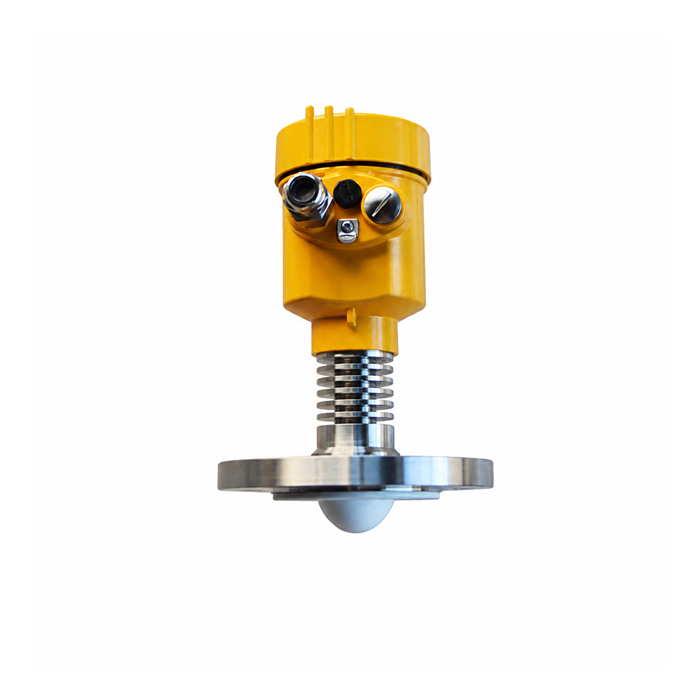
Where laser is the better instrument
Despite the dust problem, laser has a real and growing place, especially with 3D scanning heads that map a whole silo surface rather than a point.
- Large silos with difficult internals. Compare an optical small-spot path with the available radar antenna patterns and possible mounting positions; neither principle is excluded by tank height alone.
- Surface profiling. A suitable scanning system can estimate a surface map and volume, subject to visibility, coverage, geometry and validation. A map does not by itself guarantee inventory accuracy.
- Long range with a small opening. Check actual optical range, target reflectivity, alignment and aperture; do not infer a guaranteed range from the technology label.
- Solids at a steep angle. Return depends on roughness, reflectivity, incidence angle and the instrument. Validate the relevant filling and discharge surface rather than assuming every rough slope is measurable.
- Emissions and optical safety. Check the regulations and approval conditions for the actual installation. An optical instrument also has laser-safety and potentially hazardous-area requirements.
Where radar is the better instrument
Radar can be an appropriate alternative where optical-path reliability is insufficient, provided its own signal and process requirements are met.
- Dust, steam and vapour. Assess the actual atmosphere and model. There is no universal 26 GHz pass versus 80 GHz fail rule.
- Liquids. Suitable radar and optical models can measure particular liquid surfaces. Assess the actual reflection and false-target risks for each.
- Weather-exposed installations. Review rain, ice, deposits, sunlight, access and mounting for either system. Antenna shape does not make a radar automatically self-cleaning.
- Condensing atmospheres. Verify whether the approved window or antenna arrangement remains usable; any heating or purge must be compatible with the process and ratings.
- Hazardous area. Obtain the certificate and conditions for the exact optical or radar assembly. Do not assume that one product family has every required approval.
| Comparison item | Evidence for either instrument |
|---|---|
| Range and accuracy | Selected model, target and reference conditions |
| Beam and clearance | Published pattern plus vessel drawing |
| Process atmosphere | Test over the required worst conditions |
| Cleaning | Approved method and observed interval |
| Safety and approvals | Actual laser class, Ex scope and local requirements |
| Cost | Current compliant installed scope |
Check the laser classification and instructions for the complete instrument, including maintenance conditions and any optical aids. Class 1 describes defined accessible-emission conditions, not safety under every conceivable use or modification. Apply the required site risk controls for the actual class.
The retro-reflective problem
An optical instrument may encounter competing returns from shiny surfaces, structures or a lower boundary. Its selection logic and available diagnostics are model-specific; it does not universally report only the first or strongest return.
Radar can also track a wrong reflector. Compare the actual diagnostic and suppression capabilities of the proposed models, and verify the intended target after any change. No suppression setting replaces a valid measuring path.
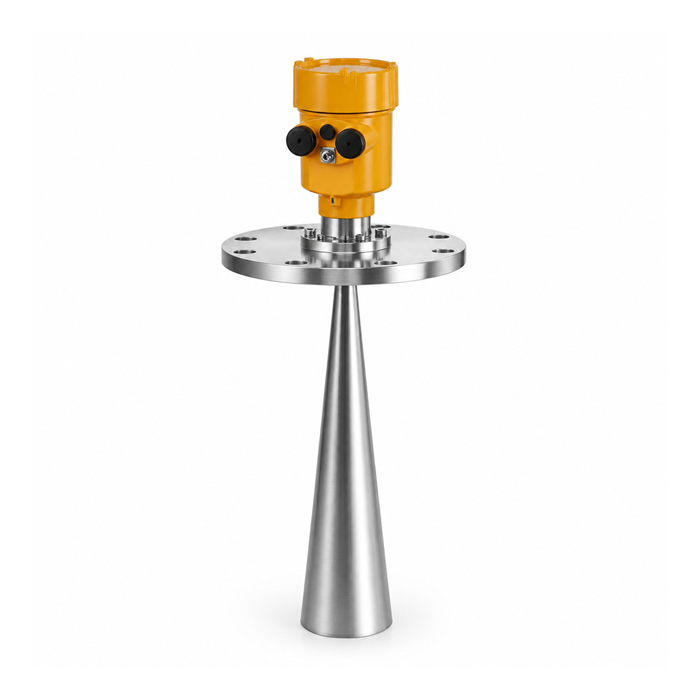
Cost, and where the crossover is
Compare current quotations for instruments that meet the same duty, including access, mounting, cleaning, testing and required documentation. A universal optical-to-radar price ratio is not a reliable budget.
Use site dust and maintenance evidence in the lifecycle comparison. Do not assume that a purge makes an opaque path measurable or that either technology has a fixed cleaning frequency.
Frequently asked questions
Q1. Can a laser level sensor measure through dust?
Some dust conditions are measurable and others attenuate or confuse the optical signal. Validate the actual model during filling. Purpose-suitable radar, including 80 GHz models, also needs dust and deposit assessment.
Q2. Can a laser select a bottom return in a clear-liquid tank?
It can in an unsuitable arrangement, while some laser models are designed for clear-liquid surface detection. A bottom return gives a longer distance and normally a lower calculated level; check the actual output mapping and selected target.
Q3. Is a laser level sensor safe for eyes?
Use the actual classification and manufacturer instructions, including maintenance and optical-aid restrictions. Do not infer safety or required controls from range alone.
Q4. Which is more accurate, laser or radar?
Compare selected-model specifications and the installed reference uncertainty. A radar footprint is not necessarily a simple average of all surfaces within it, and a small optical spot does not by itself establish better absolute accuracy.
Q5. Can a laser measure the level in a cement silo?
A suitable model may work if visibility, deposits and surface return remain acceptable. Test during filling and discharge and compare appropriate alternatives; frequency alone does not determine the outcome.
Q6. Does a laser work in a vacuum?
Optical and radar propagation do not require a gas medium. Their complete process assemblies must still be rated for the vacuum and other operating conditions, and any window or target effects must be assessed.
