


 Chinese
 Spanish
 Russian
 Portuguese
 French
 German
 Indonesian
 Thai
 Vietnamese
 Arabic
 Italian
 Turkish
 Polish
 Japanese


Cement silo level measurement is most demanding during pneumatic delivery, when the operator needs a usable indication while dust, falling powder and aeration change the surface. A reading obtained after the silo has settled is useful for inventory trending, but it does not prove that the same installation can support the filling decision.
Compare the antenna and opening before comparing frequency
The METRAVON MV-RD21 uses a 76 mm PTFE lens with a nominal 3-degree beam. The MV-RD903 uses a horn, with published 96 mm/8-degree and 121 mm/6-degree options. These differences affect clearance through the roof opening and the structures illuminated at depth; they do not establish a universal winner for every cement or fly-ash silo.
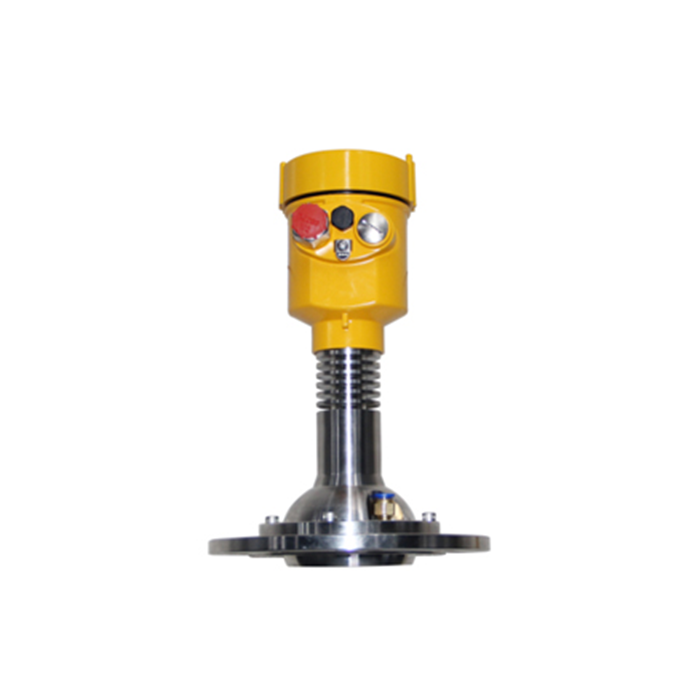
Check the empty distance and the closest permitted material distance separately. The published MV-RD903 distance range starts at 0.6 m; its horn position must therefore be included in the headroom review. MV-RD21 has different range configurations, so use the reference plane and near limit of the ordered assembly rather than copying the old transmitter scale.
Test cement silo level measurement during delivery
| Stage | Record | What it reveals |
|---|---|---|
| Before filling | Known level, raw distance and echo | Establishes a baseline without the powder stream. |
| Delivery | Signal validity and trend near the inlet | Shows whether dust or incoming material disrupts the usable return. |
| Settling | Level after delivery has stopped | Separates a real change in powder packing from a sensor offset. |
| Discharge | Surface change above the outlet | Checks whether the chosen location remains representative as a valley forms. |
Keep the inlet, vent, filter, ladders and braces visible on the installation drawing. A narrow beam still spreads with distance, and the falling stream can move into the measuring path as the pile grows. Review the full fill range, not just the space immediately below the flange.
Separate level error from stock-conversion error
Aerated powder can occupy more space than the same material after settling. Fly ash and cement also need their own density assumptions. Consequently, a stable radar distance specification cannot be used as a percentage accuracy for tonnes in storage.
For stock reconciliation, preserve the raw level history and compare weighed receipts over several fill and discharge cycles. If the discrepancy changes after settling, investigate the volume and density model before changing the radar offset. An offset that forces agreement with one delivery may worsen the next one.
Delivery and maintenance questions
Q1. Can the continuous radar replace the existing high-level switch?
Not solely because both indicate level. Filling shutdown needs a review of independence, fault response and the consequences of a missed alarm. Retain the approved protection arrangement unless the responsible engineer has validated a replacement design.
Q2. Should a noisy trend be smoothed until it stops moving?
First compare the echo with the delivery record. Filtering can hide short disturbances, but it also delays detection of a rising level. Accept a setting only after checking response near the operating limit at the relevant filling rate.
Q3. What makes two radar quotations comparable?
Require each offer to identify antenna size, nozzle arrangement, distance configuration, thermal limits and output. Add commissioning access and the receiving system's fault handling. A price attached only to a frequency and maximum range omits several installation costs.
Summary
A useful powder-silo specification includes delivery conditions and a separate definition of inventory performance. Send the silo section, fill-line position and required PLC interface for a METRAVON configuration quotation; compare MV-RD21 and MV-RD903 against that same installation.
