


 Chinese
 Spanish
 Russian
 Portuguese
 French
 German
 Indonesian
 Thai
 Vietnamese
 Arabic
 Italian
 Turkish
 Polish
 Japanese


Grain and feed silo level monitoring is most useful when it answers an operational question: can another delivery fit, is enough usable material available for production, or has discharge stopped unexpectedly? One surface reading cannot answer all three reliably without information about the pile and the equipment moving the material.
A Full-Looking Silo Can Still Starve a Feeder
A bridge or a narrow flow channel can leave substantial material above an empty outlet region. Radar may correctly report that upper surface while the feeder receives little or nothing. Treat a high level with absent discharge as a process discrepancy, not immediate proof that the sensor is faulty.
Compare the commanded gate and feeder states with the available flow, weighing or downstream process evidence. Motor current alone may not prove delivery in every machine. Choose evidence appropriate to the feeder and consequence, and leave blockage investigation to the site's approved isolation and material-handling procedures.
Grain and Feed Silo Level Monitoring for Daily Decisions
| Decision | Needed input | Limitation |
|---|---|---|
| Receive | Free space at the credible pile peak and incoming delivery quantity. | Average estimated inventory may miss a local high point. |
| Reorder | Usable stock, expected consumption and replenishment time. | Material above a bridge is not necessarily usable stock. |
| Run a batch | Ingredient identity and the designated batch weighing result. | A level percentage does not establish recipe mass. |
| Clear a fault | Actual discharge evidence and verified equipment state. | A stable surface does not confirm that a blockage has cleared. |
Match the Ambient-Temperature Model to the Actual Silo
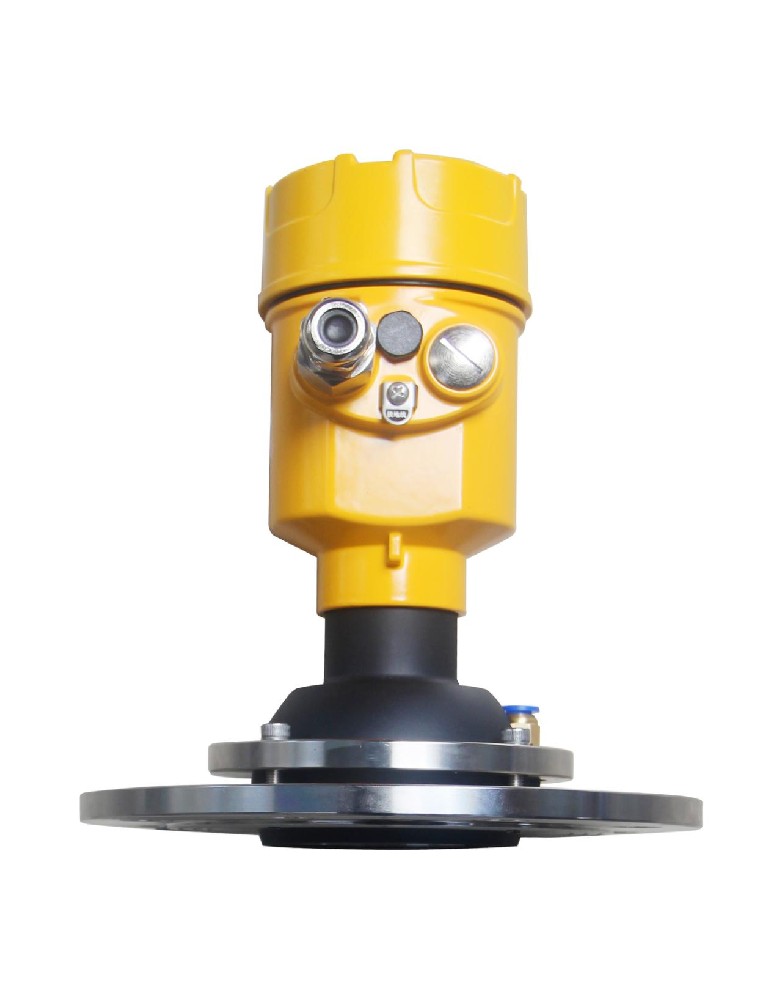
The METRAVON MV-RD21S provides an 80 GHz bulk-solids measurement with a PE lens. Its model limits include a process temperature up to 80 deg C. Range options are 0.1-30 m and 0.3-150 m; the relevant near and far distances must fit the ordered configuration, including the antenna height above the roof.
Show the filling spout, outlets, ladder and roof supports on the layout. Select a point that remains useful as a peak becomes a discharge depression. The 3-degree beam improves spatial selectivity but cannot convert that local measurement into a complete surface survey.
Grain dust and the site's area classification require their own equipment review. Ask for documentation for the exact ordered version, cable entries and installation conditions. An enclosure IP rating is not evidence of dust-explosion approval. Also review process-facing cleanliness and permitted maintenance methods where they affect the stored feed or grain.
Use Weighed Movements to Check the Inventory Estimate
Record a defined pre-delivery state, the weighed receipt and a comparable post-delivery state after material movement has settled sufficiently for the chosen method. During use, compare the estimated change with batch or dispatch quantities over the same interval. Retain grain type, moisture information where available, and the density assumption used.
Do not reuse one conversion factor blindly after switching to a different feed formulation. A systematic difference may arise from density or pile shape rather than distance error. Store raw level and the conversion version so a later adjustment does not rewrite the meaning of earlier records.
Operator Questions
Q1. Where should a low-stock alarm be set?
Base it on the usable material required until replenishment can occur, including the remaining production commitment and any unreliable discharge region. Convert that requirement to a conservative site-tested level. A convenient round percentage has no inherent relationship to the time needed to avoid a production interruption.
Q2. Is a steady display after pneumatic filling enough for acceptance?
No. Check the dusty filling period, the change after settling and normal discharge. Record how lost echo is presented to the PLC. The refill decision must not continue from an apparently healthy frozen value when the instrument has stopped providing a valid measurement.
Q3. What changes the installed quotation?
The range and antenna configuration are only part of it. Roof access, mounting steelwork, hazardous-area documentation, cabling and integration can change the work substantially. Supply these conditions with the silo drawing so the quote distinguishes instrument supply from installation and commissioning.
Summary
Use radar to observe the surface, weighed records to assess stock accuracy, and separate process evidence to confirm discharge. Request a grain or feed silo review with the filling and extraction layout, material grades and the decisions that depend on the signal.
