


 Chinese
 Spanish
 Russian
 Portuguese
 French
 German
 Indonesian
 Thai
 Vietnamese
 Arabic
 Italian
 Turkish
 Polish
 Japanese


A single radar level point above a conical pile describes one height, not the volume beneath it. Treating that height as a flat surface is the main source of silo level to volume error: an apex reading can overstate stock by a third at a 30° repose angle. For an 8.0 m diameter silo, aim at two-thirds of the radius or use several points.
The geometry behind silo level to volume error
Bulk material poured through a central inlet does not settle flat. It forms a heap whose sides stand at the angle of repose, a property that changes with moisture, particle size and the fill route. During discharge the shape inverts into a crater. A roof-mounted radar level transmitter aimed at one spot returns the distance to whatever lies under its beam, so one number stands for a surface that has many heights.
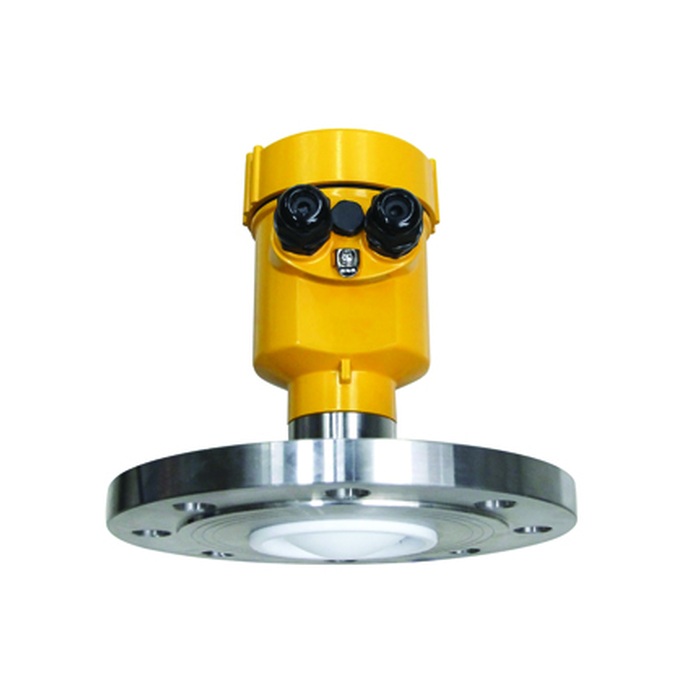
Silo level to volume error enters at the conversion from level to stock. If the reading is treated as a flat surface across the full cross-section, volume is computed as A * h, with A the silo area and h the indicated height. The true surface is a cone of height h_c = r*tan θ sitting on a cylinder, where r is the silo radius and θ the repose angle. For a centred cone the flat assumption overstates stock by (2/3)*A*r*tan θ. Silos for grain, wood pellets, cement and activated coke have different repose angles and inlet arrangements, but the geometry is shared.
The volume of a conical pile on a flat floor
Worked example based on assumed site values (illustrative calculation, not field-measured data): a cylindrical silo of internal radius r = 4.0 m, a measured apex height H = 6.000 m above the floor, and a repose angle θ = 30°. The cross-sectional area is A = π*r² = 50.265 m².
| Symbol | Quantity | Assumed value | Unit / condition |
|---|---|---|---|
| r | Internal silo radius | 4.0 | m, at 20 °C |
| A | Cross-sectional area | 50.265 | m², cylindrical section |
| H | Indicated apex height | 6.000 | m, radar aimed at centre |
| θ | Angle of repose | 30 | degrees, dry material |
| h_c | Cone height, r*tan θ | 2.309 | m, centred fill point |
| V_cone | Cone volume, (1/3)*A*h_c | 38.694 | m³ above the wall level |
These are assumed site values for one illustrative calculation. Measure the actual radius, the installed radar position and the repose angle of the delivered material; confirm the beam angle and mounting radius on the current product page before applying any conversion factor.
With a flat-surface conversion the operator books V_flat = A * H = 301.593 m³. The true volume is the cylinder below the cone base plus the cone itself: V_true = A*H - (2/3)*A*h_c = 301.593 - 77.389 = 224.204 m³. The overstatement is 77.389 m³, or 34.5 % of true stock. Silo level to volume error of this size is geometric, not instrumental; a more accurate transmitter aimed at the same apex returns the same wrong number.
The worked example at 30 degrees
The correction term is proportional to tan θ, so the repose angle is the most sensitive input. If the converter assumes a fixed 30° angle and the real material settles at 28° or 33°, the same apex reading produces a different true volume. The table gives the derived quantities for the 4.0 m radius silo above.
| Repose angle θ (degrees) | tan θ (-) | Cone height h_c (m) | Cone volume V_cone (m³) | Flat-surface overstatement (m³) | True stock V_true (m³) |
|---|---|---|---|---|---|
| 28 | 0.5317 | 2.127 | 35.636 | 71.271 | 230.322 |
| 30 | 0.5774 | 2.309 | 38.694 | 77.389 | 224.204 |
| 33 | 0.6494 | 2.598 | 43.524 | 87.047 | 214.545 |
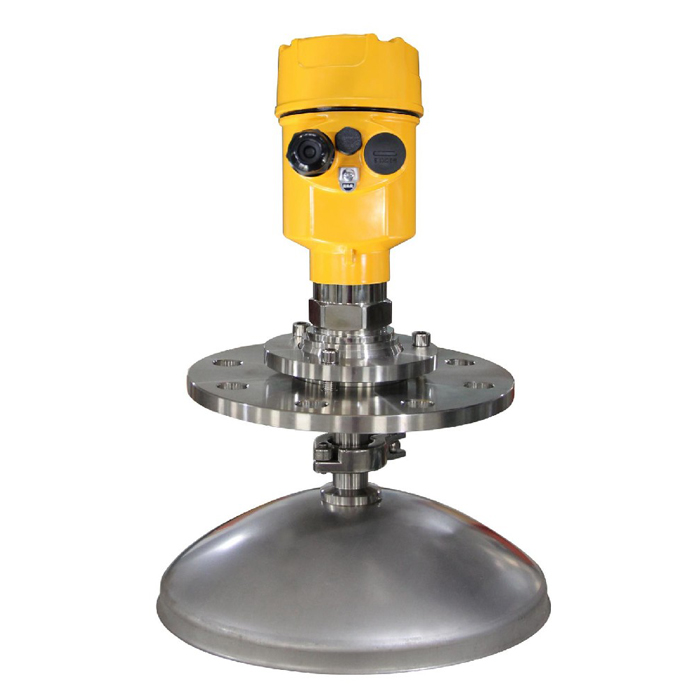
If the converter subtracts the 30° correction of 77.389 m³ but the real angle is 28°, reported stock is 6.118 m³ low; at 33° it is 9.659 m³ high. The two cases differ by about 15.8 m³, about 7.0 % of the 224.204 m³ reference stock. The boundary condition is a single centred cone, a flat floor and a known apex height. Off-centre filling, multiple inlets, a flattened heap or wall-fast deposit break the assumption, and their error can exceed the illustrated 28°-to-33° repose effect itself.
The sensitivity of stock to a five-degree repose shift
Two conclusions follow from the illustrated 28°-to-33° band. First, one correction factor taken from a handbook is not enough when the material changes grade: wood pellets, cement and activated coke each settle at a different angle, and moisture moves it further. Second, the sensitivity is asymmetric in tan θ; the step from 30° to 33° adds 9.658 m³ to the correction term, while the step from 30° to 28° removes only 6.118 m³. A converter tuned at one angle therefore drifts in one direction as the material dries.
The effect can be measured rather than guessed. Take reference readings after a fill has stopped and the surface settled, take the known delivered mass or volume from the delivery note, and back-calculate the effective repose angle from the difference between booked and true stock. Repeat for at least three fill events and for each inlet route. If the derived angle varies by more than ±5° between events, a fixed geometric correction is not defensible and a multi-point measurement is the next step. A technical article on silo installation covers aiming, dust purging and checks after a grade change.
The reduction available from area-weighted points
For silo level to volume error, geometry also gives the cheapest fix. For a centred cone the area-weighted mean surface height occurs at a radius of 2r/3, which is 2.667 m in this silo. A single radar aimed there reads H - (2/3)*h_c = 6.000 - 1.540 = 4.460 m, and A * 4.460 = 224.204 m³ — exactly the true volume, with no correction factor at all. Moving the one existing point from the apex to two-thirds of the radius removes the entire 77.389 m³ bias under the ideal-cone assumption. The cost is that a 2r/3 aim never sees the apex, so a high-level interlock loses its most conservative observation point. Keep a separate point or a high-high switch at the apex if overfill protection is required; the 2r/3 position is for stock volume, not for peak level.
A second option is to keep several points and weight them by the annular areas they represent. Take the three points at the area-centroid radius of three equal-area annuli — 0 to 2.309 m, 2.309 to 3.266 m and 3.266 to 4.000 m — not at their mid-radius. The centroid radii are 1.540 m, 2.814 m and 3.646 m, and they give heights of 5.111 m, 4.375 m and 3.895 m. Their mean, 4.460 m, multiplied by A gives 224.2 m³, within 0.05 % of the true stock — a reduction from the 34.5 % single-point error to effectively zero under the ideal cone. The improvement holds only while the heap stays centred; where the fill point moves, residual error is dominated by pile position, not by the number of points. Check beam clearance at every mounting radius before adding instruments.
The conditions that invalidate a level-to-volume conversion
Do not convert a single radar level point into usable stock volume when the surface shape is not a stable, centred cone. The conversion should not be used for custody or reconciliation on silos that fill and discharge through different routes, that bridge or rathole, or that hold material which cakes against the wall. In those cases a low reading may mean a cavity around the probe rather than an empty silo, and a high reading may describe a heap with nothing behind it. Ratholing produces a stable-looking level while most of the cross-section is already void.

Two further boundaries apply. Level is not mass: bulk density changes with compaction and moisture, so a volume figure cannot become tonnage without a measured density for the same fill state. And a single point cannot describe a surface deliberately flattened by a distributor or shaped by several inlets. Where these conditions hold, use several points, a scanning instrument or load cells, and keep the level reading as a level reading. Silo level to volume error is then bounded by geometry rather than hidden inside a conversion factor. Confirm the available roof nozzles and the recommended mounting radius on the current product page before choosing.
FAQ
Q1. What causes most silo level to volume error on a conical pile?
Treating one height as a flat surface. A radar aimed at the apex of a centred cone reads the maximum height, and multiplying it by the full area overstates stock. In the worked 8.0 m silo the flat figure is 301.593 m³ against a true 224.204 m³, an overstatement of 77.389 m³ or 34.5 %.
Q2. Can a more accurate radar level transmitter remove the error?
No. The error comes from surface geometry, not the distance measurement. A transmitter with tighter accuracy still returns the same height, and the flat-surface conversion still multiplies it by the whole area. Change the aiming radius, use several area-weighted points or apply a verified geometric correction.
Q3. How much does a repose-angle change from 28° to 33° change the result?
About 15.776 m³ in the worked silo, roughly 7.0 % of the 224.204 m³ reference stock. If the converter assumes 30° and the real angle is 28°, reported stock is 6.118 m³ low; at 33° it is 9.659 m³ high. The step is asymmetric because tan θ is non-linear. Measure the angle from delivery records rather than a handbook value.
Q4. Where should a single radar be aimed on a centre-filled silo?
At two-thirds of the internal radius, 2.667 m for a 4.0 m radius silo. That radius carries the area-weighted mean surface height of a centred cone, so the reading multiplied by the cross-sectional area gives true volume with no correction term. It works only while the heap stays centred.
Q5. When is a level-to-volume conversion not valid at all?
When the surface is not a stable, centred cone: ratholing, bridging, wall caking, multiple fill routes or a flattened heap from a distributor. A low reading can describe a local cavity rather than an empty silo. Level is also not mass, so a volume figure needs a measured bulk density.
Q6. How much do three area-weighted points improve the result?
In the worked silo they cut the error from 77.389 m³ to within 0.05 % of the true stock — effectively zero under the ideal cone. Points at 1.540 m, 2.814 m and 3.646 m, the area-centroid radii of three equal-area annuli, give a mean height of 4.460 m. A moving fill point can dominate the residual. Repeat the check after a grade change.
SUMMARY
Silo level to volume error on a conical pile is a geometry problem with a quantified bound: in the worked 8.0 m diameter silo a flat-surface conversion of an apex reading gives 301.593 m³ against a true 224.204 m³, an overstatement of 34.5 %, and a repose-angle change from 28° to 33° moves derived stock by about 15.8 m³. The next step is to measure the actual repose angle and fill-point position, then aim the radar at 2r/3 or add area-weighted points.
Talk to a METRAVON engineer about this application
Provide the silo diameter and height, the product and its measured angle of repose, the fill and discharge points, and the number of available roof nozzles. We will work through the level-to-volume conversion for your geometry and advise whether one point, a repositioned point or several points are needed for the stock accuracy you require.
