Chinese
 Spanish
 Russian
 Portuguese
 French
 German
 Indonesian
 Thai
Thai Vietnamese
 Arabic
 Italian
 Turkish
 Polish
 Japanese
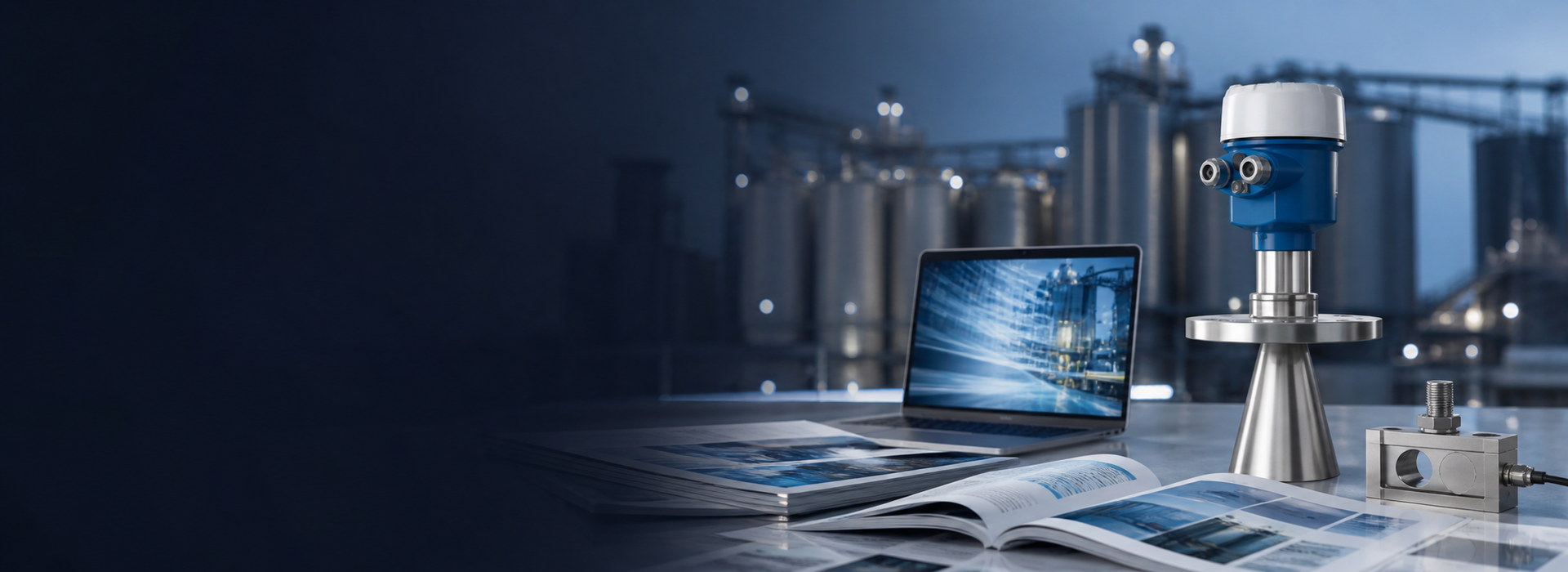
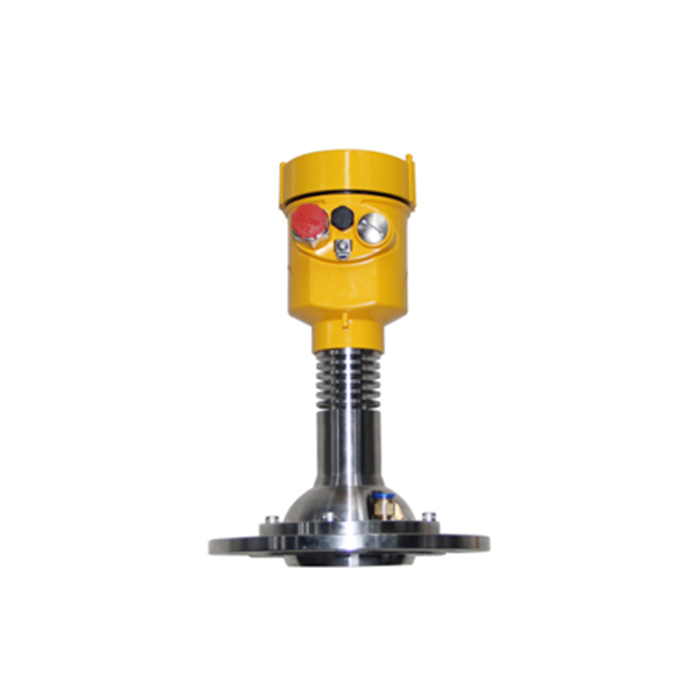
An 80GHz radar level meter is a non-contact instrument that uses high-frequency electromagnetic waves for continuous level measurement. Compared with lower-frequency radar systems, 80GHz technology can provide a narrower beam with a relatively compact antenna, making it particularly suitable for narrow tanks, vessels with internal structures, and installations close to tank walls. Today, 80GHz radar is widely used for liquids, slurries, sludge, powders, and granular bulk solids.
1. How Does an 80GHz Radar Level Meter Work?
Radar Transmission
The antenna transmits high-frequency electromagnetic waves toward the material surface.
Echo Reflection
The signal is reflected from the liquid or solid surface and returns to the antenna.
Distance Calculation
The instrument analyzes the relationship between the transmitted and reflected signals to determine the distance to the material surface.
Level Conversion
The measured distance is converted into level, percentage, or volume using the configured tank dimensions.
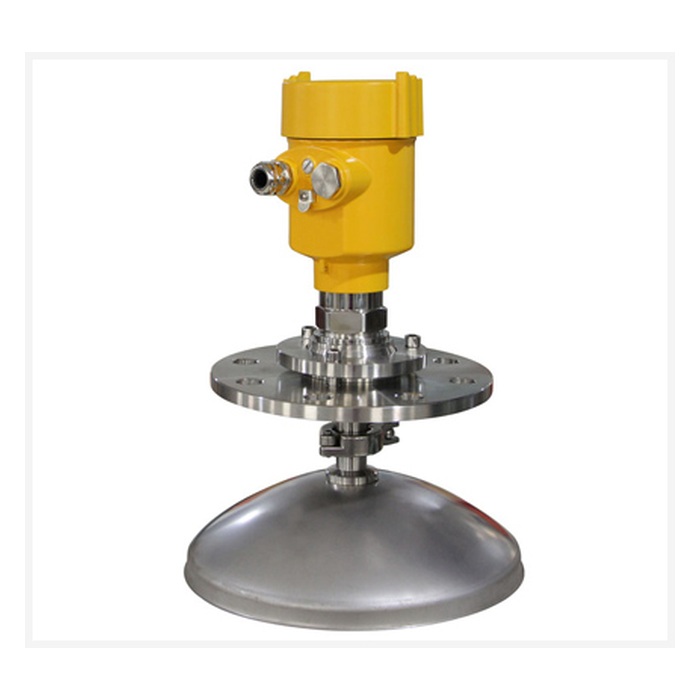
2. What Are the Main Advantages of 80GHz Radar?
Narrow Beam
A narrow radar beam can help avoid tank walls, pipes, supports, agitators, and other internal obstructions.
Compact Antenna
The high operating frequency allows good beam focusing with relatively small antenna dimensions.
High Measurement Resolution
Suitable models can provide millimeter-level process measurement, while specialized tank-gauging instruments can achieve even higher accuracy.
Wide Process Adaptability
Radar measurement is generally less affected by temperature changes, gas blankets, and vapor than technologies that depend on the speed of sound in air.
3. Why Does 80GHz Radar Have a Narrow Beam?
Higher-frequency radar has a shorter wavelength. With a similar antenna size, this generally allows a narrower beam and better focusing. This is particularly useful in narrow vessels and tanks with complex internal structures.
| Application Condition | Benefit of 80GHz Radar |
|---|---|
| Installation close to tank wall | A narrow beam reduces the possibility of strong wall echoes. |
| Agitators inside the vessel | The beam can often be positioned to avoid major internal structures. |
| Internal pipes or supports | Improved focusing helps reduce unwanted reflections. |
| Tall, narrow vessels | A narrow beam reduces the chance of hitting the vessel wall over long measuring distances. |
4. How Accurate Is an 80GHz Radar Level Meter?
There is no single accuracy value for all 80GHz radar level meters. Performance depends on the instrument design, antenna, application, and product class.
Process Measurement
Some 80GHz liquid radar transmitters provide approximately ±1 mm accuracy.
Tank Gauging
Specialized instruments for inventory and custody-transfer applications can achieve accuracy levels of approximately ±0.5 mm.
Bulk Solids
Accuracy specifications for solids differ because the material surface may be uneven or inclined.
5. What Can an 80GHz Radar Level Meter Measure?
Liquids
Water, wastewater, oils, chemicals, and other process liquids.
Slurries and Sludge
Suitable for many slurry and sludge applications, depending on surface conditions and buildup.
Powders
Cement, mineral powder, fly ash, and other powdered bulk materials.
Granular Solids
Grain, plastic pellets, minerals, and other granular materials.
6. Are Vapor, Dust and Temperature Changes a Problem?
Free-space radar uses electromagnetic waves rather than sound waves, so its measuring principle does not depend on the speed of sound in air. For this reason, radar generally performs well in applications with changing temperature, gas blankets, or vapor.
However, no radar instrument is completely unaffected by all process conditions. The following situations still require careful evaluation:
Heavy antenna condensation;
Severe buildup or crystallization;
Extreme process temperature or pressure;
Very thick foam layers;
Low-reflectivity media;
Strongly inclined bulk-solid surfaces.
7. Can 80GHz Radar Measure Through a Tank Wall?
A standard industrial free-space 80GHz radar should not be assumed to measure directly through a metal tank wall or roof.
Typical installation uses:
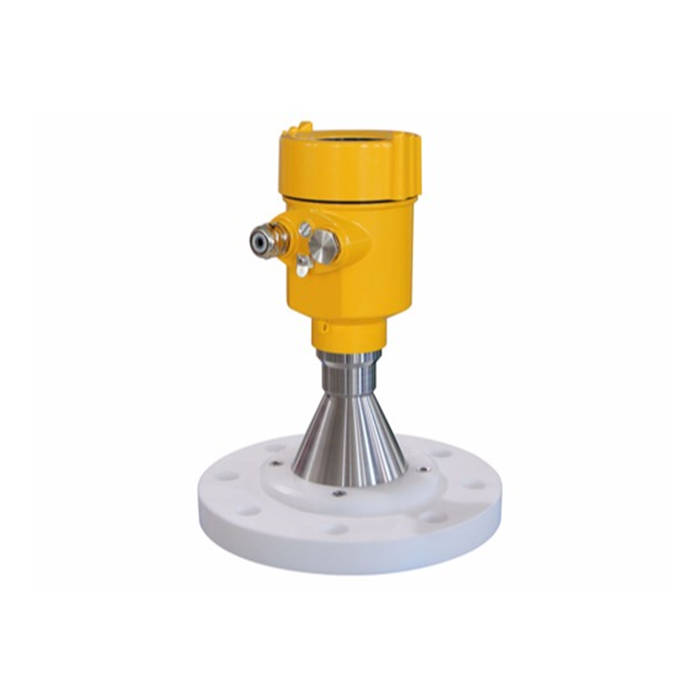
Threaded process connections;
Flanges;
Mounting nozzles;
Specially designed radar-transparent windows.
Some non-metallic materials may allow radar transmission under specific conditions, but compatibility depends on the material, thickness, frequency, and instrument design. Higher frequency should not be interpreted as automatically providing stronger penetration through tank walls.
8. Typical Applications of 80GHz Radar Level Measurement
| Application | Main Benefit |
|---|---|
| Storage tanks | Non-contact measurement with narrow beam and high accuracy options |
| Chemical process vessels | Good adaptability to changing process conditions and internal structures |
| Oil storage | Suitable models are available for inventory and high-accuracy tank gauging |
| Wastewater and sludge | Non-contact measurement reduces direct sensor exposure to the process medium |
| Bulk-solid silos | Narrow beam is suitable for tall silos and complex internal structures |
9. 80GHz vs. 26GHz Radar: How to Choose?
| Condition | Selection Consideration |
|---|---|
| Narrow vessel | 80GHz narrow-beam radar often offers an advantage. |
| Small process connection | 80GHz can provide good focusing with a relatively compact antenna. |
| Many internal obstructions | A narrow-beam 80GHz radar is often worth evaluating first. |
| Existing proven 26GHz application | Changing frequency may not be necessary if the existing technology meets the process requirements. |
10. What Information Is Required for Selection?
Medium
Liquid or solid
Medium name
Viscosity
Dielectric characteristics
Foam condition
Tank
Height
Diameter
Internal structures
Inlet position
Process connection size
Process
Temperature
Pressure
Vapor
Dust
Vacuum condition
Electrical
Power supply
4–20 mA
HART
RS485
Explosion protection
FAQ: 80GHz Radar Level Meter
1. How accurate is an 80GHz radar level meter?
It depends on the model. Process instruments may provide millimeter-level accuracy, while specialized tank-gauging instruments can achieve approximately ±0.5 mm. This value should not be applied to all 80GHz radar products.
2. What is the maximum measuring range?
There is no universal maximum. Liquid radar products may cover tens of meters, while specialized bulk-solid radar instruments can provide significantly longer ranges.
3. Does every 80GHz radar have a 3° beam angle?
No. A 3° beam angle is a typical specification for certain products. The actual beam angle depends on antenna design and size.
4. Can 80GHz radar measure wastewater and sludge?
Yes, suitable models can be selected. Foam, vapor, buildup, and surface conditions should still be evaluated.
5. Can 80GHz radar measure bulk solids?
Yes. Dedicated 80GHz radar transmitters are widely used for cement, mineral powder, grain, and other powdered or granular materials.
6. Can 80GHz radar measure through a metal tank wall?
A standard free-space radar cannot normally measure directly through a metal tank wall. A suitable process opening or radar-transparent window is generally required.
7. What information does METRAVON need for selection?
Please provide the medium, measuring range, tank height and diameter, temperature, pressure, vapor, foam, internal structures, process connection size, output signal, explosion-protection requirements, and installation photos.
Conclusion
The main advantage of an 80GHz radar level meter is not simply its higher operating frequency. Its real strengths are narrow beam focusing, compact antenna design, high measurement resolution, and improved target separation in complex vessels.
For METRAVON radar level selection, the operating frequency should be considered together with the measuring range, medium, process temperature and pressure, tank structure, installation connection, and hazardous-area requirements.