Chinese
 Spanish
 Russian
 Portuguese
 French
 German
 Indonesian
 Thai
Thai Vietnamese
 Arabic
 Italian
 Turkish
 Polish
 Japanese
Level and water-level measurement are important process variables in industrial production, water treatment, agricultural irrigation and infrastructure monitoring. Reliable level data supports process control, equipment protection, alarm management and remote monitoring.
An ultrasonic level transmitter provides non-contact measurement by installing the sensor above the liquid surface. Because the sensing element does not normally need to remain immersed in the medium, the technology is widely used for water, wastewater, tanks, reservoirs and selected chemical liquid applications.
1. How Does an Ultrasonic Level Transmitter Work?
An ultrasonic level transmitter determines the distance to a liquid surface by measuring the travel time of an ultrasonic pulse through the air. The sensor emits an ultrasonic pulse toward the liquid surface. The sound wave is reflected by the surface and returns to the sensor.
Distance = Sound Velocity × Round-Trip Time ÷ 2
When the installation reference height or tank height is known, the actual liquid level can be calculated as:
Liquid Level = Reference Height − Measured Distance
The instrument therefore measures distance first and then converts the distance value into liquid level or water level according to the configured installation parameters.
The ultrasonic pulse travels mainly through the air space between the sensor and the liquid surface. It does not measure level by transmitting sound through the liquid itself.
2. Main Features of Ultrasonic Level Measurement
Non-Contact Measurement
The sensor is normally installed above the liquid, reducing direct exposure to corrosion, contamination and sediment.
Continuous Level Monitoring
Continuous level values can be supplied for process monitoring, alarms, control and remote data acquisition.
System Integration
Depending on the model, interfaces may include 4–20mA, RS485, Modbus RTU and relay outputs.
No Mechanical Moving Parts
Measurement does not depend on floats, mechanical arms or other moving sensing mechanisms.
Suitable for Multiple Liquids
Applications include water, wastewater and selected oils or chemical liquids, depending on process conditions.
3. Main Technical Parameters
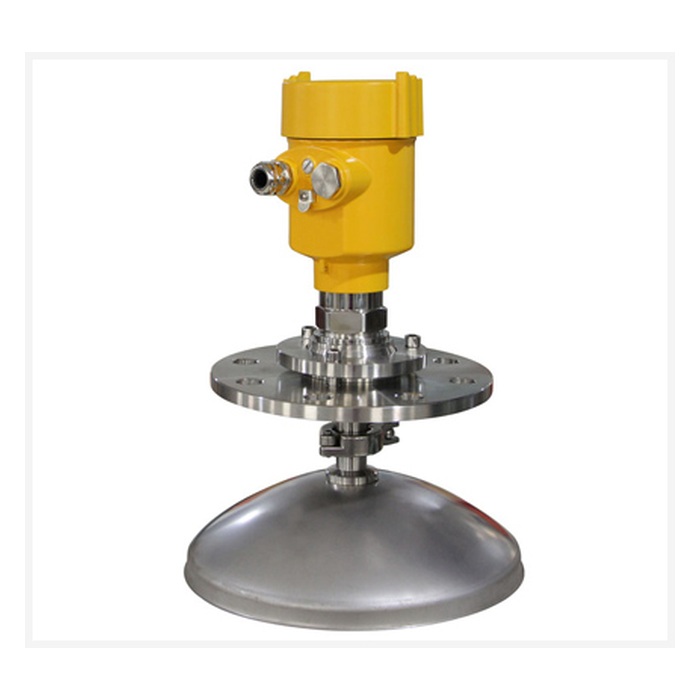
Technical specifications vary according to measurement range, transducer design, output configuration and environmental requirements. The final model should be selected according to the actual installation conditions.
| Parameter | Description |
|---|---|
| Measurement Principle | Ultrasonic Time of Flight |
| Measurement Type | Non-contact continuous measurement |
| Measurement Range | Selected according to model and required measuring distance |
| Measurement Accuracy | Depends on model, range and application conditions |
| Dead Zone | Depends on transducer design and measurement range |
| Power Supply | Depends on the selected model |
| Output Signal | 4–20mA, RS485 or other available options depending on model |
| Communication Protocol | Modbus RTU available on applicable digital models |
| Temperature Compensation | Normally available on industrial ultrasonic models |
| Power Consumption | Depends on supply and output configuration |
| Protection Rating | Selected according to indoor or outdoor installation requirements |
| Operating Temperature | Depends on the selected model |
| Installation | Threaded connection, mounting bracket or other structure |
| Sensor / Housing Material | Selected according to medium and environmental conditions |
| Cable Material | Depends on sensor structure and installation environment |
For a specific METRAVON ultrasonic level transmitter, measurement range, accuracy, power supply, protection rating and signal interface should be confirmed from the corresponding product datasheet.
4. Typical Applications
Industrial Level Monitoring
Typical applications include industrial water tanks, process tanks, wastewater basins, clean-water reservoirs, collection tanks, pumping stations and raw-water treatment systems.
Level signals can be connected to PLCs or control systems for continuous monitoring, alarms and pump control.
Agricultural Water-Level Monitoring
Applications include irrigation tanks, farm reservoirs, water-storage basins, open channels and fertigation storage tanks.
When combined with data loggers and communication devices, water-level information can be monitored remotely.
Urban Drainage and Road Flooding Monitoring
Ultrasonic sensors can be used in low-lying roads, underpasses, drainage channels, stormwater wells and urban drainage systems.
Measurement data can support flood alarms, drainage-pump control and remote monitoring.
Typical Remote Monitoring Architecture:
Ultrasonic Level Transmitter → Data Logger → 4G / LoRaWAN → Remote Monitoring Platform
In agricultural applications, ultrasonic level transmitters are used primarily for water-level or liquid-level monitoring. They are not intended for direct soil-moisture measurement. Soil moisture should be measured using a dedicated soil-moisture sensor.
5. Factors That Affect Ultrasonic Level Measurement
Foam
Thick foam can absorb or weaken the ultrasonic echo.
Steam and Vapor
High-temperature steam or vapor can affect sound-wave propagation.
Temperature
Air temperature affects sound velocity, so temperature compensation is commonly used.
Surface Movement
Strong agitation or rapid inflow can produce unstable echoes.
Obstructions
Pipes, ladders, beams and other internal structures may generate unwanted echoes.
6. How to Select an Ultrasonic Level Transmitter
| Selection Item | Information to Confirm |
|---|---|
| Measured Medium | Water, wastewater, oil or chemical liquid |
| Maximum Measuring Distance | Distance from sensor to the lowest expected liquid level |
| Maximum Liquid Level | Confirm that the highest level remains outside the dead zone |
| Process Conditions | Foam, vapor, temperature changes and surface movement |
| Installation Environment | Indoor, outdoor, tank, reservoir or open channel |
| Output Signal | 4–20mA or RS485 |
| Communication | Whether Modbus RTU is required |
| System Integration | PLC, RTU, SCADA, data logger or IoT platform |
| Protection Requirements | Selected according to site environment |
For remote monitoring projects, communication interfaces and future system expansion should also be considered. This allows the level transmitter to integrate more easily with existing automation and IoT infrastructure.
FAQ
Q1: Does an ultrasonic level transmitter need to contact the liquid?
A1: No. The sensor is normally installed above the liquid surface and measures the distance using ultrasonic pulse travel time.
Q2: Can an ultrasonic level transmitter measure wastewater?
A2: Yes. It can be used in many wastewater applications, but foam, vapor and surface movement should be evaluated.
Q3: Can ultrasonic sensors measure water level in tanks?
A3: Yes. Water tanks, reservoirs and storage tanks are common applications.
Q4: Can an ultrasonic level transmitter use RS485?
A4: Some industrial models provide RS485 communication and support Modbus RTU.
Q5: Why is temperature compensation required?
A5: Air temperature affects the velocity of sound. Temperature compensation helps reduce the resulting distance-measurement error.
Q6: Does foam affect ultrasonic level measurement?
A6: Yes. Thick foam can reduce the strength of the reflected ultrasonic signal and should be evaluated during selection.
Q7: Can ultrasonic level transmitters be used outdoors?
A7: Yes. The protection rating and installation structure should be selected according to rain, temperature and site conditions.
Q8: Can an ultrasonic level transmitter connect directly to a PLC?
A8: Yes. Depending on the PLC input interface, 4–20mA or RS485 Modbus communication can be used.
Conclusion
An ultrasonic level transmitter is a non-contact continuous level measurement instrument based on ultrasonic time-of-flight technology. It can be applied to industrial tanks, water treatment systems, irrigation water storage and urban flooding monitoring.
Successful application depends on measurement range, dead zone, foam, vapor, temperature, liquid-surface conditions, installation position and signal interface. METRAVON ultrasonic level measurement products can be integrated with PLCs, RTUs,data acquisition systems and remote IoT monitoring platforms according to project requirements, supporting compatible and scalable level-monitoring systems.