


 Chinese
 Spanish
 Russian
 Portuguese
 French
 German
 Indonesian
 Thai
 Vietnamese
 Arabic
 Italian
 Turkish
 Polish
 Japanese


Radar water level sampling can miss a short peak even when the sensor and communications are working normally. The sensor update, RTU polling, stored record and remote upload are separate stages. Specify the event that must be captured before selecting intervals for a battery-powered or intermittently connected station.
Specify radar water level sampling at each stage
| Stage | Required decision |
|---|---|
| Measurement | How long the sensor needs power before a new valid result is available. |
| Acquisition | How often the RTU reads the value and checks its validity or age. |
| Storage | Whether raw samples, maxima, averages or another defined statistic are retained. |
| Upload | How stored records and their original times survive interrupted communications. |
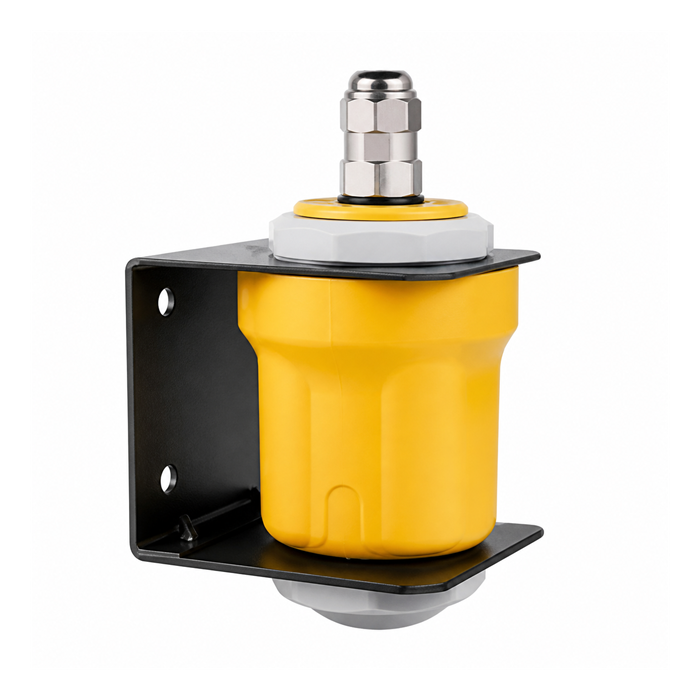
A frequent upload cannot recover an unmeasured event
If a station takes one reading every fifteen minutes, a brief rise and fall between readings may never appear in its record. Uploading those readings every minute would not reconstruct the missing peak. Conversely, a station can retain frequent local measurements and upload them later, provided the logger preserves their original timestamps and enough storage.
Those intervals are an illustration of data handling, not a claimed update rate for the METRAVON MV-RD12T. Ask for the selected electronics' startup and measurement timing before deciding how rapidly the station can acquire valid independent readings.
Define the shortest event that matters
Give the integrator the expected rise time, duration and consequence of the event. Choose an acquisition strategy that provides enough observations to describe it, allowing for measurement response and filtering. An interval shorter than the event is only a starting point; it does not guarantee that the true maximum will fall exactly on a sample.
For applications needing local action, review whether the action can wait for a cloud upload. A remote dashboard and an on-site decision have different latency requirements. Any flood-warning or protective duty needs the responsible system designer's assessment, not an assumption that a water-level data logger is automatically suitable.
MV-RD12T includes different supply and output options, including a low-power configuration. Do not derive the station battery life from that label. Account for sensor startup, valid measurement, RTU activity and modem transmissions using the chosen hardware's actual operating profile.
Test storage and timing together
Use controlled input changes or a suitable simulator to verify logger timestamps, peak retention and upload recovery. Separately verify the sensor's real response under representative water conditions. An electronics simulation tests data handling but does not prove performance over a turbulent surface.
Q1. Can interpolation fill gaps in the peak record?
It can estimate values under stated assumptions, but cannot establish an unobserved maximum. Label estimates separately and do not present them as measured flood peaks.
Q2. Should only the highest value be stored?
A maximum helps identify a peak, but supporting samples and validity information help distinguish a real event from a bad reading. Choose retention according to the investigation and reporting needs.
Summary
Specify event capture first and communications second. Provide the required event timescale, data-retention plan and power constraints for an MV-RD12T station configuration review.
