


 Chinese
 Spanish
 Russian
 Portuguese
 French
 German
 Indonesian
 Thai
 Vietnamese
 Arabic
 Italian
 Turkish
 Polish
 Japanese


Low dielectric radar level measurement becomes difficult when the useful surface return is weak relative to other echoes. Two instruments with the same quoted maximum distance can then behave differently because their antennas, mounting and signal processing differ. A liquid name or an 80 GHz label is not enough to approve the application.
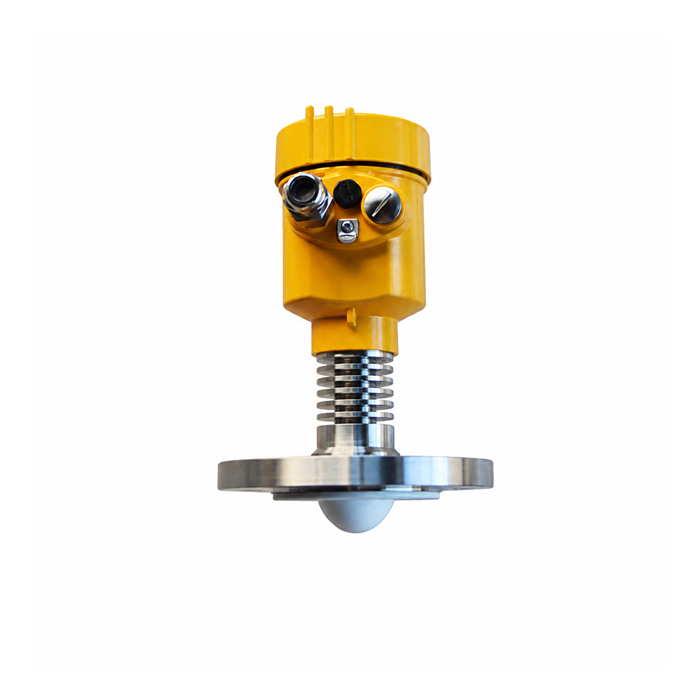
Low dielectric radar level measurement needs more than a material label
Radar receives a reflection where electromagnetic properties change, including at the boundary between the gas space and the product. Lower dielectric contrast can mean a weaker return. That does not directly specify a distance error: the question is whether the instrument can reliably identify the intended surface through the required operating interval.
Describe the actual product rather than assigning one dielectric value to all oils or solvents. Supply composition information where available, operating temperature and expected batch variation. If a dielectric value is provided, retain its source and measurement conditions, including frequency. A number copied from an unrelated material table should be treated as uncertain application information.
Also describe what changes above and on the surface. Foam, condensation, deposits and a filling stream can affect the measurement even when the bulk liquid remains the same. The supplier needs to assess these together, not approve a low-dielectric application from a single material property.
Antenna choice and mounting must be reviewed together
The antenna determines how energy is directed and received. Aperture and operating frequency influence the beam, but nominal frequency alone does not describe the complete antenna pattern or practical echo discrimination. A compact high-frequency instrument can still be badly positioned behind a restrictive nozzle.
Mark the proposed antenna position, nozzle bore and length, internal structures and working surface interval on a section drawing. Check the view at the lowest normal level as well as near full. Strong fixed reflections may become more troublesome as the useful surface return weakens or moves farther from the instrument.
| Condition | Why it matters | Evidence to request |
|---|---|---|
| Low level | The return travels farther and other reflecting features may compete with the surface. | Performance evidence at the lowest required operating surface, not only a full tank. |
| Nozzle | The connection can obstruct the antenna or introduce a nearby reflection. | Approval of the actual antenna and nozzle dimensions as an arrangement. |
| Deposits | Material on the process-facing surface can change the near-antenna response. | A realistic inspection and cleaning provision, with the expected residue described. |
| Batch change | A successful result with one product does not establish every product in the vessel. | A list of qualified media and any remaining trial conditions. |
Use the model to narrow the review, not to skip it
METRAVON MV-RD14 is an 80 GHz liquid radar with a 44 mm lens antenna. Those are identifiable product characteristics, not a universal minimum-permittivity guarantee. Ask for confirmation of the required liquid and distance with the proposed mounting arrangement before treating it as an approved selection.
A guided-wave route may also be assessed if contact with the liquid and the probe's mechanical requirements are acceptable. MV-RD701 uses a rod or cable, so it introduces clearance, coating and service-access questions of its own. A contacting probe does not automatically resolve a weak free-space return; its own mechanical and process conditions still need assessment.
The free-space and guided-wave comparison explains that installation choice. Keep product capability separate from general technology: a probe arrangement from another series, or an interface-measurement claim from another manufacturer, cannot be assigned to MV-RD701 without supporting documentation.
Plan a trial that tests the demanding part of the duty
A demonstration on clean water can confirm that an instrument powers up and produces a reading. It does not qualify a different liquid with a weak surface return. Where application evidence is incomplete, agree a trial using the actual medium or a technically justified representative condition.
Record an independent level reference, product identity, instrument configuration and the available measurement diagnostics. Include the required low-level region and the normal filling condition where safely achievable. If only part of the interval can be tested, identify that limit in the result.
Look for consistent tracking of the correct surface, credible fault handling and recovery after a disturbance. A smooth number is not enough if it follows a fixed obstruction or remains held after echo loss. Agree the acceptance method and tolerance before reviewing the data, and do not turn a short favourable trial into a guarantee for untested products or extremes.
Questions about weak radar returns
Q1. Does a higher dielectric constant always give better accuracy?
A stronger usable reflection can improve the margin for detecting the surface. It does not automatically improve the instrument's basic accuracy or correct an installation offset. Distinguish reliable target detection from agreement with a calibrated distance reference.
Q2. Does 80 GHz automatically separate nearby echoes better?
Not from the frequency label alone. Beam direction, waveform bandwidth, processing and the target arrangement all matter. The FMCW specification guide distinguishes operating band from range separation and accuracy.
Q3. Can software suppression compensate for an obstructed antenna?
It may help handle documented fixed reflections within the instrument's supported procedure. It does not create a clear measurement path through an unsuitable obstruction. Review mounting first and avoid suppressing echoes when the real surface position is unknown.
Q4. Must every low-dielectric liquid use a guided probe?
No. A properly assessed free-space radar may be suitable. A guided probe is another candidate when its contact, installation and maintenance conditions are acceptable. Compare supported configurations rather than selecting by a general technology ranking.
Q5. What should the enquiry include if dielectric data is missing?
State that it is unknown and provide the exact material, available composition information, temperature range, process observations and vessel drawing. Ask METRAVON for an application review of the proposed radar, material and mounting arrangement. Identify what trial is needed to resolve missing information. Do not replace missing data with an assumed value simply to complete a form.
Summary
Qualify the liquid, antenna, mounting and operating interval as one application. Use low-level and process-state evidence to judge the useful return, and keep unsupported material values out of the purchase specification. A defensible selection states both what has been demonstrated and what remains to be confirmed.
