


 Chinese
 Spanish
 Russian
 Portuguese
 French
 German
 Indonesian
 Thai
 Vietnamese
 Arabic
 Italian
 Turkish
 Polish
 Japanese


HART vs Modbus RTU is an instrument-interface decision, not a contest between two wire types. A project may need only a level value, or it may also need device status, remote configuration and fault identification. Specify those data requirements first, then choose an electrical version that the existing PLC, RTU or data logger can actually use.
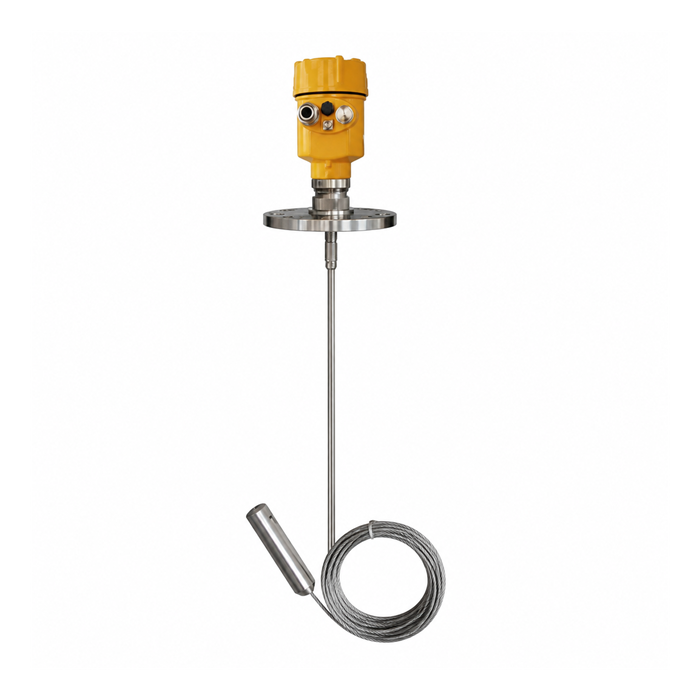
HART vs Modbus RTU: decide which data must reach the host
Traditional wired HART adds digital communication to a 4-20 mA loop. An ordinary analog input can read the current value, but accessing the digital information requires a HART-capable host path. Check the input module, modem or multiplexer and any intervening equipment, not just the field transmitter's label.
Modbus RTU exchanges digital messages and is commonly carried over RS485. RS485 describes the electrical interface; it does not define the meaning of a register. An RS485 connector on both devices does not prove that they share the same protocol, supported functions or data representation.
| Need | Possible route | Confirm before ordering |
|---|---|---|
| One value | A 4-20 mA output connected to a suitable analog input. | Loop power, input arrangement, scaling and fault interpretation. |
| Device data | HART through a compatible host path while retaining the analog signal. | Which variables and functions the host exposes for the actual device revision. |
| Shared bus | Modbus RTU instruments on a designed RS485 network. | Instrument register documentation, controller role and required polling performance. |
| New network | A converter or gateway between the field interface and the required upstream system. | The conversion functions, data-quality handling and responsibility for configuration. |
Check the installed input before specifying the replacement
Collect the exact input-module model, its configuration and the existing connection drawing. "The PLC accepts 4-20 mA" is incomplete if the loop-power arrangement is unknown. Likewise, an available serial port is not useful until its electrical interface and the controller's communication software have been confirmed.
For METRAVON MV-RD701, the original electrical documentation describes a two-wire 4-20 mA/HART arrangement and separate-powered Modbus-RS485 arrangements. These are configuration choices to verify on the order and drawing. Do not connect a separately powered version according to the diagram for a loop-powered version.
Ask who needs digital access. A maintenance technician using a local communicator has a different requirement from a control room that must continuously collect device diagnostics. Purchasing a HART-capable transmitter alone does not complete the second requirement. Include the host hardware, software support and permitted configuration access in the scope.
Resolve the two different meanings of "two-wire"
In a loop-powered 4-20 mA transmitter, the same pair carries operating power and the analog measurement signal. In two-wire RS485, the phrase refers to the differential data pair. It does not normally include the separate power conductors or settle the signal-reference requirements. Count conductors from the selected terminal drawing, not from the interface shorthand.
The voltage available at a loop-powered instrument is less than the supply voltage after other circuit drops are included. For a hypothetical design with a 24 V supply, an 11 V minimum transmitter requirement and 500 ohms of total series resistance, 20 mA produces a 10 V resistive drop. That leaves 3 V before other losses and tolerances. These are illustrative values, not MV-RD701 specifications or a recommended circuit.
The actual check must use minimum supply voltage, the instrument's documented requirements, additional barriers or protectors and the highest relevant operating or fault current. Adding a resistor solely because HART is mentioned can consume voltage unnecessarily if the receiving equipment already provides the required loop impedance.
Buy a documented data interface, not just a working connection
For a digital integration, request the data list alongside the quotation. Identify the value to display, its units, valid range and the indication of invalid data. Clarify which settings are read-only and which can change the instrument configuration. A plausible number on a screen is not enough to prove that the correct measurement has been decoded.
For a shared serial bus, assess the time to acquire the required readings with all intended devices connected and with a non-responsive device present. A sensor's internal update rate is not the same as the age of the value displayed by the host. The RS485 commissioning guide covers wiring and register checks once the interface route has been selected.
Acceptance should include the measurement value, fault indication, communication loss and recovery after restart. If the system retains a previous value, operators need a way to recognise that it is stale. Record the final interface settings and document any converter so that a later replacement does not depend on undocumented commissioning knowledge.
Provide the host and input-module models, existing drawing, required data, cable route and power arrangement. State whether remote configuration or only measurement acquisition is needed. Request an electrical-version review with responsibility for any gateway, host setup and commissioning clearly assigned.
Interface questions
Q1. Can HART be connected directly to an RS485 port?
Not as a direct wire-for-wire connection. They use different signalling arrangements. A suitable interface device may translate selected information, but its supported functions and data mapping must be established. A change of connector is not a protocol conversion.
Q2. Will a HART instrument still work with an ordinary analog input?
A compatible analog loop can use its current output, subject to the instrument's operating mode and electrical requirements. That does not give the input access to HART diagnostics or configuration. Decide whether analog-only operation meets the intended duty.
Q3. Does digital communication make the level measurement more accurate?
It can avoid a separate analog conversion path, but it cannot correct a wrong level reference, unsuitable probe or incorrect echo selection. Compare the complete measurement chain and required information rather than assuming that a protocol changes the sensor's physical performance.
Q4. What must be checked before reusing the existing cable?
Review conductor count, cable type, resistance or communication suitability, routing, shielding and the approved grounding arrangement. Changing from loop power to a serial data bus can change several of these requirements. Reuse is an engineering decision, not an automatic benefit of a replacement.
Q5. Can the same instrument supply HART and Modbus RTU simultaneously?
Only if the selected electrical version explicitly supports that combination. A product family listing both options does not establish that every unit contains both interfaces. Obtain the ordered version's terminal drawing and supported operating modes before allocating controller inputs or purchasing a gateway.
Summary
Select the interface from the required information and the receiving system's capabilities. Identify the ordered instrument version, account for the complete power and data path, and verify faults as well as valid readings. This prevents a compatible-looking connector from becoming an unresolved integration job.
