


 Chinese
 Spanish
 Russian
 Portuguese
 French
 German
 Indonesian
 Thai
 Vietnamese
 Arabic
 Italian
 Turkish
 Polish
 Japanese


Radar through a plastic tank roof can be possible with a suitable design, but "plastic" is not a complete description of the signal path. Roof construction, reinforcement, layers and surface moisture can affect the result. An 80 GHz label alone does not establish that a proposed instrument will measure reliably from outside a particular tank.
Describe everything between the antenna and the liquid
| Roof detail | Information for the assessment |
|---|---|
| Material | Polymer, reinforcement, conductive additives and any lining or coating. |
| Section | Thickness, layers, air gaps, curvature and available mounting position. |
| Exposure | Rain, standing water, condensate, ice or deposits on the relevant surfaces. |
| Surroundings | Metal cages, supports, nearby walls and possible movement of the container. |
Some non-conductive materials transmit part of a radar signal, while interfaces can also produce reflections. A roof return must not be confused with the liquid return. Do not extrapolate from a thin clean sample to a reinforced or wet tank without examining the actual construction.
Radar through a plastic tank roof is not a standard MV-RD12 claim
The METRAVON MV-RD12 page describes a liquid radar with a PTFE lens and process connections. It does not qualify that model for transmission through arbitrary tank roofs. A successful example from another manufacturer's instrument does not provide that missing model-specific evidence.
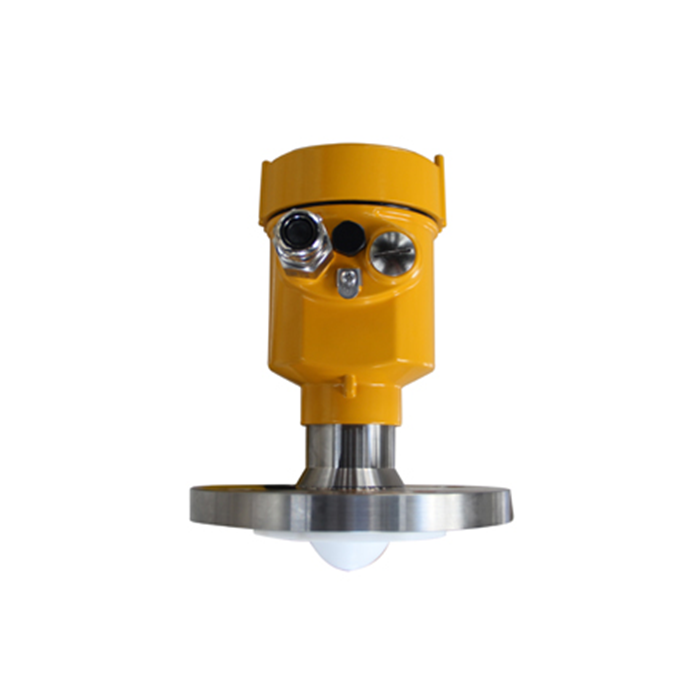
Before ordering for external mounting, request an explicit application assessment and an agreed test. If that evidence is unavailable, consider an appropriately engineered opening and process-connected installation instead. Do not drill or modify a vessel without the owner's approval and the required design review.
Test the roof condition that will actually occur
Use the real roof section and intended stand-off arrangement where a trial is authorised. Compare readings at the required liquid levels against an independent reference. Include relevant surface conditions and container positions rather than accepting a single dry, stationary observation.
If the container can move, define how its position will be controlled relative to the antenna. A change in roof angle or the location of nearby metal can change the measurement path. Test after replacement of the container with another nominally identical unit if manufacturing variation is material to the application.
External-mounting questions
Q1. Does a stable reading prove the liquid has been detected?
No. A fixed roof reflection can also be stable. Demonstrate that the identified return tracks independently known liquid changes across the required interval.
Q2. Can paint or a cover be added after a successful trial?
Review any added material in the signal path before assuming the result remains valid. Its electrical properties and geometry may differ from those of the tested roof.
Summary
Treat the roof as part of the measurement assembly. Provide its material section, exposure and intended mounting geometry; request documented suitability rather than inferring it from frequency.
