Chinese
 Spanish
 Russian
 Portuguese
 French
 German
 Indonesian
 Thai
Thai Vietnamese
 Arabic
 Italian
 Turkish
 Polish
 Japanese
How to Buy a Reliable Radar Level Transmitter
When purchasing a radar level transmitter, matching the instrument to the actual operating conditions and ensuring long-term reliability should be the primary considerations rather than focusing only on price. A reliable product should provide stable microwave signal transmission, remain largely unaffected by atmospheric conditions, meet the requirements of harsh environments involving volatile gases, high temperatures, high pressures, steam, vacuum, and heavy dust, and provide continuous measurement at different material or liquid levels.
Key factors to evaluate during model selection include medium characteristics such as dielectric constant, viscosity, corrosiveness, and crystallization tendency; process temperature and pressure ranges; tank structure and installation conditions; output signal requirements; and explosion-proof requirements. Priority should be given to products equipped with advanced echo-processing algorithms, false-echo suppression functions, and reliable electronic components. The manufacturer's technical support and after-sales response capability directly affect troubleshooting efficiency and the overall service life of the instrument. In engineering procurement, providing complete operating-condition parameters can significantly reduce model-selection risks and ensure that the instrument delivers its intended low-maintenance and high-performance advantages in actual applications.
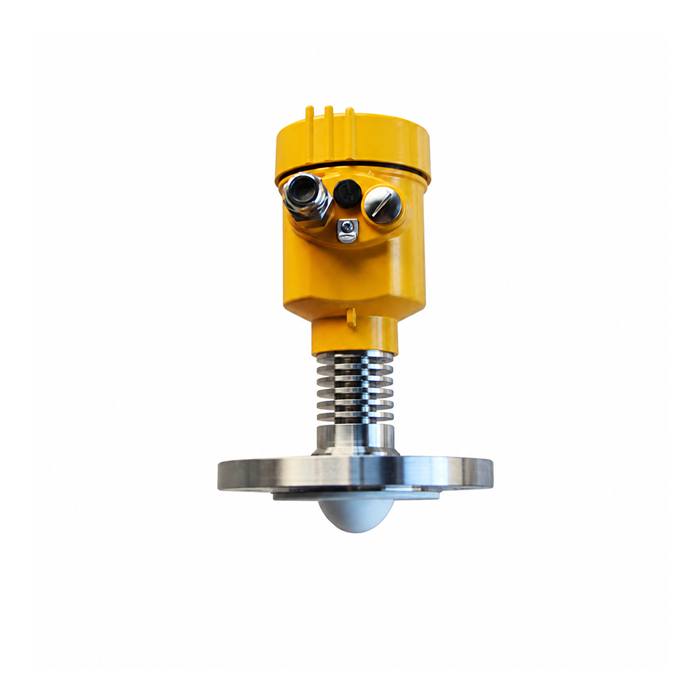
METRAVON radar level transmitters cover both non-contact and guided wave series. They are optimized for complex operating conditions and support engineering model-selection confirmation and long-term operational reliability.
Advantages of Radar Level Transmitters
Radar level transmitters offer advantages including low maintenance, high performance, high accuracy, high reliability, and long service life. Compared with contact-type instruments such as capacitance and weight-and-cable level measurement devices, their advantages are significant.
Microwave signal transmission is not affected significantly by atmospheric conditions and can meet the requirements of harsh process environments involving volatile gases, high temperatures, high pressures, steam, vacuum, and heavy dust. These products are suitable for applications involving high temperature, high pressure, vacuum, steam, heavy dust, and volatile gases, and they can continuously measure different material or liquid levels. Their non-contact measurement characteristics reduce the direct effects of medium adhesion and corrosion on the instrument, thereby reducing routine maintenance requirements. High accuracy and high repeatability also help improve process-control stability and inventory-management accuracy.
Radar level transmitters are widely used in industries such as cement, power generation, metallurgy, petroleum, chemicals, coal, and food processing. They are suitable for liquids, slurries, liquids containing steam, high-temperature media, low-dielectric-constant media, tanks with agitators, and various process vessels.
What Is an FMCW Radar Level Transmitter?
A frequency-modulated radar level transmitter generally refers to a frequency-modulated continuous-wave (FMCW) radar level transmitter operating according to the FMCW principle. The instrument uses a linearly frequency-modulated high-frequency signal, with the transmitted frequency increasing linearly over a defined time interval, also known as the sweep frequency. Because the transmitted frequency varies with signal propagation time and is proportional to the distance from the reflecting object, the level can be determined from the frequency difference between the currently transmitted signal and the received reflected signal.
Its accuracy mainly depends on the linearity and temperature-drift characteristics of the voltage-controlled oscillator. FMCW technology provides a relatively high signal-to-noise ratio and high resolution, making it suitable for applications requiring high accuracy or involving relatively complex operating conditions. Compared with pulse radar, frequency-modulated continuous-wave radar offers advantages in continuous signal processing and finer distance resolution.
METRAVON FMCW radar series uses optimized linear frequency modulation and signal-processing algorithms and is suitable for storage tanks and process vessels requiring high-accuracy continuous measurement.
How to Commission a Guided Wave Radar Level Transmitter
There are mainly three methods for commissioning a guided wave radar level transmitter:
Using a HART handheld communicator. It should be noted that the adjustment range of a handheld communicator may be limited and it is not applicable to every product. The measurement range corresponds to the 4–20 mA output values.
Using a handheld adjustment module. This module functions similarly to an instrument analysis and processing unit. It consists of operating buttons and an LCD screen and can display adjustment menus and parameter settings.
Using commissioning software. HART software can be used for commissioning, and the appropriate instrument driver is required. During commissioning, supply the radar instrument with 24 VDC and install a 250 Ω resistor at the front end of the HART adapter. If the power-supply instrument has an integrated HART resistor with an internal 250 Ω resistor already included, no additional external resistor is required. In this case, the HART adapter can be connected in parallel with the 4–20 mA loop.
During commissioning, confirm that the empty-tank and full-tank parameters are correctly configured, perform false-echo learning when necessary, and verify that the output signal corresponds correctly to the actual liquid level. After commissioning is completed, lock the parameters and record the configuration data.
Where Can You Find a Rod-Type Guided Wave Radar Level Transmitter?
Rod-type guided wave radar level transmitters operate according to the time-domain reflectometry (TDR) principle. Electromagnetic pulses travel at the speed of light along a steel cable or probe rod. When the pulses encounter the surface of the measured medium, part of the pulse energy is reflected to form an echo and returns to the pulse transmitter along the same path. The distance between the transmitter and the surface of the measured medium is proportional to the pulse propagation time, and the liquid level is calculated accordingly.
Rod-type guided wave radar level transmitters are mainly used for liquid level measurement. The signal is concentrated and transmitted along the guided probe rod, resulting in low energy loss and good adaptability to media with low dielectric constants and to small vessels. During installation, the probe rod should remain vertical, must not touch the tank wall, and should be positioned away from inlet disturbance areas.
METRAVON provides a range of rod-type guided wave radar level transmitters with various probe lengths and material options for liquid storage tanks and process vessels. Engineering users can obtain product information and model-selection support through official channels. Providing the medium parameters and tank dimensions is sufficient to begin configuration matching.
Radar Level Transmitter Manufacturers Continue to Create Value for Customers
Radar level transmitters are widely used in industries such as cement, power generation, metallurgy, petroleum, chemicals, coal, and food processing. They are suitable for liquids, slurries, liquids containing steam, high-temperature media, low-dielectric-constant media, tanks with agitators, and process vessels.
High-quality manufacturers help customers reduce maintenance costs, improve measurement stability, and enhance production safety through reliable product performance, comprehensive technical support, and rapid after-sales response, thereby creating continuous long-term value. When selecting a supplier, users should evaluate not only the product itself but also the manufacturer's application experience under complex operating conditions and its long-term service capability.
As a professional radar level measurement supplier, METRAVON continuously optimizes its product performance and service system, providing suitable measurement solutions and technical support for customers across different industries.
FAQ
Q1: What are the main advantages of radar level transmitters compared with contact-type instruments?
A: They offer low maintenance, high accuracy, and high reliability. Microwave signals are not significantly affected by atmospheric conditions and can adapt to environments involving volatile gases, high temperatures and pressures, steam, vacuum, and heavy dust.
Q2: What mainly affects the accuracy of FMCW radar?
A: Accuracy mainly depends on the linearity and temperature drift of the voltage-controlled oscillator. Better linearity and lower temperature drift result in more accurate distance calculations.
Q3: Is a 250 Ω resistor always required when commissioning guided wave radar?
A: When using HART software for commissioning, if the power-supply instrument does not have an integrated HART resistor, a 250 Ω resistor must be installed at the front end of the HART adapter. If an integrated 250 Ω resistor is already provided, no additional external resistor is required.
Q4: What type of medium is rod-type guided wave radar mainly used to measure?
A: It is mainly used for liquid level measurement. The signal travels along the probe rod, making it suitable for low-dielectric-constant media and small vessels.
Q5: Are radar level transmitters suitable for tanks with agitators?
A: Yes. Guided wave radar is often more stable under conditions involving severe surface fluctuations, while non-contact high-frequency radar can also adapt through narrow-beam transmission and advanced signal-processing algorithms.
Q6: What is the most important point to avoid mistakes when purchasing a radar level transmitter?
A: Complete medium and tank parameters must be provided to ensure correct model matching. The manufacturer's technical support and after-sales response capability should also be evaluated rather than selecting based only on price.
Q7: What is the difference between FMCW radar and pulse radar?
A: FMCW radar uses linearly frequency-modulated continuous waves and calculates distance from the frequency difference, generally providing higher resolution and signal-to-noise ratio. Pulse radar determines distance based on the travel-time difference of transmitted and reflected pulses.
Q8: What can a handheld adjustment module do for guided wave radar?
A: It can display adjustment menus and parameter settings and functions similarly to an instrument analysis and processing unit, allowing direct on-site operation.
Q9: Which industries commonly use radar level transmitters?
A: Common industries include cement, power generation, metallurgy, petroleum, chemicals, coal, and food processing, covering applications involving liquids, slurries, high-temperature media, and low-dielectric-constant media.
Q10: How can users obtain support for METRAVON rod-type guided wave radar or FMCW radar?
A: Provide the medium name, dielectric constant, temperature and pressure, tank dimensions, and installation conditions to obtain model-selection confirmation and commissioning guidance.
Conclusion
Purchasing a reliable radar level transmitter should begin with correct matching of the medium and operating conditions, with particular attention to low maintenance, high accuracy, and adaptability to harsh environments. FMCW radar achieves high-accuracy distance measurement through linear frequency modulation and frequency-difference calculation. Guided wave radar can be commissioned using a HART handheld communicator, adjustment module, or software. When using software commissioning, attention should be paid to the 24 V power supply and 250 Ω resistor configuration. Rod-type guided wave radar operates according to the TDR principle and is suitable for liquid level measurement. High-quality manufacturers create long-term value for customers through reliable products and continuous technical service.
METRAVON radar level transmitter products cover FMCW, pulse radar, and guided wave radar series and are used in complex operating conditions across multiple industries. METRAVON provides model selection, commissioning, and after-sales support. If you require purchasing guidance, operating-principle information, or specific model matching, please provide detailed operating-condition parameters, and we will assist with reliable model selection and implementation.
Related resources
Radar level meters · Level measurement
Author: Arvin · Source: METRAVON Instruments