


 Chinese
 Spanish
 Russian
 Portuguese
 French
 German
 Indonesian
 Thai
 Vietnamese
 Arabic
 Italian
 Turkish
 Polish
 Japanese



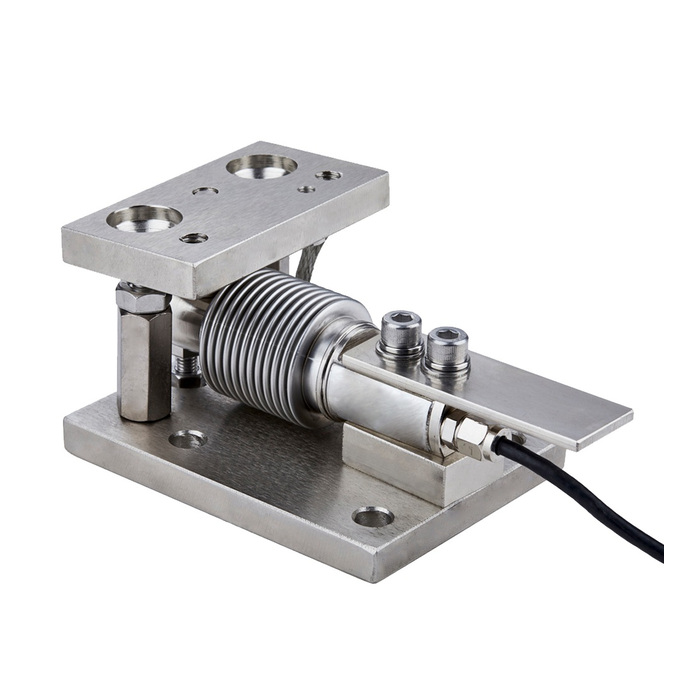
METRAVON MV-WM0017 is a bellows weigh module with a horizontal sensing assembly, an upper load plate and a lower mounting base. It is a candidate for a vessel support only after its rating, attachment geometry and measuring chain have been matched to the installation. The visible bellows identifies part of the sensor construction; it does not establish the capacity, permissible vessel movement or performance of every assembly offered under this model.
Count vessel tare before selecting a bellows weigh module
A vessel may contain little material yet place a substantial reaction on each support through its own mass. List vessel tare, maximum contents and the support positions, then assess the largest individual reactions during normal operation. Include anything attached to the weighing structure. Zeroing the empty vessel subtracts a displayed value but does not release the mechanical load already carried by the sensor. Specify the smallest useful contents change as well as the maximum load so that sensor selection is not based on net contents alone.
Keep contact away from the bellows and cable entry
The reference view shows the bellows exposed between the fixed end of the sensor and the loaded end beneath the upper plate. Provide enough clearance for the surrounding structure, cleaning equipment and cable route without pressing on that section. Keep handling loads off the bellows and protect it from contact with adjacent parts. Any protective guard must remain clear of the weighing assembly throughout the intended movement. The photograph is not a quantified clearance drawing; obtain the rated outline before locating a close-fitting guard.
Define both attachment surfaces and the retaining settings
Measure the vessel-side bracket and the foundation independently, including available height and access around the cable end. Ask for plate envelopes, hole positions, load-contact location and the approved restraint settings. A top plate that can be bolted to the leg does not prove that the underlying load transfer is correct. Retaining hardware must follow the assembly procedure rather than being tightened until all visible movement disappears. Resolve the external support and pipe arrangement before assigning accuracy to the installed weighing system.
| Item | Value | Selection notes |
|---|---|---|
| Gross support loading | Vessel tare plus operating loads | Provide the support layout and maximum individual reactions, not only net contents. |
| Mechanical release | Rated assembly drawing | Require upper and lower interfaces, height, clearances and load-contact location. |
| Sensor identification | Selected rating and calibration | The model photograph is not a confirmed capacity or electrical schedule. |
| Acquisition package | Matched weighing input | State the reader, wiring and any required process-output converter. |
| Installation acceptance | Connected vessel verification | Agree reference loads, repeat readings and unloading return with final services fitted. |
Request one identifiable sensor and readout package
The quotation should identify the supplied sensor rating, calibrated sensitivity, excitation, resistance and lead functions, together with the compatible indicator or conditioning equipment. Do not derive those values from the bellows appearance or from a different load cell of similar shape. If the receiving controller needs a process signal, define that input and the separate conversion equipment. Material, ingress protection, temperature limits and any required approvals likewise need a specification for the offered version, not an assumption based on its metallic finish.
Tare, connected services and assembly confirmation
Q1. Does zeroing the empty vessel leave the full sensor capacity available for material?
No. Zeroing changes the displayed reference, not the load already carried by the supports. Include vessel tare, maximum contents and other operating forces when assessing the largest reaction at each module. Then obtain the rated assembly drawing and sensor specification for that reaction; a zero indication does not establish spare mechanical capacity.
Q2. Can a short rigid hose be treated as an unloaded connection?
Its effect depends on stiffness, supports, movement and operating conditions. Check the force it transfers to the vessel rather than its length alone. Verify the weighing response with that connection installed through the useful load interval.
Q3. What can the commissioning record establish?
It can document the actual assembly, agreed reference-loading results, repeatability and return after unloading. It cannot turn an unspecified sealing grade or an unconfirmed sensor rating into a procurement guarantee.
