


 Chinese
 Spanish
 Russian
 Portuguese
 French
 German
 Indonesian
 Thai
 Vietnamese
 Arabic
 Italian
 Turkish
 Polish
 Japanese

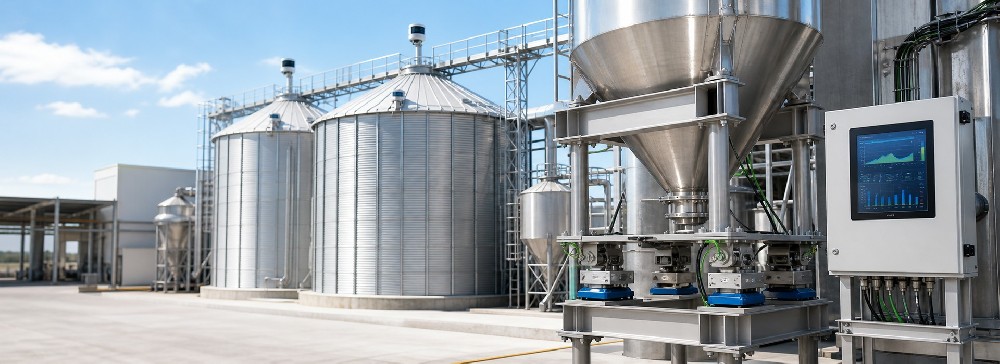

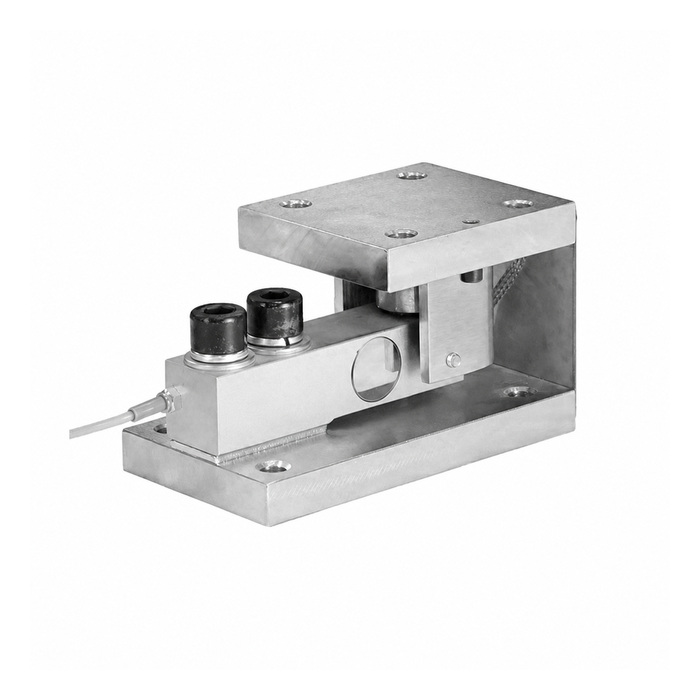
METRAVON MV-WM0020 is a dynamic weigh module built around a single-ended shear beam sensor. The installation drawings show 0.5-2.5 t and 3-5 t groups. For an agitated vessel or equipment exposed to changing loads, assess the mechanical forces and the required weighing cycle before specifying the module.
Dynamic weigh module does not mean unrestricted in-motion accuracy
A mixer or moving mechanism can add oscillating forces to the weight signal. A dynamic-load mounting arrangement does not, by itself, guarantee a stable reading while that mechanism is running. Decide whether the process needs continuous monitoring, a settled reading after motion stops, or a controlled dosing result.
Describe the motion, its frequency and the expected force direction in the enquiry. The support designer must check peak loads and lateral effects, while the instrument must provide the required measurement rate and filtering. Increasing the filter can reduce visible fluctuation but also delay a dosing cutoff; it cannot correct an overloaded or binding support.
Compare the two mounting envelopes
| Drawing group | Base size | Overall height | Hole dia. |
|---|---|---|---|
| 0.5-2.5 t | 170 × 100 mm | 99.5 mm | 13.5 mm |
| 3-5 t | 220 × 120 mm | 129 mm | 14 mm |
The upper and lower mounting patterns differ. For the smaller group, the upper plate is 104 mm long while the base is 170 mm long; the larger group's corresponding lengths are 135 mm and 220 mm. Use the complete upper and lower drawings rather than copying one plate's hole pattern to the other.
Include the complete loading cycle in the specification
Provide the empty vessel weight, maximum contents and the reaction expected at each support. Add the equipment loads that occur during filling, discharge or agitation. Normal product weight alone does not describe the maximum force that a module may experience.
Confirm the fitted cell's sensitivity, supply requirement and wiring before choosing the weighing controller. If a PLC needs a continuous weight value, define the update rate and signal interface as well as the acceptable fluctuation. No sampling rate or response-time guarantee follows from the module's capacity designation.
Questions for an agitated-vessel installation
Q1. Should calibration be performed with the agitator running?
First establish a repeatable reference under defined stable conditions. Then test the operating states used by the process and determine whether readings meet the agreed limits. Record agitator state, fill level and instrument settings so a filtered running value is not confused with a settled reference.
Q2. Can the 3-5 t mounting group be ordered as 7.5 t?
Do not extend the assembly rating from a related beam sensor or an unconfirmed drawing label. A 7.5 t requirement needs a quotation identifying the complete module rating and its released drawing. The dimensional groups presented here do not establish that configuration.
Q3. Why might a stable empty reading become noisy during filling?
Material impact, feeder vibration and contact with connected equipment can all add force to the support. Compare the signal during filling and after settling, then inspect the relevant mechanical path. Change filtering only after confirming that the module is operating within its mechanical limits.
Q4. What belongs in the acceptance test for batching?
Test the actual fill and discharge sequence, including the conditions used to stop feeding and record batch weight. Check repeatability across representative batch sizes and document residual material after discharge. Agree allowable batch error and cycle time together; a quiet display alone is not an acceptance criterion.
Request an MV-WM0020 configuration with the vessel layout, loading cycle, motion details and controller requirements. State the required complete-module capacity rather than only the load cell's nameplate rating.
