


 Chinese
 Spanish
 Russian
 Portuguese
 French
 German
 Indonesian
 Thai
 Vietnamese
 Arabic
 Italian
 Turkish
 Polish
 Japanese



The METRAVON MV-WM0011 restrained weigh module combines a central compression sensor, mounting plates and a horizontal link. Its drawing distinguishes a 25-50 klb group from a 100 klb version. Use it when the vessel support design needs an explicit assessment of both vertical load transfer and lateral restraint.
What the horizontal link changes
The link connects the upper and lower parts of the assembly and provides a defined restraint feature. Its presence does not establish an allowable lateral load, uplift capacity or fatigue life. Those limits, together with the permitted movement and adjustment procedure, must be specified for the offered configuration.
For a vessel with several supports, decide where expansion is allowed and how the restraint directions work together. Restraining every support in conflicting directions can introduce forces into the measurement as the vessel expands. Submit the complete support layout rather than selecting each module independently.
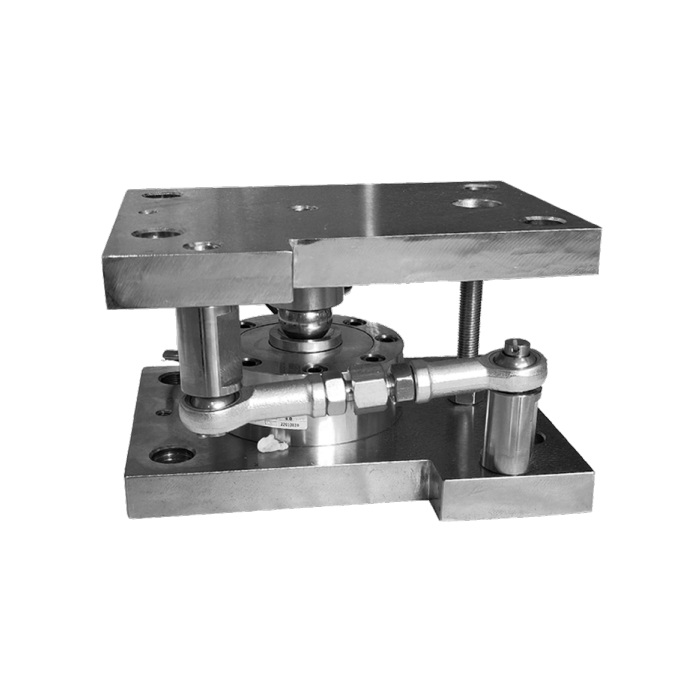
Restrained weigh module dimensions
| Capacity group | Plate envelope A × C | Height B | Mounting hole I |
|---|---|---|---|
| 25-50 klb | 240 × 200 mm | 151.3 mm | 20.5 mm |
| 100 klb | 290 × 230 mm | 182.7 mm | 26 mm |
Capacity is expressed in klb, meaning thousands of pounds. The dimensions are in millimetres. Keep those units explicit on the purchase order and engineering drawing; a 100 klb designation must not be entered as 100 t in a metric load calculation.
Decide whether to replace the sensor or the assembly
A faulty reading does not automatically require a new mounting kit. Inspect the link, contact surfaces, fasteners and freedom of movement as well as the sensor circuit. Binding or a distorted support can remain after a perfectly functional replacement sensor has been installed.
For sensor-only replacement, obtain the fitted model, loading interface and calibration details. A similar round sensor or a matching nominal capacity does not establish compatibility. For a complete assembly replacement, compare both plate patterns and the final height so the vessel and connected services are not forced into a new position.
The selected sensor's electrical output and the indicator input must be checked as a pair. List any junction box, signal cable or controller interface separately. The mechanical assembly does not itself specify RS485, Modbus RTU or an analog current output.
Questions about restraints and purchasing
Q1. Can the horizontal link be adjusted to correct the displayed weight?
Do not use restraint adjustment as a calibration control. Set the mechanical arrangement according to the approved installation instructions, then calibrate the weighing system. A weight change when the link is moved is a reason to examine preload or binding, not evidence that the scale has been corrected.
Q2. Is the kit suitable for an outdoor silo with uplift?
Only after the uplift and lateral load cases have been assessed against documented assembly ratings and the foundation design. A visible restraint or retaining feature is not a certified anti-uplift capacity. Provide the structural loads before accepting the module for this duty.
Q3. What should be tested after installation?
Check repeated loading and unloading, then evaluate readings under the operating conditions that produce lateral forces or thermal movement. Record the restraint settings and support condition with the calibration data. A static test with disconnected pipework may not represent the final installation.
Send an MV-WM0011 enquiry with the capacity in klb, support drawing, expected movement and required lateral or uplift ratings. Identify whether the purchase is for the complete module, a replacement sensor or associated weighing electronics.
