


 Chinese
 Spanish
 Russian
 Portuguese
 French
 German
 Indonesian
 Thai
 Vietnamese
 Arabic
 Italian
 Turkish
 Polish
 Japanese


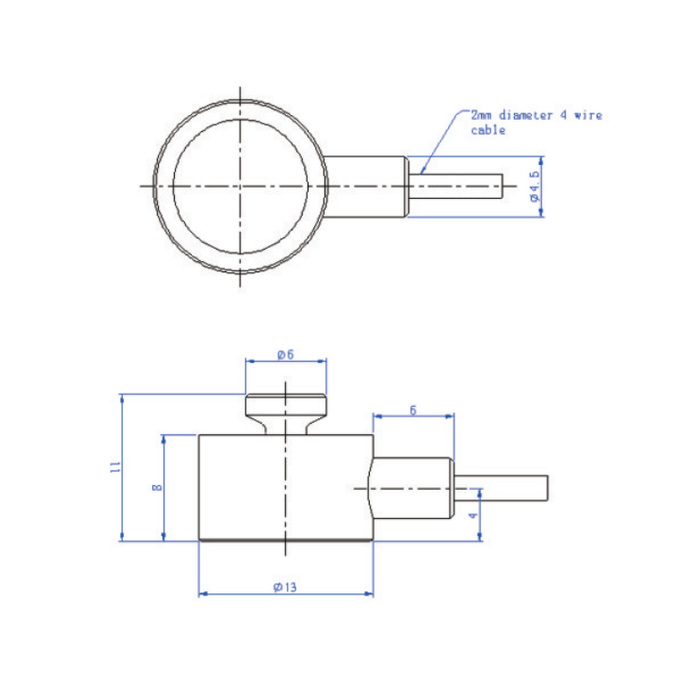
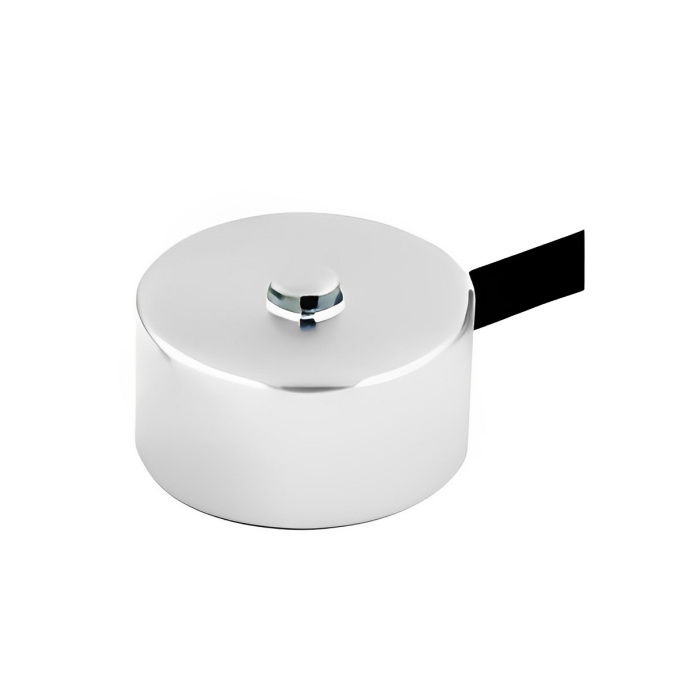
METRAVON MV-LC0230 is a miniature button compression load cell with a 10 kg catalogue load rating. Its 13 mm diameter body and raised contact suit a compact compressive load path. It has no documented role as a rope-tension pin or a tensile attachment; the force must be introduced through the intended button and supported at the base.
Keep the contact and the support separate
The drawing shows an 8 mm body height and an 11 mm height to the top of the loading button. The button is 6 mm in diameter. Allow space for the mating part and cable outlet, and check that the moving part does not touch the body beside the button. A cover or retaining plate that bridges the moving contact to the base can bypass the measurement.
Does the error specification fit the intended decision?
Nonlinearity, hysteresis and repeatability are each listed at +/-0.5% Cn; the creep/DR entry is +/-0.5% over 30 minutes. These figures should be compared with the permitted error and hold duration of the application. Do not describe the 1 mV/V sensitivity as an accuracy rating, or select this unit solely because its nominal capacity covers the force.
| Item | Value | Use / fit |
|---|---|---|
| Rated load | 10 kg | Keep the catalogue unit on the order; define force conversion where needed. |
| Sensitivity | 1 mV/V; +/-10% | The actual sensor requires individual scaling. |
| Zero balance | +/-0.05 mV/V | Allow for initial offset and installation preload. |
| Input / output resistance | 350 +/-30 / 350 +/-3 ohms | Use a compatible bridge channel. |
| Excitation | 5 V reference; 1-15 V operating | Not a direct 0-5 V industrial output. |
| Nominal / service temperature | -10 to +40 / -10 to +50 deg C | The two ranges describe different operating conditions. |
| Ingress rating | Confirmation required | Conflicting IP65 and IP66 entries must be resolved for the ordered version. |
Ingress protection must be confirmed
The available specification table states IP66, while the feature text states IP65. Because those entries conflict, no single ingress rating is treated here as an order commitment. Request a consistent specification for the supplied version before approving use in a wet or washdown location. The stainless-steel housing by itself does not resolve the sealing question.
Read and calibrate the assembled force path
At 5 V excitation, the nominal full-rated output is approximately 5 mV before sensitivity tolerance. Use a differential bridge reader with the required excitation and calibration adjustment. Test using the final loading part and support: record zero, known compressive loads, unloading and repeated cycles. If the result changes when the cable is repositioned, correct that influence before changing the span setting.
For a fixture that must pull as well as push, review the threaded MV-LC0231 instead of adapting the compression button.
Compression fixture questions
Q1. Can I use the 150% safe-load limit as the measuring range?
No. It is an overload limit, not a specified extension of the rated measuring range. Account for closure force and accidental impacts when designing the fixture, and use the nominal rating for normal measurement.
Q2. What if the application requires tensile force as well?
Select a documented bidirectional sensor and matching attachments. MV-LC0231 provides tension/compression options, but its threaded geometry, ratings and calibration need review; the button model is not converted into a tensile sensor by adding a clamp.
