


 Chinese
 Spanish
 Russian
 Portuguese
 French
 German
 Indonesian
 Thai
 Vietnamese
 Arabic
 Italian
 Turkish
 Polish
 Japanese


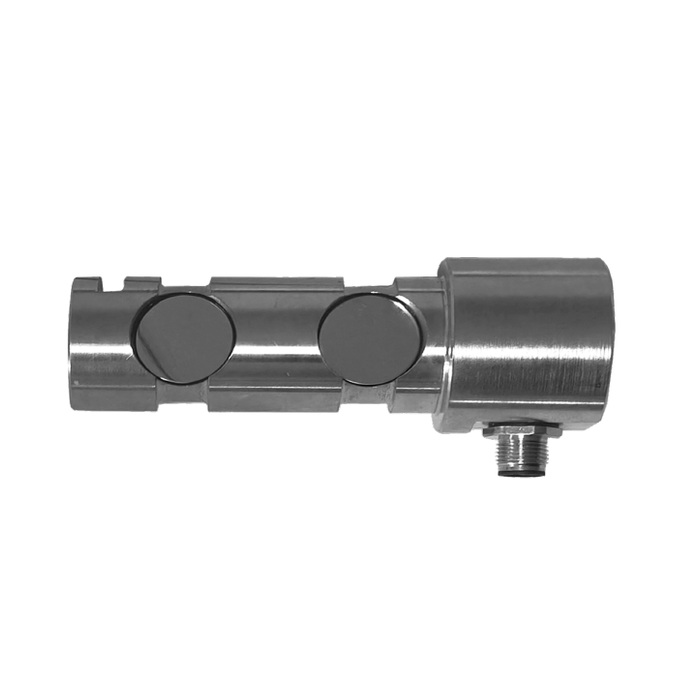
METRAVON MV-LC0227 is a load-sensing pin for measuring the reaction transmitted through a mechanical joint. The listed load ratings are 1000 kg and 2000 kg. Its bridge wiring provides one measuring signal, not independent force components for multiple axes. For hoist or overload-monitoring work, the pin, supporting members and receiving instrument must be assessed as one installation.
Define the joint reaction before selecting the pin
A payload value does not automatically equal the reaction at a particular pin. Rope directions, reeving and the position of the joint determine the load transferred into it. Provide the assembly drawing and the highest anticipated reaction, including transient conditions. Do not multiply the catalogue rating by a support count as if this were a multi-leg tank weighing installation.
Dimensions that control mechanical compatibility
The outline shows 120 mm overall length, a 35 mm shaft diameter and a 45 mm head diameter. Those three dimensions are only the first checks. Compare the support widths, relieved sections, retaining feature, cable connector access and required loading orientation. A pin that fits through the bore can still be unsuitable if its sensing regions do not match the joint support positions.
| Item | Value | Use / fit |
|---|---|---|
| Rated options | 1000 / 2000 kg | Confirm the actual reaction at the intended joint. |
| Bridge sensitivity | 1.0 +/-0.05 mV/V | Use the individual calibration factor for indication and alarms. |
| Nonlinearity | +/-0.3% FS | Not a stated uncertainty for the installed hoist. |
| Creep, 30 minutes | +/-0.03% FS | Consider duration where the load remains suspended. |
| Input / output resistance | 700 +/-10 / 700 +/-2 ohms | Check the receiving bridge channel and excitation load. |
| Working temperature | -10 to +40 deg C | Review the temperature near the installed pin. |
| Material / ingress rating | Alloy steel / IP67 | Specify connector sealing and corrosion exposure as well. |
Bridge output and optional current output are different orders
The standard bridge sensitivity is 1.0 +/-0.05 mV/V. Its specified excitation is 4-12 V DC, with a 15 V DC maximum. The available data also lists an optional 4-20 mA output, but does not establish its supply requirements, loop wiring or scaling. Request those details for the quoted current-output version rather than applying the bridge excitation figures to it.
Set alarm behaviour at system level
The catalogue identifies overload-limiter and hoist applications; it does not certify the completed protective function. Agree the indicated quantity, alarm threshold, response, fault indication and reset behaviour with the machine controls engineer. Commission using an approved reference-loading procedure, with the pin in its final orientation. Retain zero, loaded and unloaded readings alongside the instrument settings.
Compare MV-LC0228 when the joint requires a different pin envelope or a 500/1500 kg rating option; it is not a dimensional substitute.
Hoist installation questions
Q1. Can this replace a plain pivot pin without changing the joint?
Not on diameter alone. The sensing sections, bearing positions and retention geometry must agree with the joint drawing. Obtain a dimensional comparison and a loading-orientation check before removing an existing structural pin.
Q2. Does a 4-20 mA option mean the bridge version connects to a PLC current input?
No. The millivolt bridge needs a bridge measuring input or a separate conditioner. A current-output quotation must identify the supplied configuration, supply voltage, terminals and load-to-current scaling so the PLC channel can be specified correctly.
Q3. What should be sent for a hoist enquiry?
Send the joint and existing-pin drawings, load calculation, required quantity, cable access and instrument details. State whether the signal is for indication, recording or a protective action; those uses require different system-level checks.
