


 Chinese
 Spanish
 Russian
 Portuguese
 French
 German
 Indonesian
 Thai
 Vietnamese
 Arabic
 Italian
 Turkish
 Polish
 Japanese


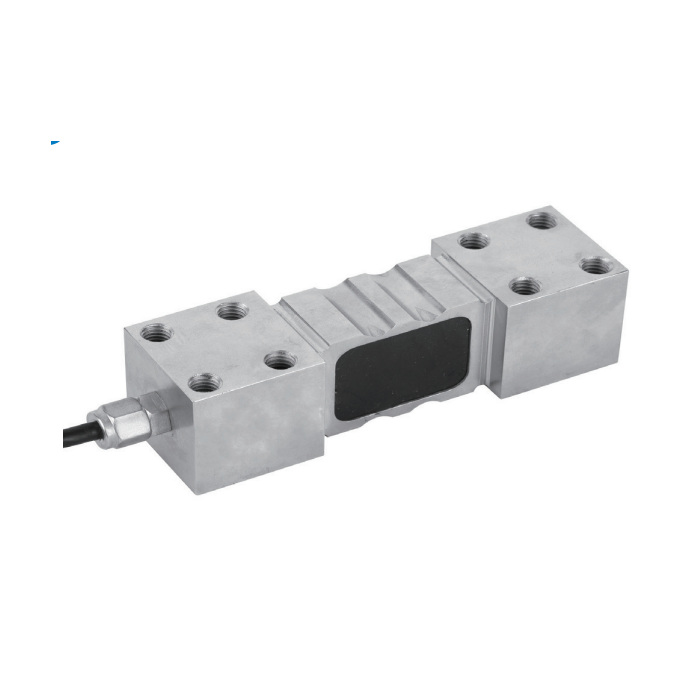
METRAVON MV-LC0223 is a single-point platform load cell with 30, 60, 100, 150, 200 and 300 kg options. Its 120 mm structure provides separate base and load-receptor attachment regions. For a replacement or a new fixture, first establish how force reaches the loaded end and whether the moving assembly can deflect without touching the surrounding frame.
Mount the single-point load cell at its end regions
The outline shows a 120 mm overall length and 36 mm end-section dimensions, with multiple threaded fixing features. Check the selected drawing for the full hole pattern and engagement details. The narrowed central region must remain mechanically free; a plate or spacer spanning the sensing section can alter its response. Cable strain relief should act on the cable, not restrain the loaded end.
Choose the 30-300 kg option from the real load path
Document the platform tare, maximum product load and possible impact during placement. If the sensor is proposed for a force-test fixture rather than a scale, state the applied force and loading arrangement explicitly. The catalogue uses kg capacity labels, so agree any force-unit conversion and calibration reference rather than silently treating a displayed number as newtons.
| Item | Value | Use / fit |
|---|---|---|
| Capacity steps | 30, 60, 100, 150, 200, 300 kg | No intermediate capacity is established by a range label. |
| Total error, catalogue value | +/-0.02% FS | Define fixture acceptance separately from the sensor entry. |
| Creep, 30 minutes | +/-0.016% FS | Include the process hold period in the verification plan. |
| Bridge input / output resistance | 380 +/-10 / 351 +/-2 ohms | Check electrical compatibility even when mechanical dimensions match. |
| Recommended excitation | 4-12 V DC; maximum 15 V DC | Do not apply the supply of an unrelated amplified sensor. |
| Cable | Four-core; 3 m listed | Keep final cable configuration with the calibration record. |
| Working temperature / ingress | -30 to +70 deg C / IP67 | Confirm the ordered material and actual exposure conditions. |
Bridge scaling needs the actual sensitivity
The nominal rated output is 2.0 +/-0.2 mV/V. A 10 V excitation therefore gives approximately 20 mV at rated load, with an 18-22 mV range from sensitivity tolerance before individual calibration. Choose a reader with suitable gain and zero adjustment. This tolerance concerns the output scale factor; it is not the total-error figure given separately for the sensor.
Test the fixture after routing the 3 m cable
The listed four-core cable is 3 m long for the 30-300 kg options. Finish the mounting, connections and cable supports before zero and span adjustment. Record known-load results after repeated placement and unloading. For a platform assembly, include load-position tests and check that guards, conveyor transfers or adjacent tables do not support part of the load.
MV-LC0222 offers 50-500 kg choices with a different 145 mm outline; it is a separate mounting option, not a drop-in extension of capacity.
Platform and fixture checks
Q1. Can a short body support any size of weighing platform?
No platform-size limit is specified in the available data. Supply the load-receptor dimensions, off-centre load positions and gross load for review. A satisfactory centre-weight result does not establish performance at the tray corners.
Q2. When does a mechanical problem look like an electrical drift?
Frame contact, a moving cable or insufficient support stiffness can shift the force reaching the sensor. Compare the reading before and after the surrounding parts are moved or secured, using a controlled test. Investigate those effects before changing amplifier filtering or recalibrating.
