


 Chinese
 Spanish
 Russian
 Portuguese
 French
 German
 Indonesian
 Thai
 Vietnamese
 Arabic
 Italian
 Turkish
 Polish
 Japanese



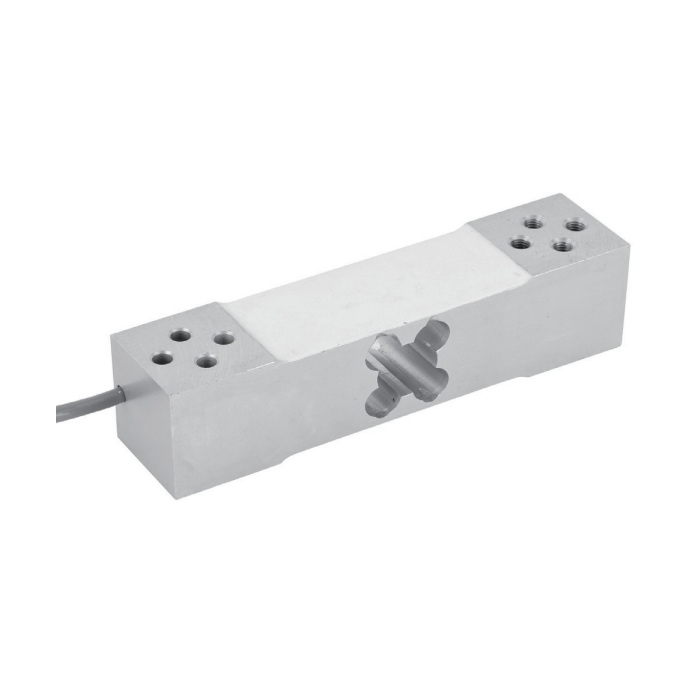
METRAVON MV-LC0219 is a single-point load cell with 50, 60, 75, 100, 150, 200 and 300 kg ratings. Its eight M6 fixing features distinguish the mounting from the narrower attachment layout of MV-LC0217. A replacement review should therefore begin with the scale-frame drawing, not with matching the 2 mV/V nominal output.
Compare the single-point load cell fixing pattern first
The outline is 150 mm long, 35 mm wide and 40 mm high. Check the individual fixing positions, thread engagement and supporting surfaces against the selected drawing. The loaded end must remain free to move relative to the fixed base. Do not bridge the sensing section with a rigid spacer in an attempt to adapt an incompatible hole pattern.
Keep the overload entries out of the normal load budget
The documented safe overload is 120% FS and the destructive-load entry is 150% FS. Include the platform tare and product load within the selected rated capacity, then assess impact and mechanical protection separately. A package dropped onto the tray can create a different peak force from its static weight. The percentages do not establish a permissible drop height.
Plan the 2 m bridge connection
A four-core 2 m cable is listed for the 50-500 kg group, covering this model's listed capacities. Route it without applying force to the moving assembly and protect any separate terminal enclosure for the actual environment. The bridge input is 385 +/-10 ohms and the output resistance is 350 +/-3 ohms. Match both the excitation supply and measuring input before retaining an existing indicator.
| Item | Value | Use / fit |
|---|---|---|
| Rated choices | 50, 60, 75, 100, 150, 200, 300 kg | Select the individual rating, including platform dead load. |
| Attachment pattern | Eight M6 features | Check the full drawing and engagement; do not infer tightening torque. |
| Rated output | 2.0 +/-0.2 mV/V | Calibrate the installed replacement with known weights. |
| Excitation | 4-12 V DC; maximum 15 V DC | A bridge reader is required, not a plain voltage input. |
| Creep, 30 minutes | +/-0.016% FS | Review sustained-load requirements independently of zero adjustment. |
| Working temperature | -30 to +70 deg C | Identify the ordered material for the exposure conditions. |
| Ingress protection | IP67 | The terminal and cable arrangement need their own review. |
Acceptance needs a record of load position
After installation, load and unload the scale using reference weights at representative working points. Repeat the same load at the agreed platform positions, recording zero return and any position-dependent difference. No maximum platform dimensions are stated in the available sheet, so ask for the permitted receptor envelope before approving a new tray. Mechanical fit does not establish acceptable eccentric-load behaviour.
For a 500 kg requirement, review MV-LC0220 separately; its body section, fixing layout and bridge input resistance differ.
Questions about replacements
Q1. Can the 300 kg version replace a 500 kg sensor if the usual load is low?
Not from the usual product weight alone. Include receptor mass, peak loading and abnormal placement conditions, then check the mounting and system calibration. A lower-rated replacement needs an explicit capacity review.
Q2. Does a stainless-steel scale imply a stainless-steel sensor?
No. The data lists alternative construction materials. State the material required on the quotation and verify the supplied version, especially where moisture or cleaning chemicals reach the load cell.
