


 Chinese
 Spanish
 Russian
 Portuguese
 French
 German
 Indonesian
 Thai
 Vietnamese
 Arabic
 Italian
 Turkish
 Polish
 Japanese



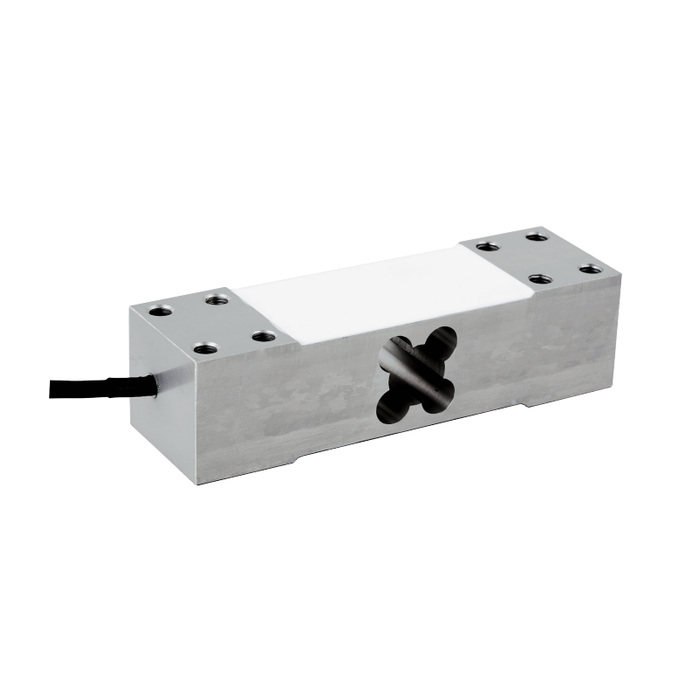
METRAVON MV-LC0211 is a single-point load cell for platform weighing, with seven capacity options from 50 kg to 500 kg. Its 150 mm long body has separate attachment regions for the base and load receptor. A workable scale needs the receptor mass, product load and attachment layout to agree with the selected version; net weighing capacity is not established by the model name alone.
Plan the platform around the single-point load cell
The body envelope is 150 x 44 x 40 mm, with eight M6 fixing features shown on the drawing. Verify the complete hole arrangement, screw engagement and the two support faces before manufacturing the base. The sensing section must not touch a spacer or guard. Include the expected movement of the receptor when checking clearance, not only the unloaded gap.
Specify the gross supported load and where it acts
Add the receptor dead load to the heaviest product, then assess how the product reaches the platform. A box placed gently and material released from a chute can produce different transient forces. Submit the receptor dimensions and off-centre loading positions for review. The available data does not state a maximum platform envelope, so there is no documented tray-size limit to copy from another model.
| Item | Value | Use / fit |
|---|---|---|
| Capacity steps | 50, 100, 150, 200, 250, 300, 500 kg | Choose one option after accounting for receptor dead load. |
| Rated output | 2.0 +/-0.2 mV/V | Set span using the installed unit, not a nominal gain alone. |
| Bridge excitation | 4-12 V DC; maximum 15 V DC | Not a direct 4-20 mA or amplified voltage output. |
| Creep over 30 minutes | +/-0.016% FS | Include a hold check where weighing involves sustained load. |
| Working temperature | -30 to +70 deg C | Evaluate the actual operating cycle and required performance. |
| Safe / destructive loads | 150 / 200% FS | Neither entry extends the rated measuring range. |
| Housing protection | IP67 | Confirm the ordered material and exposed cable connections. |
Bridge matching and the 2 m cable
The nominal output is 2.0 +/-0.2 mV/V, with 406 +/-10 ohms input resistance and 350 +/-2 ohms output resistance. Use an instrument with a suitable bridge supply and differential input. A four-core 2 m cable is listed across the published 50-500 kg group. Finish its route and any agreed termination work before zero and span adjustment.
What to record before releasing the scale
Use reference weights to check the assembled scale at the loads and positions relevant to its task. Include repeated placement, unloading and zero return after the surrounding hardware is secured. Keep the selected capacity, excitation, calibration weights and results together. The sensor's +/-0.02% FS total-error entry does not, by itself, establish the production scale's accuracy or display division.
MV-LC0212 has a similar nominal envelope but different bridge resistance specifications; compare the electrical channel as well as the drawing before substitution.
Platform design questions
Q1. Can this load cell be read by a normal PLC analogue input?
A standard current or voltage input cannot supply bridge excitation and read the millivolt signal directly. Use a bridge measurement module or weighing transmitter, then specify its output and calibrate the complete path to the PLC.
Q2. How should I request a quotation for a new bench scale?
Send the receptor drawing, tare and maximum product load, load positions and indicator details. Include the required material and cable route. Ask for confirmation of platform suitability and calibration scope rather than requesting a price for capacity alone.
