


 Chinese
 Spanish
 Russian
 Portuguese
 French
 German
 Indonesian
 Thai
 Vietnamese
 Arabic
 Italian
 Turkish
 Polish
 Japanese


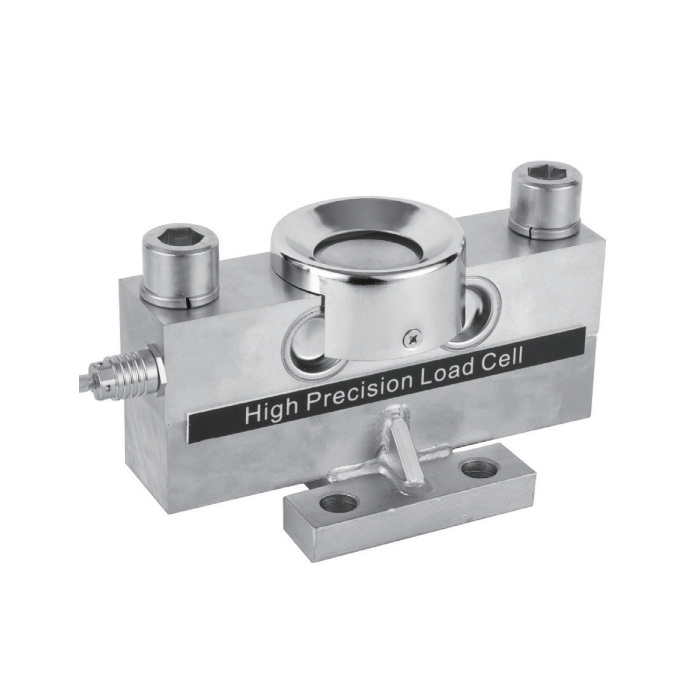
METRAVON MV-LC0202 is a shear beam weighing assembly shown with a spherical contact arrangement, offered at 10, 15, 20, 25, 30 and 40 t. Its electrical data is paired with a 6 m double-shielded, four-core cable. For an existing installation, the first checks are whether that route reaches the measuring instrument and whether the reader supports the specified bridge.
A double shield is not a remote-sense connection
The cable is described as four-core. Additional shielding does not establish separate excitation-sense conductors or make the bridge a digital sensor. Obtain the delivered wiring identification and the reader's bonding instructions before terminating the shields. There is no universal termination rule established here, and the shield must not be improvised as a measurement or supply conductor.
Lay out the 6 m cable before choosing the instrument position
The listed length is 6 m for 10-40 t, not the 16 m listed for MV-LC0201. Check the actual route around the foundation, protective conduit and junction box. If an extension is necessary, agree the connection method and enclosure protection before span adjustment. Shielding does not correct a loose electrical joint, cable strain or an unstable mechanical contact.
Weighing assembly height still changes at 40 t
The drawing table lists H = 224.7 mm for 10-30 t and H = 230.7 mm for 40 t, with a 76.2 mm spherical diameter D2. Review the selected contact, surrounding structure and available movement together. Compare the scope of supplied mechanical parts with the installation drawing; a similar photograph does not establish that an existing contact or base can be retained.
| Item | Value | Use / fit |
|---|---|---|
| Rated options | 10, 15, 20, 25, 30, 40 t | Assess the individual measuring-point reaction, not only total scale load. |
| Rated output | 2.0 +/-0.002 mV/V | A sensitivity tolerance, not a complete-system accuracy limit. |
| Cable specification | 6 m; four-core; double-shielded | Confirm supplied terminations and the final route. |
| Excitation range | 4-12 V DC; maximum 15 V DC | Check bridge supply and input headroom on the reader. |
| Creep, 30 minutes | +/-0.02% FS | Use a defined loaded hold if relevant to the weighing task. |
| Working temperature | -30 to +70 deg C | Check the installed sensor and cable temperature. |
| Construction / ingress | Alloy steel; IP68 listed | Request test scope and protect external connections independently. |
Commission the completed measuring channel
Input resistance is 760 +/-10 ohms and output resistance is 702 +/-2 ohms. Use a bridge reader that supports the actual connected load, excitation and millivolt input. Finish cable work and mechanical seating, then check zero, multiple reference loads and unload return. Keep the delivered cable identification and instrument settings with the results so a later wiring change can be assessed against the accepted setup.
Compare MV-LC0201 if the documented 16 m cable is relevant, while checking contact parts, height and the final calibration arrangement.
Cable and signal questions
Q1. Does double shielding guarantee a stable reading near drives?
No interference limit is specified by the shielding description alone. Review the cable route, bonding arrangement and reader installation instructions. Also investigate mechanical vibration or binding, because electrical shielding cannot remove those sources of indication change.
Q2. Can MV-LC0201 settings be retained when changing to this version?
Use them only as a starting reference after checking the exact configuration. The cable length and installation can change measurement conditions, even where rated sensitivity and bridge resistance match. Verify the completed channel with known loads before returning the system to service.
Q3. What should be provided for an enquiry involving electrical noise?
Include the reader model, cable route and length, drive or power-cable locations, shield termination details and the conditions under which the reading changes. Add the mechanical arrangement and selected capacity so noise is not assumed to be the only possible cause.
