


 Chinese
 Spanish
 Russian
 Portuguese
 French
 German
 Indonesian
 Thai
 Vietnamese
 Arabic
 Italian
 Turkish
 Polish
 Japanese



METRAVON MV-LC0199 is a flat tension load cell for 60, 75, 100, 150, 200, 300 and 500 kg applications. Its standard four-core lead is only 0.3 m long. In a compact hanging-scale or tensile fixture, locate the protected electrical connection and provide cable support before deciding that the sensor will fit the assembly.
Place the short-lead connection where it can be serviced
A nearby terminal point or measuring circuit may be necessary, depending on the enclosure layout. Provide the route from the cable exit to that point, with allowance for assembly and maintenance. The lead must not restrain the sensing body or rub against a moving attachment. If an extended run is needed, specify its complete wiring and environmental protection as part of the enquiry; no connector or longer lead is implied by the standard listing.
| Item | Value | Use / fit |
|---|---|---|
| Capacity options | 60, 75, 100, 150, 200, 300, 500 kg | Confirm the maximum intended axial force. |
| Main connection centres | 100 mm | Compare with the complete mating assembly. |
| Body dimensions | 129 x 46 x 4 mm | Include external contacts and lead clearance. |
| Standard lead | Four-core, 0.3 m | A protected connection must be within the planned cable route. |
| Excitation range | 4-12 V DC; maximum 15 V DC | Use the specified bridge input rather than a generic PLC channel. |
| Material choices | Alloy steel or aluminum alloy | No capacity-to-material split is stated; confirm the offered version. |
| Operating conditions | -30 to +70 deg C / IP67 | Protect any added joints for the actual enclosure conditions. |
Use the 129 mm drawing, not the adjacent flat-body model
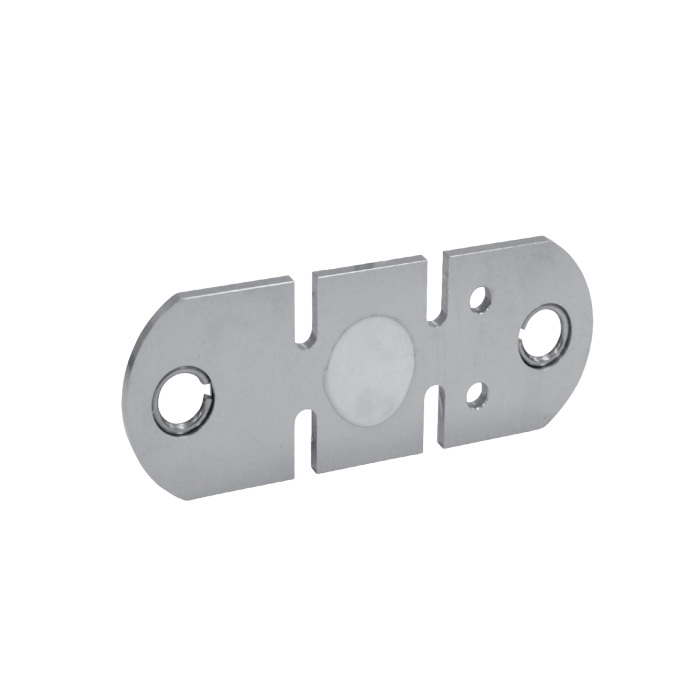
The outline is 129 mm long, 46 mm wide and 4 mm thick, with the two main connection centres 100 mm apart. Two smaller holes are shown as 6.1 mm diameter on 23 mm centres. Their presence does not establish that they are substitutes for the main load connections. Obtain the complete assembly drawing to identify the intended function of every attachment and keep the slotted sensing areas free.
Set up the flat tension load cell at its actual sensitivity
The bridge specification is 1.2 +/-0.1 mV/V, input resistance 1000 +/-10 ohms and output resistance 1000 +/-2 ohms. The four-core connection does not provide a direct serial or current-loop output. Match excitation and measurement range to the selected reader, then use reference loads to establish the installed scale factor. Check the smallest required load as well as the normal upper working load.
Separate sensor error from fixture performance
Total error and the 30-minute creep entry are each +/-0.03% FS. For an assembly that holds tension, include the relevant hold period and unload return in the test plan. Repeat the test after checking cable freedom and connection seating if the zero changes. No sampling rate, dynamic accuracy or guaranteed fatigue life is given, so a changing-force test requires a review of both the mechanics and the measuring electronics.
MV-LC0198 offers a shorter 100 mm body and a listed 2 m lead for 200-500 kg; check its 72 mm connection spacing before considering it.
Short-lead integration and replacement questions
Q1. Does the short lead mean that signal conditioning is built in?
No conditioned output is documented. The listed output remains a low-level bridge signal expressed in mV/V. Place any amplifier or measuring circuit according to its own requirements and confirm what equipment is included in the quotation.
Q2. Can MV-LC0198 be used in the same fixture instead?
The main-hole centres differ: 72 mm on MV-LC0198 versus 100 mm here. The body outline, material choices, capacity list and standard cable are also different. Review a revised fixture drawing rather than assuming electrical similarity establishes a mechanical replacement.
Q3. What should accompany an enquiry for a compact assembly?
Send the required rating, pin or bolt arrangement, available envelope and position of the electrical connection. Identify the reader, required working-load interval and whether force is held or changes during operation. State the material requirement explicitly because the listed options are not assigned to specific ratings.
