


 Chinese
 Spanish
 Russian
 Portuguese
 French
 German
 Indonesian
 Thai
 Vietnamese
 Arabic
 Italian
 Turkish
 Polish
 Japanese


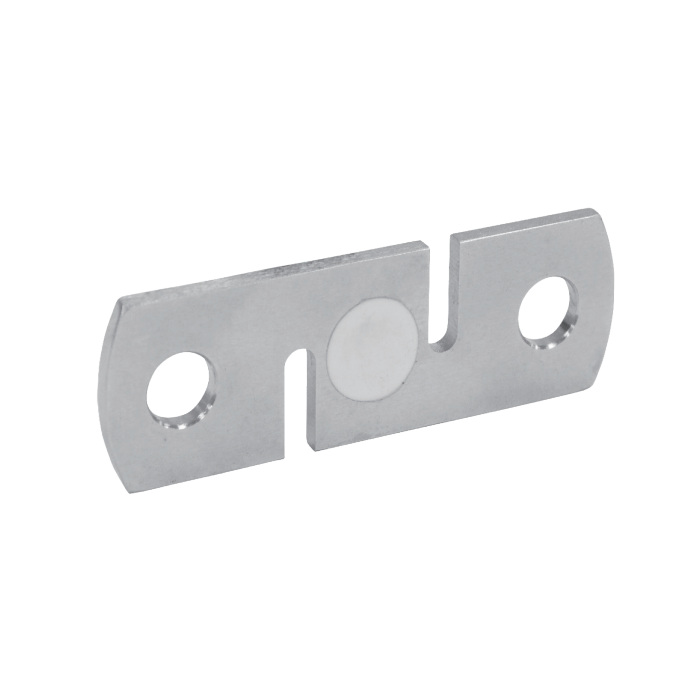
METRAVON MV-LC0198 is a flat tension load cell offered at 200, 300 and 500 kg for tensile measurement and hanging-scale assemblies. The drawing has two main holes on 72 mm centres in a 100 mm long, 32 mm wide body. This is a thin inline sensing element; its mounting must transfer force through the intended connections without bending or bypassing the sensing region.
Design the connections around the flat tension load cell
Body thickness is shown as 4 mm and the main holes as 12.2 mm diameter. Submit the mating pins or bolts and the surrounding fixture drawing to check alignment, bearing contact and clearance. Do not clamp across the slots or assume the thin section tolerates out-of-plane force. The sensor dimensions alone do not define the acceptable fastener preload or the strength of a complete suspended assembly.
Allow for a 1.2 mV/V signal rather than 2 mV/V
Rated sensitivity is 1.2 +/-0.1 mV/V. At 10 V excitation the nominal full-rated-load signal is about 12 mV, not a 12 V output. A reader previously set for 2 mV/V needs the correct input range and a new calibration. Input and output resistances are 1000 +/-10 and 1000 +/-2 ohms respectively. Confirm the individual calibration value instead of assuming every sensor has exactly the nominal sensitivity.
| Item | Value | Use / fit |
|---|---|---|
| Available ratings | 200, 300, 500 kg | Select for the force carried by this inline element. |
| Envelope | 100 x 32 x 4 mm | Reserve room for the attachment parts and cable. |
| Main-hole centres / diameter | 72 mm / 12.2 mm | Confirm the load-transfer arrangement with the fixture drawing. |
| Standard cable | Four-core, 2 m | Review any extension before final calibration. |
| Excitation | 4-12 V DC; maximum 15 V DC | Requires a compatible low-level bridge input. |
| Safe / ultimate overload | 150 / 200% FS | Not an approved service range above rated load. |
| Temperature / ingress | -30 to +70 deg C / IP67 | Confirm material and protect all external terminations. |
Route the 2 m lead before closing the fixture
The listed cable is four-core, 2 m long and 3.8 mm in diameter. Keep it clear of the pulling line, moving contacts and fixture edges. If the reader is farther away, agree the extension and termination before commissioning rather than adding an unprotected splice after calibration. IP67 applies to the specified sensor configuration; an added connector or joint needs its own suitable protection.
Use reference loads to expose connection problems
First inspect the attachment seating and the free sensing region, then check zero and several known tensile loads. Repeat loading and unloading to reveal slippage or contact hysteresis. Total error is listed as +/-0.03% FS and creep over 30 minutes as +/-0.03% FS. Set the acceptance tolerance for the complete fixture and reader separately; neither figure establishes test-machine accuracy or dynamic bandwidth.
If 60-150 kg ratings are required, compare MV-LC0199 with its longer outline, different hole spacing and much shorter standard lead.
Fixture and signal compatibility
Q1. Can this replace a threaded S-type sensor at the same capacity?
Not as a direct mechanical exchange. This model uses a flat, hole-connected body, and its nominal sensitivity is 1.2 mV/V. Reassess the fixture, alignment and reader calibration; an equal load rating does not make the two connection systems equivalent.
Q2. Will any analogue PLC input read the sensor?
A normal industrial voltage or current input is not automatically a strain-gauge input. The channel must provide suitable bridge excitation and measure the millivolt signal, or a compatible amplifier must perform those functions. Select any required conditioned output separately.
Q3. Is stainless steel the default construction?
The specification lists alloy steel or stainless steel rather than one universal material. Put the required material on the enquiry and obtain confirmation for the ordered version. Stainless construction alone would not establish compatibility with every chemical or cleaning process.
