


 Chinese
 Spanish
 Russian
 Portuguese
 French
 German
 Indonesian
 Thai
 Vietnamese
 Arabic
 Italian
 Turkish
 Polish
 Japanese

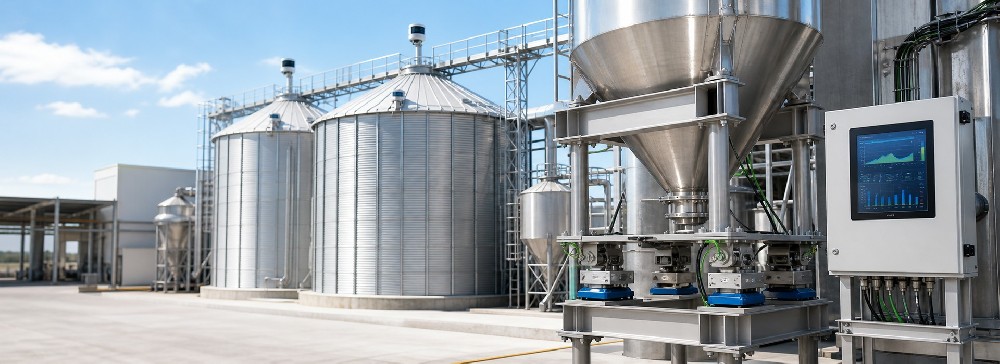

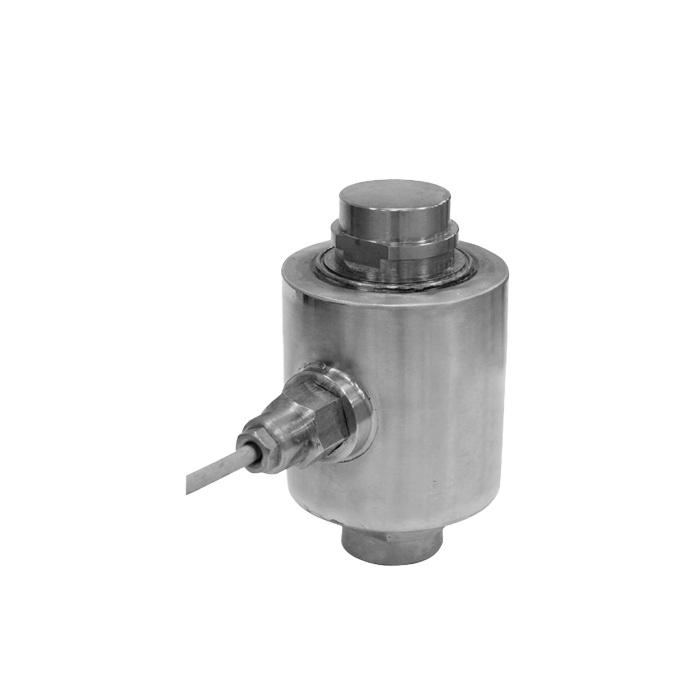
METRAVON MV-LC0184 is a high-capacity compression load cell for tank, hopper and silo weighing supports and weighing-module assemblies. Ratings are 7.5, 15, 22.5, 30, 40, 50, 100, 150 and 300 t. Capacity changes affect contact and body dimensions as well as cable length, so the selected version must be reviewed as part of the whole support assembly.
Equal body height does not establish a matching support
The 50 t and 100 t rows both give height A = 178 mm, but upper contact diameter D1 changes from 44 to 62 mm and body diameter D2 from 99 to 141.3 mm. A height-only replacement check would miss those differences. At 150 t the height is 210 mm, and at 300 t it is 280 mm. Compare the complete dimensional row with the mating contacts, support spacing and maintenance access before approving any increase in capacity.
| Item | Value | Selection notes |
|---|---|---|
| Rated versions | 7.5, 15, 22.5, 30, 40, 50, 100, 150, 300 t | Select a discrete version from the peak support reaction. |
| 7.5-22.5 t A / D1 / D2 | 89 / 28 / 65 mm | The same geometry does not establish the same load rating. |
| 30 t / 40 t height A | 140 / 150 mm | Check the remaining dimensions and contact parts as well. |
| 50 t / 100 t height A | 178 / 178 mm | D1 and D2 differ despite equal height. |
| Standard cable groups | 12 m: 7.5-22.5 t; 18 m: 30-300 t | Match reader placement to the ordered version. |
| Excitation / temperature | 4-12 V DC / -30 to +70 deg C | Maximum bridge excitation is 15 V DC. |
| Safe / ultimate overload | 150 / 200% FS | No unreviewed impact, uplift or side-load capacity is implied. |
The compression load cell needs a reviewed module arrangement
For a tank or silo, determine the largest support reaction including the vessel, contents and relevant process forces. Check piping connections, thermal movement, support stiffness and the intended restraints. The compression element measures force; it does not itself establish uplift protection, lateral restraint or acceptable movement for the complete module. Keep those mechanical requirements explicit in the enquiry rather than assuming that a high tonnage rating covers them.
Select the correct cable group and measuring input
The standard four-core cable is 12 m for 7.5-22.5 t and 18 m for 30-300 t. Rated sensitivity is 2.0 +/-0.002 mV/V, with input resistance 1150 +/-50 ohms and output resistance 1000 +/-2 ohms. Verify that the reader supports the complete bridge arrangement, including any shared excitation supply. Finish the installed cable route and all agreed terminations before establishing the system calibration.
Make the reference-loading method possible before installation
Large vessel supports can be difficult to access after pipework and enclosure panels are complete. Agree how reference force will be applied and how the individual measuring points will be checked. Record empty return, repeat loads and the effect of the required operating states. A 30-minute creep entry of +/-0.02% FS is not a substitute for an acceptance method that can be repeated on the installed equipment.
MV-LC0185 is another vessel-weighing compression option, but its temperature range, output and fixing configuration require their own review.
Capacity upgrades and module scope
Q1. Can a 100 t sensor replace a 50 t unit because both are 178 mm high?
The 100 t version has larger contact and body diameters. Check seating surfaces, surrounding clearance and every adjoining load-bearing part against the selected drawing. Do not approve a replacement or higher service load from the shared height alone.
Q2. Can the lower-rating cable length be assumed for a 30 t order?
The documented change occurs at 30 t: 7.5-22.5 t lists 12 m, while 30-300 t lists 18 m. State the selected rating, route and termination requirements together so cable allowance and reader position match the proposed installation.
Q3. Does the sensor complete the tank weighing system?
The project still needs a defined support arrangement, suitable contacts and restraints, measuring electronics and an installed verification procedure. Confirm what the quotation includes. Required module functions must be supported by the actual assembly documents, not inferred from the compression sensor rating.
