


 Chinese
 Spanish
 Russian
 Portuguese
 French
 German
 Indonesian
 Thai
 Vietnamese
 Arabic
 Italian
 Turkish
 Polish
 Japanese


The METRAVON MV-LC0176 canister load cell has a round, low-profile body for axial load measurement. Its listed capacities are 5, 10, 25, 50 and 100 klb, with a 3 mV/V nominal output. For tank supports or compression fixtures, first check whether its specified nonlinearity and creep meet the measurement requirement; capacity and physical fit alone do not establish suitability.
Canister load cell error limits at the working load
Specified nonlinearity is ±1% FS, and creep over 30 minutes is ±1% FS. These are separate sensor characteristics, not a claim of 1% installed-system accuracy. FS refers to the rated capacity rather than the current reading, so selecting an unnecessarily large cell can be unsuitable for measuring small changes in load.
For example, 1% of a 10 klb rating is 100 lb. This calculation illustrates the scale of a full-scale-based specification; it is not a measured error or a combined uncertainty estimate. A process requiring much smaller load increments needs a documented uncertainty assessment or a different sensor specification.
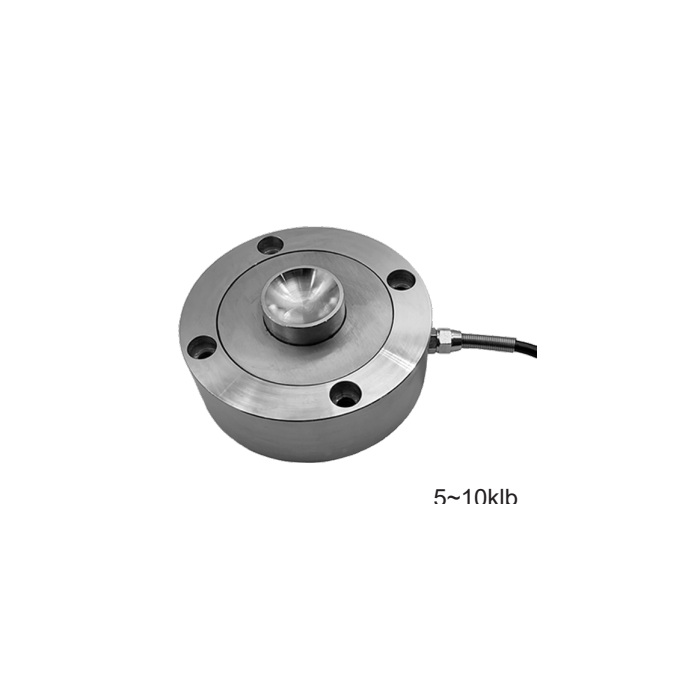
Compare the capacity-specific mounting pattern
| Capacity group | Body diameter D | Mounting circle D2 |
|---|---|---|
| 5, 10 klb | 104.7 mm | 88.9 mm |
| 25, 50 klb | 120.7 mm | 101.6 mm |
| 100 klb | 138 mm | 116.8 mm |
The drawings show different central loading features across the range. Obtain the selected version's released drawing before specifying the mating part, bolt length or assembly height. A round body is not a mounting standard, and the load interface must not be inferred from a photograph of another capacity.
In a compression installation, support the body as shown on its drawing and align the force with the sensing axis. For tension measurement, confirm the exact central attachment, permitted loading direction and calibration before selecting hardware. Do not assume that every capacity has the same threaded tension connection.
Instrument and environment requirements
| Parameter | Specification |
|---|---|
| Rated output | 3.0 ± 0.006 mV/V |
| Excitation | 4-12 VDC; maximum 15 VDC |
| Input resistance | 702 ± 10 ohms |
| Output resistance | 702 ± 2 ohms |
| Operating temperature | -10 to +40 °C |
| Protection | IP67 |
| Safe overload | 150% FS |
The millivolt bridge requires excitation and a compatible measuring input. Select the weighing indicator or signal conditioner for the intended load range and response time. A 4-20 mA or digital output, if required by the controller, is a separate instrument specification.
Questions for tank and test-fixture projects
Q1. Is this suitable for measuring a small dose in a heavy tank?
Compare the smallest required change with the cell's full-scale-based errors, the tank dead load, pipe forces and instrument noise. Taring a heavy vessel does not improve the sensor's underlying error limits. Do not choose this model for fine dosing solely because its capacity can carry the vessel.
Q2. Does 100 klb mean 100 tonnes?
No. The capacity designation uses thousands of pounds, not metric tonnes. Keep the original unit on the order and make any unit conversion explicit in the calculation and indicator setup. An unmarked unit change can produce a serious capacity-selection error.
Q3. How should a sustained-load test be specified?
Define the applied load, stabilization period, hold duration, ambient conditions and allowable indicated change. Record unloading and zero recovery as well. A brief span check will not show whether drift during the process hold is acceptable.
To request an MV-LC0176 quotation, provide the capacity in klb, working-load interval, smallest change to be measured, hold duration and fixture drawing. Include material preference and cable requirements so the offered configuration can be checked against the installation.
