


 Chinese
 Spanish
 Russian
 Portuguese
 French
 German
 Indonesian
 Thai
 Vietnamese
 Arabic
 Italian
 Turkish
 Polish
 Japanese

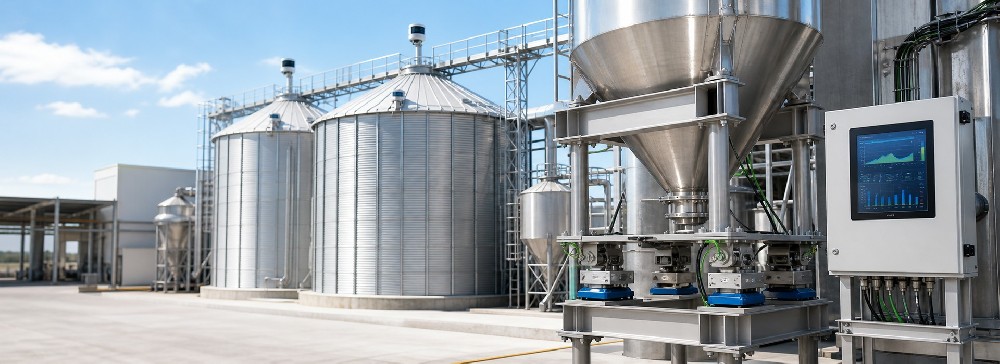

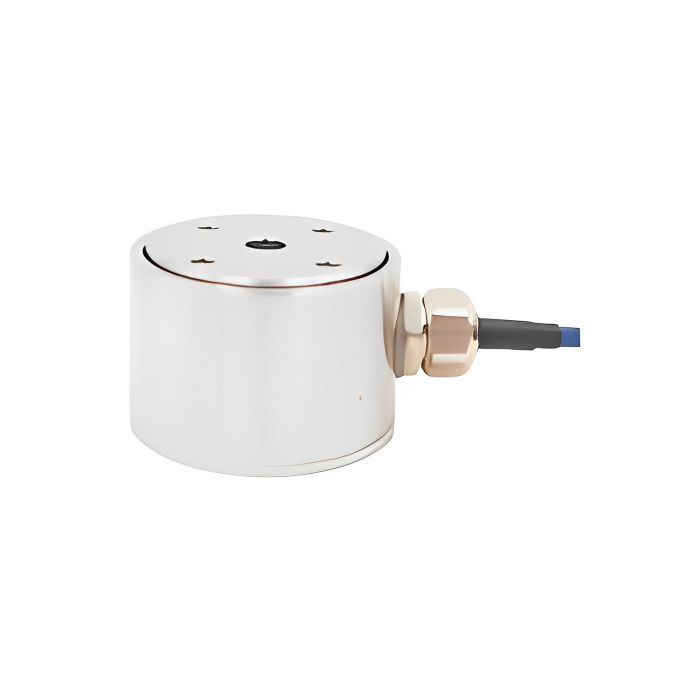
METRAVON MV-LC0172 is a miniature compression force sensor for press fitting, assembly checks and built-in force measurement where installation space is limited. Ratings are 100, 200 and 500 N or 1, 2, 5 and 10 kN. Its fixing holes locate the sensor in the fixture; they do not establish a tensile-force capability.
Reserve the miniature compression force sensor and contact space
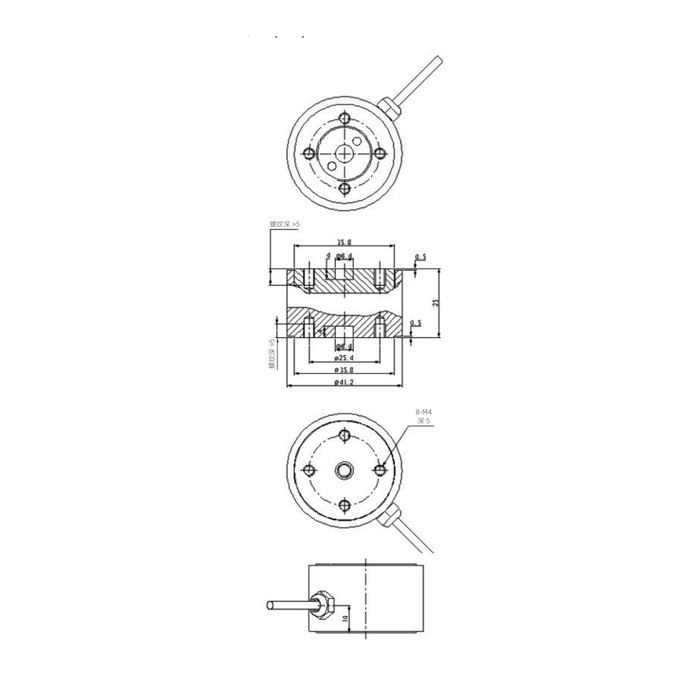
The drawing shows a 25 mm body height and a maximum diameter of 41.2 mm, excluding the additional space needed by the cable exit and mating parts. M4 fixing patterns are shown on the faces. Obtain the complete face pattern and thread-engagement requirements before machining; do not assume that every fixing shown belongs to one face. The loading component must apply the intended axial compression without rubbing against the surrounding fixture.
Choose the low-force rating from the assembled load, not the target reading alone
Include preload, tooling weight where applicable, operating peaks and foreseeable stops in the force review. On a 100 N channel, cable forces or contact friction that appear small mechanically can be significant compared with the measured force. Secure the cable independently, establish the assembled zero and check low and high reference points. A larger rating may accommodate a higher peak but does not automatically preserve the same useful resolution at the lower end.
Use calibrated bridge conditioning for the machine signal
The nominal output is 1 mV/V with +/-10% sensitivity tolerance; reference excitation is 5 V and working excitation 1-15 V. The bridge is not a direct 24 V device or a 1 V analogue output. Check the amplifier excitation, millivolt input range and installed scaling. The input and output resistances are respectively 350 +/-30 ohms and 350 +/-3 ohms. Specify the amplifier output separately if the machine requires a current loop or digital communications.
| Item | Value | Selection notes |
|---|---|---|
| N-rated options | 100, 200, 500 N | Check preload and parasitic forces at the lower ratings. |
| kN-rated options | 1, 2, 5, 10 kN | Do not enter the capacity number without its unit. |
| Body height / maximum diameter | 25 / 41.2 mm | Add cable clearance and the mating-contact stack. |
| Fixing designation | M4 patterns | Confirm each face and permitted screw engagement. |
| Nominal rated output | 1 mV/V | Use actual sensitivity when calibrating the installed reader. |
| Reference excitation | 5 V | The documented working excitation range is 1-15 V. |
| Material / protection | Stainless steel / IP66 | Confirm the protection of external connections separately. |
Inspect the force cycle after the tooling is installed
Apply reference compression through the final contacts and record repeat readings, unload return and any required hold period. Nonlinearity, hysteresis and repeatability are each +/-0.1% of nominal force Cn, not a blanket accuracy claim for the whole press. Nominal temperature is -10 to +40 deg C, service temperature -10 to +50 deg C and storage -25 to +70 deg C. Keep these limits distinct when the process heats the tooling or sensor body.
For an application that requires both pulling and pushing, review MV-LC0171 with its threaded attachments and separate installation dimensions.
Compression duty and machine connection
Q1. Can the fixing holes be used to turn this into a tension sensor?
The documented measuring duty is compression. Fixing holes do not establish tensile performance or a rated tensile attachment. If the process also pulls on the sensor, review a bidirectional model and its end connections rather than assuming this part can measure both directions.
Q2. Can it connect directly to the machine 24 V supply?
No; 24 V exceeds the stated 1-15 V bridge excitation range. Use suitable conditioning electronics with a regulated bridge supply and an input for the millivolt signal. Confirm the signal at the final machine channel after calibration.
Q3. Does the small body come with a standard 5 m cable?
The available model table does not specify that length. State the route, required termination and movement around the tooling, then confirm the supplied cable on the quotation. Do not transfer the cable specification of another force-sensor model.
