


 Chinese
 Spanish
 Russian
 Portuguese
 French
 German
 Indonesian
 Thai
 Vietnamese
 Arabic
 Italian
 Turkish
 Polish
 Japanese



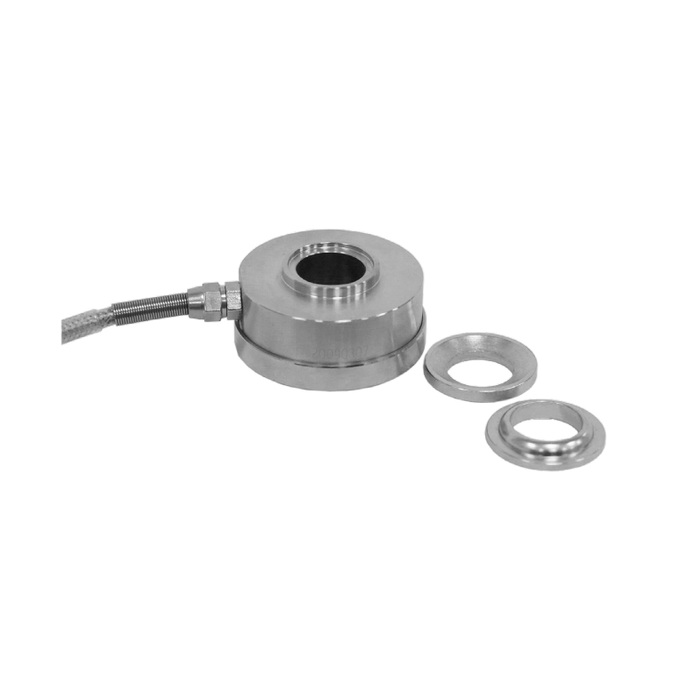
METRAVON MV-LC0169 is a 3 t load washer assembly with an annular sensing body and a central opening. Its documented applications include vessel weighing and compressive-force testing. The mating washers, base and central connection determine how force reaches the sensor, so the complete contact stack needs review before specifying a replacement or machining a fixture.
Define which parts belong to the load washer assembly
The reference arrangement shows a base, sensing element and contact pieces, with an assembly height of 52 mm and base diameter of 68 mm. The illustrated upper washer has a 40 mm outside diameter and a 24 mm inner contact dimension. Identify the supplied pieces on the quotation and assembly drawing. Loose washers shown in a photograph do not establish their quantity, material or inclusion in the sensor price.
Resolve the centre thread before building the fixture
M18 x 1.5, M20 x 1.5 and M22 x 1.5 thread configurations are shown. Select the required connection explicitly; the 3 t rating alone does not identify it. Review the mating component, contact faces and available tightening access. The fixture should transfer the intended compressive force through the annular sensing arrangement without binding against adjacent parts or creating an alternative load path.
Separate assembly preload from the force to be measured
Tightening a central connection can introduce preload, but tightening torque is not a calibrated force reading. Determine whether the required result is total compressive force or a change from an assembled reference condition. Set zero only after the intended contact stack and preload procedure are established. Then apply known forces through the actual fixture and inspect loading, unloading and return readings; subtracting a display zero does not remove preload from the sensor physically.
Scale the channel for 1.5 mV/V rather than a neighbouring model
Specified output is 1.5 +/-0.01 mV/V, input resistance 750 +/-20 ohms and output resistance 702 +/-3 ohms. Retaining a reader configured for a 2 mV/V bridge requires an input and calibration review. Nonlinearity is listed as +/-0.05% FS and 30-minute creep as +/-0.03% FS. These are separate characteristics, not a combined fixture-accuracy guarantee. The D1 entry is not evidence that the complete installed weighing system has an approval.
| Item | Value | Selection notes |
|---|---|---|
| Rated capacity | 3 t | Include existing preload when assessing the force on the sensor. |
| Assembly height / base diameter | 52 / 68 mm | Confirm the dimensional endpoints and included contact pieces. |
| Centre thread choices | M18, M20 or M22 x 1.5 | Obtain the selected configuration on the installation drawing. |
| Nominal sensitivity | 1.5 +/-0.01 mV/V | The bridge requires excitation and a suitable low-level input. |
| Working temperature | -10 to +40 deg C | Measure temperature at the installed washer, not only in the cabinet. |
| Safe / ultimate overload | 150 / 200% FS | Neither figure is an additional normal operating range. |
Preload and supplied components
Q1. Does zeroing after assembly leave the full 3 t available for additional load?
No. Zeroing changes the displayed reference, not the force already carried by the sensing element. Assess the assembly preload and the maximum additional compression that pass through the washer, including tightening or test peaks. Establish the load path and preload procedure before calibration; a zero indication does not prove that the sensor is mechanically unloaded.
Q2. Will tightening the central bolt to a stated torque calibrate the sensor?
No. Friction and contact conditions affect the relationship between torque and force. Establish the intended assembly procedure, then calibrate the measuring channel using reference forces applied through that assembly. Confirm that preload and the subsequent working load remain within the selected rating.
Q3. Which cable length is included?
No standard cable length is established in the available model table. Provide the route and required termination with the enquiry, and obtain the delivered length on the offer before fixing the reader position.
