


 Chinese
 Spanish
 Russian
 Portuguese
 French
 German
 Indonesian
 Thai
 Vietnamese
 Arabic
 Italian
 Turkish
 Polish
 Japanese



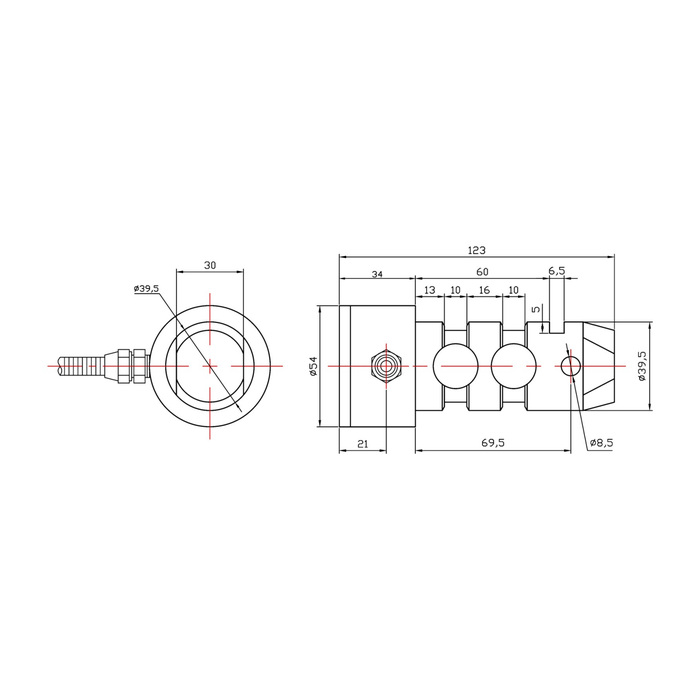
METRAVON MV-LC0146 is a 3 t load pin designed to measure radial force in a pinned connection, such as a pulley support. Its double-shear sensing structure replaces a mechanical pin only when the bearing locations and loading direction match the sensor design. It does not measure axial tension in the way an in-line tension link does.
A load pin must match the bearing arrangement
The pin receives force through its contacting parts. Moving a bearing or changing a support width changes how that force reaches the sensing sections, even if the replacement pin has the same outside diameter. Send a section drawing of the pulley or joint with the enquiry, showing the loaded member, both supports, retainers and available cable space.
| Drawing check | Installation consequence |
|---|---|
| Support positions | Match the bearing contact zones to the intended shear sections of the pin. |
| Radial load direction | Confirm sensing orientation and retention against unwanted rotation during operation. |
| Fits and clearances | Check the shaft fit and retention without clamping the sensing sections incorrectly. |
| Cable outlet | Provide clearance so movement and adjacent hardware cannot crush the cable connection. |
For pulley service, the pin reaction depends on the directions and magnitudes of the rope forces. It is not automatically equal to rope tension or the suspended mass. Define the rope path and the quantity that the display or controller must report before setting the scale factor.
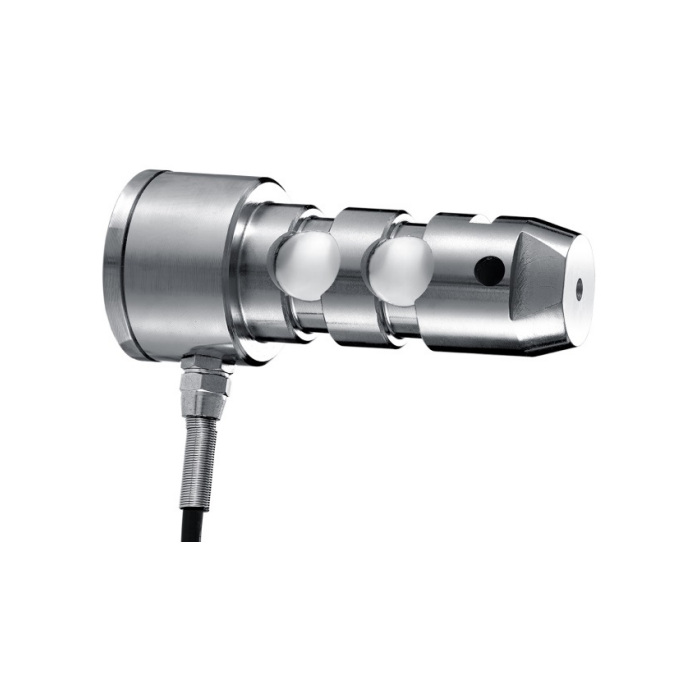
3 t bridge-output configuration
| Parameter | Value |
|---|---|
| Rated load | 3 t |
| Output sensitivity | 1.0 ±0.05 mV/V |
| Excitation voltage | 5-12 V |
| Non-linearity | ±0.1 to ±0.3% FS |
| Hysteresis / repeatability | ±0.1 / ±0.1% FS |
| Input / output resistance | 750 ±30 / 700 ±5 ohm |
| Operating temperature | -20 to +70 °C |
| Protection / safe overload | IP66 / 150% FS |
| Cable | 5 mm diameter, 3 m length |
The 1 mV/V sensitivity matters when replacing a 2 mV/V device: the old span setting cannot be assumed correct. With 10 V excitation, the nominal full-scale bridge signal is 10 mV. A compatible signal conditioner must accept that signal and provide the output needed by the control system.
A current- or voltage-output version requires a separately confirmed transmitter configuration, supply and wiring diagram. Do not connect a raw bridge-output pin to a 4-20 mA input on the assumption that both versions use the same connections.
Overload monitoring and commissioning
Validate the reading with known loads in the assembled joint and at the operating geometry. Record zero, loaded readings and return to zero. Where a controller uses the measurement to inhibit motion, test the agreed alarm and fault responses under the machine's approved commissioning procedure. A load pin by itself is not a certified overload-protection system.
Questions before replacing an existing pin
Q1. Is matching the pin diameter enough?
No. Bearing spans, support widths, load direction and retention determine the force distribution. Compare a section through the complete joint with the sensor drawing; a diameter measurement alone cannot confirm the replacement.
Q2. Does the 3 t rating mean the machine can lift 3 t?
The rating applies to the specified load on the sensor. Pulley forces and other mechanical loads must be calculated separately, and the machine's permissible load also depends on its structure and safety system. Do not use the sensor rating as a machine-capacity declaration.
Ask METRAVON to review the MV-LC0146 pin arrangement using the joint section, maximum calculated radial reaction, operating movement and required controller signal. Include the existing pin drawing for replacement work.
