


 Chinese
 Spanish
 Russian
 Portuguese
 French
 German
 Indonesian
 Thai
 Vietnamese
 Arabic
 Italian
 Turkish
 Polish
 Japanese


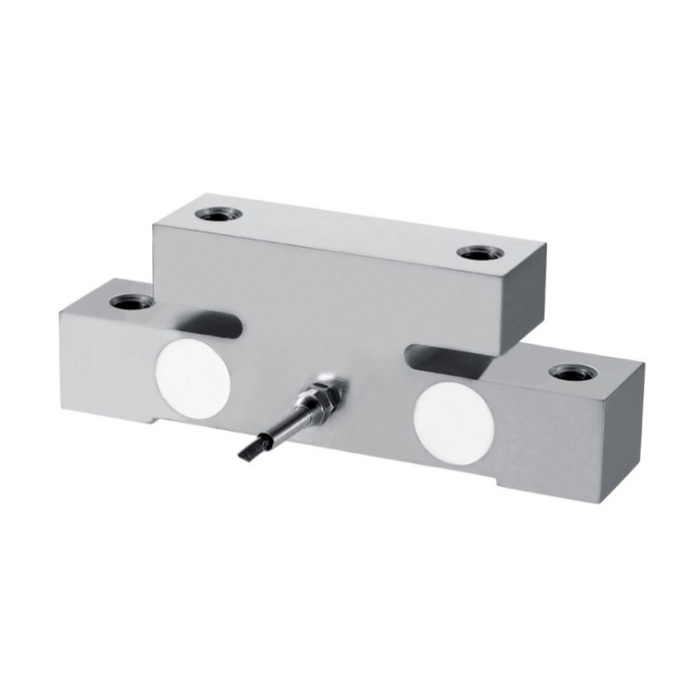
METRAVON MV-LC0106 is a parallel fixed-pulley load cell with a raised central loading section above two support ends. The documented 1-30 t family is also listed for vehicle-mounted weighing, crane weighing and screw-hoist monitoring arrangements. Those application names do not define one universal installation: identify the actual load and support interfaces before choosing the capacity group.
Draw the two support levels before machining the bracket
The sensor outline shows separate attachment positions in the raised section and end supports. For 1-5 t the reference body is 220 by 45 by 80 mm, with M16 x 2 thread designations. At 10 t it is 240 by 50 by 90 mm with M20 x 2.5. The 20-30 t group remains 240 mm long but changes to 55 mm width and 100 mm height, retaining M20 x 2.5. Confirm which mating part applies force and which reacts it; do not clamp the measuring section to a common plate that bypasses its intended deflection.
| Item | Value | Selection notes |
|---|---|---|
| 1-5 t L / W / H | 220 / 45 / 80 mm | Thread designation is M16 x 2; H1/H2 are 40/30 mm. |
| 10 t L / W / H | 240 / 50 / 90 mm | Thread designation is M20 x 2.5; H1/H2 are 47/35 mm. |
| 20-30 t L / W / H | 240 / 55 / 100 mm | The thread remains M20 x 2.5; H1/H2 increase to 52/40 mm. |
| 1-5 t L1 / L2 / L3 | 140 / 110 / 180 mm | Use these references with the full attachment drawing. |
| Higher groups L1 / L2 / L3 | 160 / 120 / 195 mm | Shared plan dimensions do not preserve the support levels. |
| Nominal bridge sensitivity | 1.5 +/-0.05 mV/V | Input resistance is 750 +/-30 ohms; output is 700 +/-5 ohms. |
| Nonlinearity | +/-0.05-0.1% FS | Hysteresis and repeatability are each +/-0.05% FS. |
| Working temperature / enclosure | -20 to +70 deg C / IP66 | Confirm material and the final cable protection. |
Compare the parallel fixed-pulley load cell levels, not length alone
The 10 t and 20-30 t rows share L1, L2 and L3 references of 160, 120 and 195 mm, but H1 changes from 47 to 52 mm and H2 from 35 to 40 mm. A bracket based only on the shared plan dimensions can therefore seat incorrectly. Obtain the capacity-specific section view and agree engagement and contact surfaces before approving reuse. Include the central cable outlet and clearance around the slotted measuring regions.
Define what force the machinery places through this support
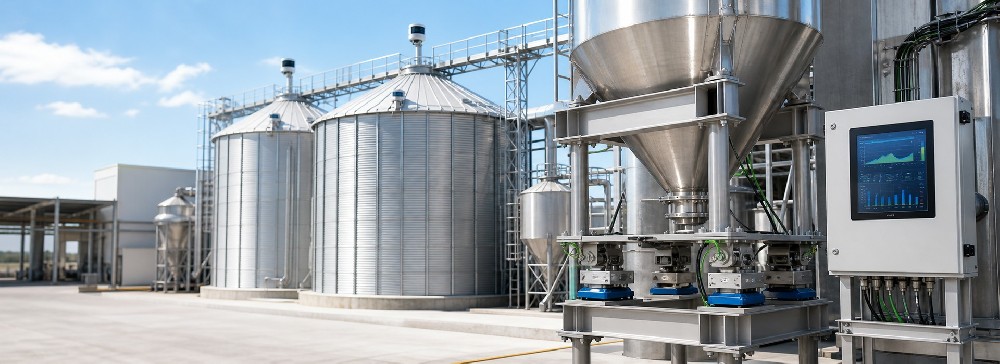
A pulley project needs the rope directions and bearing reaction; a screw-hoist or weighing fixture needs its actual mechanical force path. Do not relabel all of them with the same load conversion. State preload, maximum reaction, reversals if present and foreseeable peak events. The document does not establish a torque output, a universal travel allowance or the capacity of the surrounding machine frame. Assess those items in the assembly rather than inferring them from the family application list.
Accept the complete support and acquisition arrangement
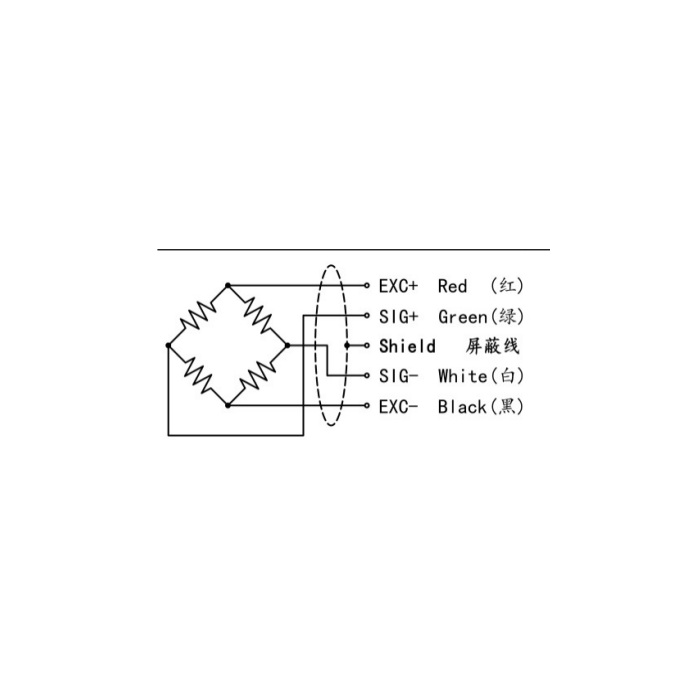
Map the measured support reaction to the displayed engineering units only after the mechanical conversion has been agreed. Use 5-12 V DC bridge excitation and confirm the termination of the listed 3 m, 5 mm cable. Reference the indicated force with the actual upper and lower attachments installed, then check unloading return and relevant operating positions. For an alarm application, specify the controller and required response separately; the 150% FS safe-overload entry is not an alarm setpoint or a machine safety approval.
Shared threads and different support levels
Q1. Can a 20 t part replace a 10 t body without changing the support?
Length and several plan references match, but body width, overall height and both support-level references change. Compare the sectional drawing and mating faces. An identical thread designation does not prove the old bracket seats the new body correctly.
Q2. Does parallel mean the sensor provides two independent measuring channels?
It describes the mechanical arrangement, not a two-channel output specification. The listed electrical interface is a bridge signal. Submit any need for redundant or separately measured forces as a system requirement instead of assuming it from the product name.
